EXCLUSIVE | Gen-Z Champion Ariha Pangambam Conquers Asia On 1999 Gear And Turns Gold Into A Call For Change
- Written by: Faham Uddin
- Updated Aug 12, 2026, 21:50 IST
From training on worn-out equipment to becoming India’s first Asian champion in aerobic gymnastics, Ariha Pangambam reflected on her journey and calls for change in schools and sports infrastructure.
EXCLUSIVE | Gen-Z Champion Ariha Pangambam Conquers Asia On 1999 Gear and Delivers Blueprint For Indian Sports
Ariha Pangambam scripted history when she became the first Indian to win Asian gold in Aerobic Gymnastics. Ariha accumulated a staggering 19.100 points to win top honours for India at the Aerobic Gymnastics Asian Championships, held in Tagaytay City, Philippines. The gold medal Ariha won was not just the culmination of a successful competition, but the answer to years of questions, disappointments, struggles, and moments when she wondered if it was even worth continuing with gymnastics.
Ariha Pangambam’s journey in sports did not begin at a state of the art academy. As a young girl in Manipur, she loved singing, dancing and watching Barbies on television. It was while watching these shows that she became fascinated by the flips and graceful movements and developed an interest in gymnastics.
“As a kid, I used to love dance and singing. I used to watch Barbies and all the kids’ shows,” Ariha told Sports Now. “I didn’t even know what gymnastics was at that time. But watching those shows, I just wanted to learn those flips, the graceful movements, something like ballet. When I heard that gymnastics was similar to that at Kumbh Melampak, I told my mom and dad that I wanted to join.”
Ariha started gymnastics at the age of 10. Initially, she started with artistic gymnastics, but later shifted to aerobic gymnastics under state and SAI (Sports Authority of India) coaches. During her school days at Kendriya Vidyalaya, she followed a demanding daily routine that left little room for anything beyond academics and training.
“As a kid, I wanted to hang out with my friends at the time, but I didn’t get that time because I used to go for training,” Ariha recalled.
Ariha’s parents gave wings to her dreams. Her father made time from his busy schedule to pick and drop her, allowing her to put in extra hours of training, while her mother, who worked as a nurse, often kept her at the hospital during night shifts when there was no one at home. Despite their demanding jobs, Ariha’s parents made sure she never missed her training.
Her long-time coach, Yumnam Ranjan Singh, who has been a strong pillar behind her success, recalled her childhood days. “She used to train in the morning and evening, going straight from the gym to school without going home,” Coach Ranjan said. “She changed her clothes and ate her food in the car. Because her mother worked night shifts at the hospital, there were nights Ariha slept in the nurse’s room at the hospital before coming back to the gym at 5:00 AM.”
The Long Road To Asian Gold
Ariha’s journey to the Asian gold wasn’t easy. In her earlier attempts, she missed out on a medal by tiny margins, and the setbacks brought moments of self-doubt. She began questioning whether she was good enough to succeed at the international level.
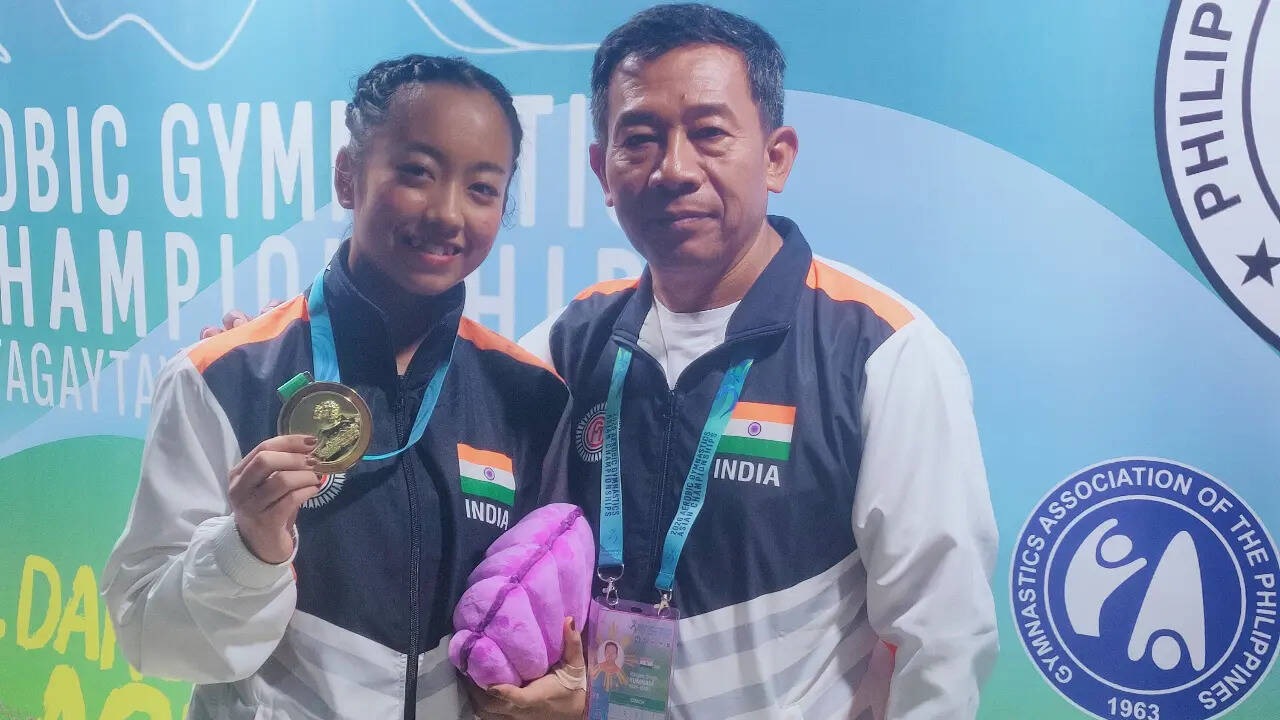
Ariha with coach Yumnam Ranjan Singh (Special arrangement)
“There were times I was so down that I cried,” Ariha shared. “I don’t know, I cried every night or something. Because at that time, I wasn’t achieving anything internationally. At the national level, I was a national champion, but my target was to get an international medal. I was going to international competitions, but I wasn’t achieving the score or the goal I wanted. My performance was stagnant, and I started asking myself why this was happening and if I was not good enough.”
But she had the support of his parents and coach Yumnam Ranjan Singh.
“I started to have frustration and all, but my coaches, my parents, they supported me and then I talked with them. One of my seniors, she is a psychologist. So with the help of her and all, I coped up with that.”
Competing in international competitions also required a lot of money, and her family paid for everything out of their own savings.
“Till now, whenever I went for international competitions, the money was fully managed by my parents,” she said. “I spoke directly with them after missing the medal. I told them we need to start saving money because I want to go to the next Asian Championship and bring home a medal.”
The Coach Who Shaped Her Journey
Ariha’s coach, Ranjan, did not just teach her sports skills; he helped her grow both as an athlete and as a person.
“Sir was my coach from the time I started aerobic gymnastics. So my bonding with him as a coach is pretty quite close, just like as a parent,” she said.
“He taught me not just in gymnastics, but not just the skill and all of the gymnastics, but he used to teach me other than gymnastics, the life skills that as a person, as a human being, we need to know.
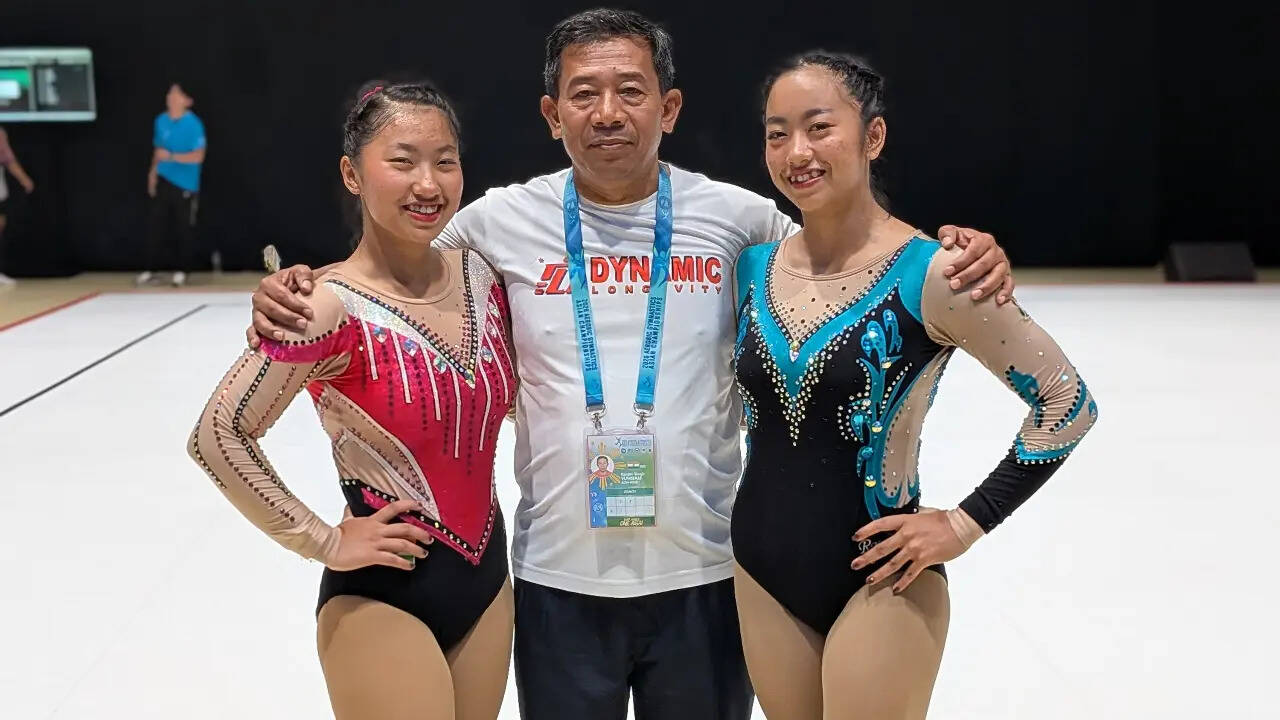
Yumnam Ranjan Singh has been instrumental in Ariha Pangambam’s success (Special Arrangement)
“Whenever we have relaxation time, we don’t always train the same thing or the same process. But whenever we have a session, at the end of session we have briefing and also he used to always tell a story to motivate us.
“In between our sessions also, since I had taken physical education and all, he used to teach us all the anatomical, biomechanical or physiological part so that we could not just learn that skill, we could understand the skill deeply.”
Beyond Medals: Ariha’s Message To Parents And State
Meanwhile, Ariha hopes that her gold medal can change the way people look at sports, especially in Manipur, where many parents still give more importance to academics, not seeing sports as a reliable career option.
“Most parents around me used to ask, ‘What will you get if you do gymnastics? What will you do after gymnastics?'” Ariha said. “I want people to understand that sports is not just about winning medals. It brings people together, builds character, and teaches you how to live life.”
Ariha revealed that young athletes in Manipur often struggle to get the support they need to compete at higher levels, and she believes this can change if they have better access to facilities and more chances to compete.
She urged state authorities and sports bodies to create more opportunities for young players, suggesting that adding aerobic gymnastics to the National School Games and offering scholarships to promising athletes could help more youngsters take up the sport seriously.
“Many talented players face financial problems and cannot go to big competitions,” she added. “If the government can create a good system or give scholarships to national-level players, many more athletes will get a chance to play for the country.”
What India Can Learn From Japan
Having competed in countries like Japan, Ariha has seen how schools can give more importance to sports alongside studies. She believes Indian schools can follow a similar approach.
“In Japan, the school systems are very supportive and dedicated to sports and co-curriculars,” Ariha explained. “I want our school system to change because most of our schools focus only on academics. Sports does not just teach us sport-specific skills and increase our physical fitness—it teaches us how to set goals, stay focused, manage priorities, and never give up. Changing our school system will not only create successful sportspersons, but also responsible citizens.”
India’s Gymnastics Problem Beyond The Podium
She also pointed to the lack of modern training equipment in her city, where athletes are forced to train with facilities that are far from the standards they face at international competitions. Ariha feels the lack of infrastructure creates a severe handicap for the Indian athletes.
“The equipment we use today at Khuman Lampak dates way back to the 1999 National Games held in Manipur,” she shared. “Other than some small items we bought later, the main equipment we use is completely worn out and in bad condition.”
“This lack of infrastructure creates a severe handicap on the international stage. Official aerobic gymnastics competitions are performed on a specialised wooden floor with double flex. However, due to limited resources, most gymnasts across India train on interlocking rubber mats.
“Because we train on rubber mats, most of us find it very uncomfortable to adjust to the wooden competition floor in just one day and give our best,” Ariha noted.
She pointed out that India currently has only one proper Aerobic Gymnastics floor in the entire country, and athletes from other states can barely use it
“Now, we have only 1 Aerobic Gymnastics floor in India we got during 2025 Uttarakhand National Games. But, still today since we have only 1 floor in the whole country and set up only in Uttarakhand, we barely even used it.”
With Asian gold now secured, Ariha has set her sights on the World Championships and the World Games, the biggest tournaments in non-Olympic sport.
Ariha also had a message for aspiring athletes. “Everyone should set a goal, whether big or small, and work toward it. We must have patience and the willingness to do the same hard work again and again. If you stay patient and keep working, your time will surely come.”
Latest News


Faham Uddin is a seasoned sports journalist currently working as a Special Correspondent on the sports desk. With over eight years of diverse experien… View More
Original source: https://www.timesnownews.com/sports