UN Names AQIS As Perpetrator Of 2025 Red Fort Blast
- Written by: Bhavatosh Singh
- Updated Aug 13, 2026, 09:34 IST
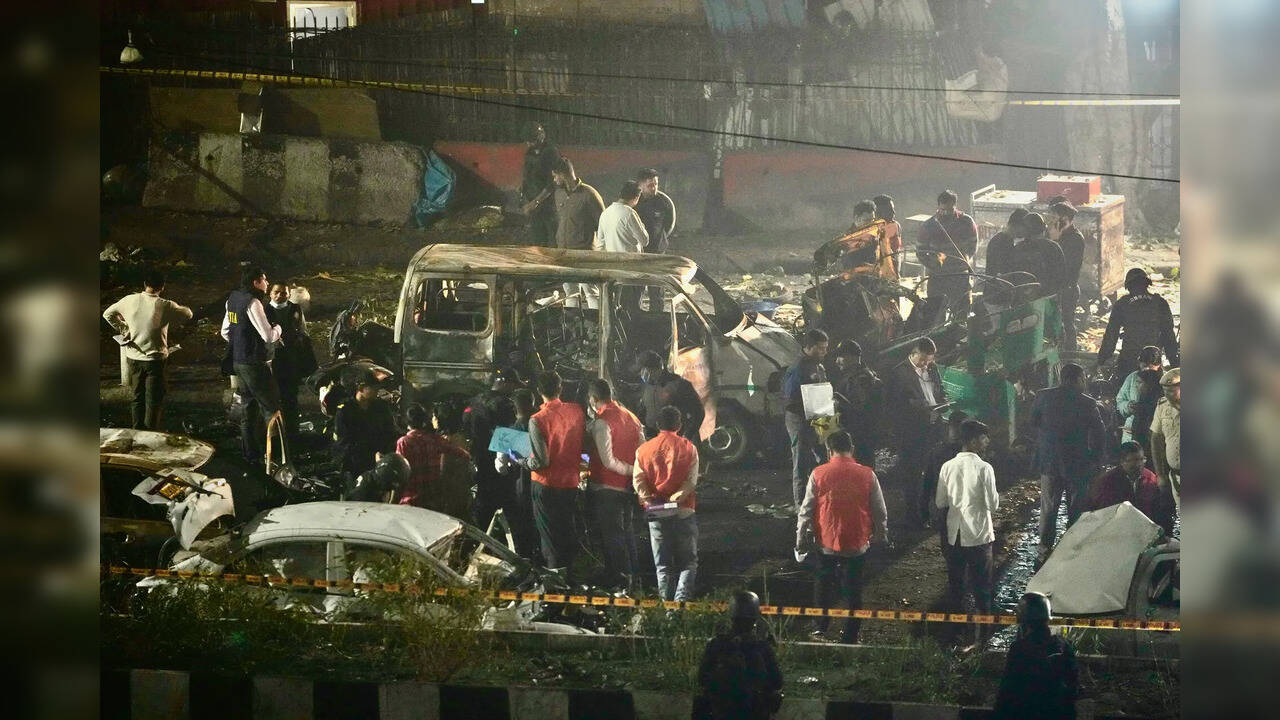
The UN has attributed the November 2025 Red Fort car blast in Delhi to AQIS, warning of the terror group’s growing regional network.
Security officers inspect the scene of a car explosion near the historic Red Fort in New Delhi, India, Monday, Nov. 10, 2025. (AP Photo/Manish Swarup)
The United Nations has attributed the November 2025 Red Fort car blast in Delhi to the Al Qaeda in the Indian Subcontinent (AQIS), according to a report by the UN Security Council Monitoring Team released on August 10.
The report said AQIS has transformed from a fragmented outfit into a regional terrorist entity by building logistics and financial networks and operating through small, decentralised cells rather than large, organised units.
“Al-Qaida in the Indian Subcontinent (AQIS, not listed) continued to evolve from a fragmented group into a regional terrorist entity; it established logistics and financial networks, working in decentralised small, scattered cells instead of large units. The attack in November 2025 on the Red Fort in Delhi was officially attributed to AQIS,” the report stated.
The Monitoring Team also noted concerns over AQIS attempting to exploit Bangladesh to establish operational cells in the country.
India has always viewed with concern the growing radicalisation in Bangladesh. Last week, R&AW Secretary Parag Jain was in Bangladesh on an official visit.
In May, the NIA filed a 7,500-page chargesheet against 10 accused persons in the Red Fort-area car bomb explosion case, in which 11 people were killed and several others injured.
Later, the anti-terror federal probe agency filed a supplementary chargesheet against three more accused.
“All 10 accused, including the main perpetrator, Dr Umer Un Nabi (deceased), were linked to the organisation Ansar Ghazwat-ul-Hind (AGuH) – an offshoot of Al-Qaida in the Indian Subcontinent (AQIS), as per the charges filed before the NIA Special Court at Patiala House Courts in New Delhi,” the NIA said in May.
“AQIS and all its manifestations were notified as a terrorist organisation by the Ministry of Home Affairs in June 2018,” the NIA said.
The chargesheet was filed under relevant sections of the UA(P) Act, 1967, the Bharatiya Nyaya Sanhita, 2023, the Explosive Substances Act, 1908, the Arms Act, 1959, and the Prevention of Damage to Public Property Act, 1984.
Charges against Pulwama-based Dr Umer Un Nabi (deceased), a former Assistant Professor of Medicine at Al-Falah University in Faridabad, Haryana, have been proposed to be abated.
Apart from Nabi, the other accused named in the chargesheet are Aamir Rashid Mir, Jasir Bilal Wani, Dr Muzamil Shakeel, Dr Adeel Ahmed Rather, Dr Shaheen Saeed, Mufti Irfan Ahmad Wagay, Soyab, Dr Bilal Naseer Malla and Yasir Ahmad Dar.
The chargesheet is based on an extensive investigation spanning Jammu & Kashmir, Haryana, Uttar Pradesh, Maharashtra, Gujarat and the Delhi-NCR region.
The NIA included detailed evidence in the form of 588 oral testimonies, more than 395 documents and over 200 seized material exhibits.
“The NIA, which had unravelled a major jihadi conspiracy through detailed scientific and forensic investigation, found that the accused, some of whom were radicalised medical professionals, had been inspired by AQIS/AGuH ideology to carry out the deadly attack,” the agency said.
At a clandestine meeting in Srinagar in 2022, the accused had reconstituted the AGuH terror outfit as “AGuH Interim” following a failed Hijrat to Afghanistan via Turkey.
“Under the umbrella of the newly constituted outfit, they had launched ‘Operation Heavenly Hind’, aimed at overthrowing the democratically established Indian government and imposing Sharia rule,” the NIA said in its probe.
The NIA investigation revealed that, as part of Operation Heavenly Hind, the accused had recruited new members, actively propagated the violent jihadi ideology of AGuH, stockpiled arms and ammunition, and manufactured explosives on a large scale using commercially available chemicals.
The accused had also fabricated and tested various types of IEDs, the NIA found during its investigation in case RC-21/2025/NIA/DLI. The explosive used in the blast was Triacetone Triperoxide (TATP), which was allegedly manufactured by the accused after clandestinely procuring its constituent ingredients and conducting experiments to perfect the explosive mixture.
The NIA, which had taken over the investigation from the Delhi Police, established the identity of the deceased accused, Dr Umer Un Nabi, through DNA fingerprinting. Evidence collected from the crime scene, as well as various locations identified by the accused in and around Al-Falah University in Faridabad and in Jammu & Kashmir, was subjected to thorough forensic examination and voice analysis as part of the investigation.
The NIA probe further revealed that the accused had also been involved in the illegal procurement of prohibited arms, including an AK-47 rifle, a Krinkov rifle and country-made pistols with live ammunition. They had experimented with rocket- and drone-mounted IEDs with the objective of targeting security establishments in Jammu & Kashmir and other parts of India.
The investigation also revealed that the accused had procured laboratory equipment, including specialised items such as MMO anodes, electrical circuits and switches, from various offline and online sources.
The accused also had plans to expand their operations to other parts of the country, which were foiled by the busting of the terror module.
Latest News


With over 18 years of experience in broadcast and print journalism, Bhavatosh Singh has been with Times Now since 2005. Primary areas of interest incl… View More
Original source: https://www.timesnownews.com/delhi