From Gandhi’s Charkha To Global Runways: How Khadi Went From A Symbol Of India’s Freedom Struggle To A Coveted Fashion Fabric
From a symbol of resistance spun on Gandhi’s charkha to contemporary silhouettes on global runways, khadi is being reimagined as a fabric of design, desire and modern luxury.
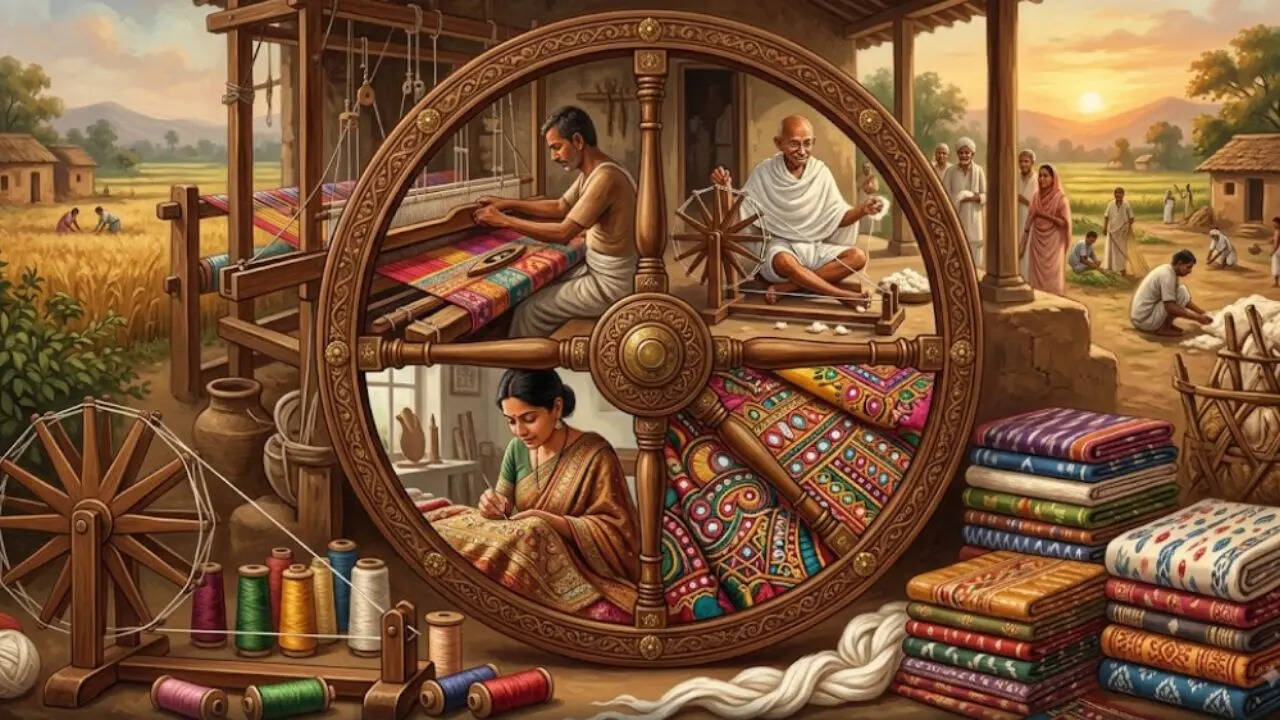
Khadi was never just a piece of cloth. During the Swadeshi movement, Gandhi turned the spinning wheel into a tool of resistance – Indians spinning and wearing their own cloth instead of British textiles, one thread at a time. It was not designed to look good. It was designed to make a point.
Eight decades on, the fight is over but the fabric stuck around out of habit – a symbol worn out of duty, not desire. That’s changing now. Khadi is on runways, being cut into pieces so fine they barely resemble the stiff cloth people picture. Last year, Vivienne Westwood built a collection around Indian handlooms – khadi, Chanderi, hand-woven silks. A fabric spun to resist empire is now being chosen because designers want it
From Symbol To Silhouette
For Kamal Haasan of House of Khaddar and Indian designer Samant Chauhan, the shift starts with a simple realisation: Khadi was never actually limited, only the way people saw it was. As Chauhan put it, “For a long time, khadi was presented within a very specific visual language, so people associated it with a certain kind of clothing. But the fabric itself was never limited.” Once you take it out of that familiar setting and give it a different silhouette or an unexpected colour, he says, you start seeing it differently.
Haasan’s entry point is more hands-on. He treats khadi “almost like a canvas” experimenting with different weights and textures rather than context. “I am experimenting with different weights and textures, combining khadi with handmade crochet, lace, patchwork and surface detailing, and using it in more contemporary silhouettes.” That thinking runs through SUTURA, a House of Khaddar collection he calls his most unconventional body of work with the fabric – an attempt, he says, to keep khadi’s raw, handwoven character visible while changing what people expect it to look like.
For Chauhan, though, the material comes first, before any idea of reinvention. “The starting point is always respect for the material,” Chauhan says. “I don’t want to manipulate khadi to the point where you can no longer recognise what made it beautiful in the first place.” Layer it, pleat it, structure it, embroider it, combine different weights – but never lose the thread back to what it actually is.
The Luxury Of Imperfection
Ask either designer what makes khadi special, and the answer keeps circling back to the same thing: its flaws. The slight unevenness in the yarn, the small variations that come from a human hand spinning thread rather – these have traditionally been treated as khadi’s limitation. However, both designers argue the opposite.
Chauhan does not mince his words: “Khadi already has something that many luxury fabrics try to recreate – individuality. Because it is handmade, there are small variations in the yarn and texture. For me, those are not imperfections; they are the luxury of the fabric.” Haasan makes almost the identical point from a different angle. For him, khadi’s appeal lies in “the touch of the person who made it. The slight irregularities, the texture, the way it falls and changes with time – those things give khadi a character that you simply cannot replicate with a mass-produced fabric.”
The very things that once made khadi feel unpolished – the coarseness, the unevenness – are now exactly what is being sold as its point of difference in a world flooded with machine-perfect fabric.
Simplicity As A Strategy
Plainness used to be the whole point of khadi. It was kept simple on purpose because anything fussy or decorative would have looked like the fine imported cloth people were boycotting. Keeping it bare was part of the protest.
Chauhan’s clean, pared-back silhouettes come from a different place, but they land on the same instinct. “When the textile has a strong character, you don’t need to over-design it,” he says. “Simplicity is not about removing design. It is about knowing where to stop.” A single raw edge or an unexpected volume, as per him, is enough to change how the fabric reads. What used to be a political statement now just looks like good design sense.
With that being said, khadi was never built to stay plain forever – it was made to stay plain. There is a difference. Give it the room, and the same cloth can hold crochet, lace, embroidery, without losing the roughness.
Perhaps the clearest thing both designers say is about what they don’t want khadi to be anymore – a symbol people wear out of obligation. Haasan is blunt about it. He says, “khadi should be something people choose because it is beautiful and desirable, not simply because it is traditional or patriotic.” He wants it to become part of everyday wardrobes as much as high fashion. Chauhan, however, takes it a step further, hoping the whole category disappears from people’s minds. His wish is precise: “I would like someone to see a beautifully designed jacket or dress, want it because of the design, and then discover that it happens to be khadi. That, to me, would represent real progress.” He does add a caveat, though – as khadi moves into luxury, streetwear and more experimental fashion, its future cannot come at the cost of the hands and communities that actually make it.
Carrying History, Not Repeating It
None of this is about erasing khadi’s past. Haasan is careful to say the history should not be treated as a marketing narrative, but that “a textile stays alive when it is allowed to evolve.” His approach is to let the fabric itself – its texture, its imperfections, its handmade character – carry that story.
That, in the end, is what most designers seem to be reaching for: A khadi that does not have to choose between honouring its past and looking forward. Eighty years after it helped a nation spin its way toward self-reliance, khadi is being asked to do something simpler but just as significant – to be worn, and loved, for what it looks like on a person, rather than what it once stood for.
Original source: https://www.timesnownews.com/lifestyle