Humanoid robots are clocking in, workers are pushing back
Humanoid robots are rapidly deploying in factories, attracting billions in investment. But workers are pushing back.
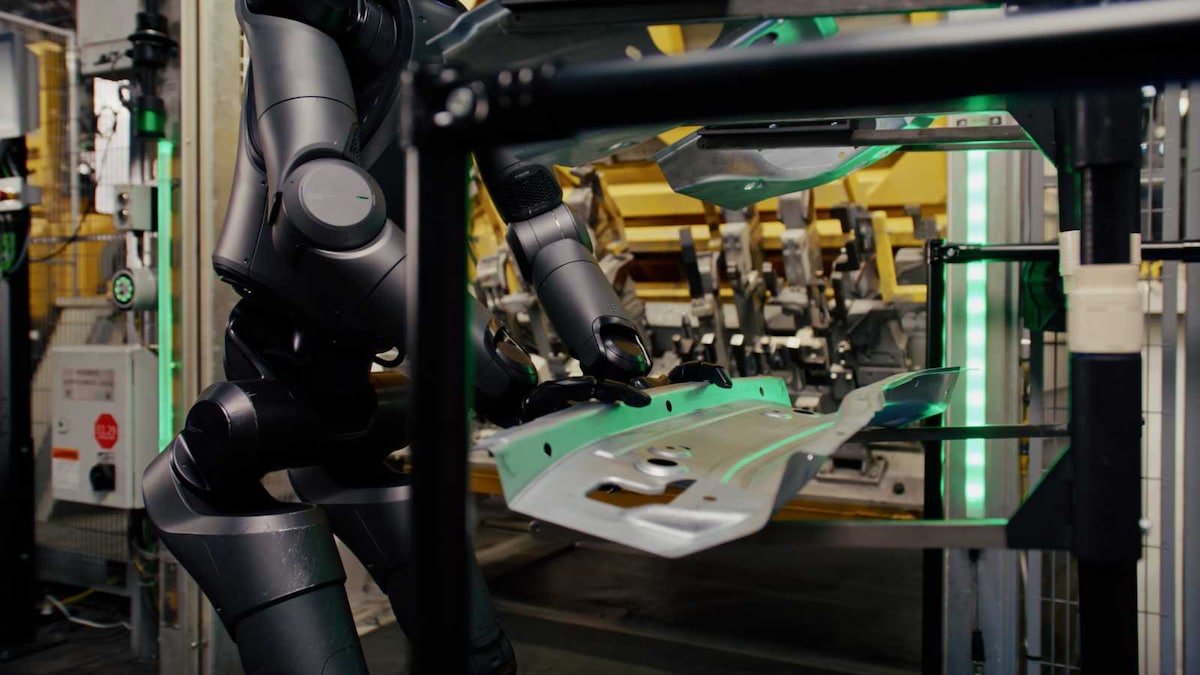
Two humanoid robots, Figure 02 from Figure AI, worked 10-hour weekday shifts for11 months at BMW’s Spartanburg plant in South Carolina in late 2025, loading more than 90,000 sheet-metal parts and contributing to the production of over 30,000 BMW X3 vehicles. They logged 1,250 operational hours with placement accuracy above 99%, according to Assembly Magazine & IIoT World.
The robots cost approximately $25 per operating hour, according to manufacturing vendor comparisons by iFactory AI. They also did not call in sick or file for overtime.
That single deployment, which led to a second phase announced earlier this year as BMW expands its humanoid programme to European plants, illustrates why the money flowing into humanoid robotics has turned from a trickle into a flood.
In the first half of 2026 alone, investors committed $4.39 billion to humanoid robotics startups worldwide, according to market data published by Statista. That figure exceeds every full calendar year before it, including 2025, which itself saw funding triple from the 2024 total, according to Statista and PitchBook.
The numbers from the previous decade tell the story of a category that barely existed: total funding sat at $10 million in 2017, $10 million in 2018, and $40 million in 2019, according to PitchBook data.
As large language models demonstrated that general intelligence was teachable, investors bet that general-purpose physical intelligence was next. By 2023, the sector had drawn $440 million; by the first six months of 2026, that figure had jumped to $4.39 billion, according to Statista.
Where the Money Went
Figure AI has raised over $1.7 billion in verified capital and is valued at $39 billion, making it the most funded pure-play humanoid company in the world, according to company filings and Intellizence reporting. Its Series C closed in September 2025, bringing in just over $1 billion from investors including Microsoft, NVIDIA, OpenAI, and Jeff Bezos, according to Parkway Venture Capital and company disclosures.
Other massive rounds include Skild AI, which raised $1.4 billion in January 2026. In Europe, NEURA Robotics is reportedly in talks to raise $1.2 billion, according to Bloomberg. Apptronik closed a $520 million Series A extension in February 2026, bringing its total Series A to over $935 million. Meanwhile, Physical Intelligence, focusing entirely on the AI layer with a generalist robot policy, is reportedly seeking an additional $1 billion in a Series C round at an $11 billion valuation
From Demos to Shift Schedules
This funding boom is being matched by deployments in real production environments.
Following the success of the Figure 02 pilot at Spartanburg, BMW announced in February 2026 that it would deploy AEON, a wheeled humanoid developed by Hexagon Robotics, at Plant Leipzig in Germany.
Mercedes-Benz is piloting Apptronik’s Apollo at its Digital Factory Campus in Berlin-Marienfelde. Apollo lifts 55 lbs, runs on hot-swappable battery packs, and uses collaborative force-control to operate safely alongside humans.
In logistics, Agility Robotics’ Digit humanoids surpassed a 100,000-tote milestone in commercial operation at a GXO fulfilment facility, deployed under a Robots as a Service contract, reported by Agility Robotics and GXO Logistics.
Tesla has also stated plans for the internal deployment of its Optimus robots. According to a global automation report by McKinsey & Company and industry cost analyses, return-on-investment timelines for humanoid deployment have dropped from 5.3 years in 2019 to roughly 2.8 years today.
The Labour Confrontation Begins
The clearest signal that humanoid robotics has shifted from a technological novelty to a labour flashpoint emerged from South Korea.
Hyundai Motor workers staged partial strikes in July amid a broader labour dispute that included demands for job protections as the automaker prepares to deploy Boston Dynamics’ Atlas humanoid robots. The Wall Street Journal described it as the auto industry’s first factory stoppage addressing humanoid robots.
Even before a single robot was introduced, workers demanded job security guarantees, fixed salaries instead of hourly wages, and larger bonuses. The union stated: “Under no circumstances will workers welcome the plan, as the robot deployment will bring a huge employment shock”.
Hyundai plans to manufacture 30,000 humanoid units annually by 2028 and intends to deploy Atlas robots at its Georgia facility, according to corporate filings and public statements from Hyundai Motor Group.
This asymmetry extends directly to how the machines are being trained.
To teach robots complex physical skills like stitching shoes or welding steel, AI-powered robotics companies are fiercely competing to collect video data of humans performing these tasks, according to recent reporting by Bloomberg News. Much of this manual labour is being filmed by workers in India, who are effectively generating training data for systems that could eventually automate some of their own jobs, Bloomberg reported.
Original source: https://www.cnbctv18.com/technology/