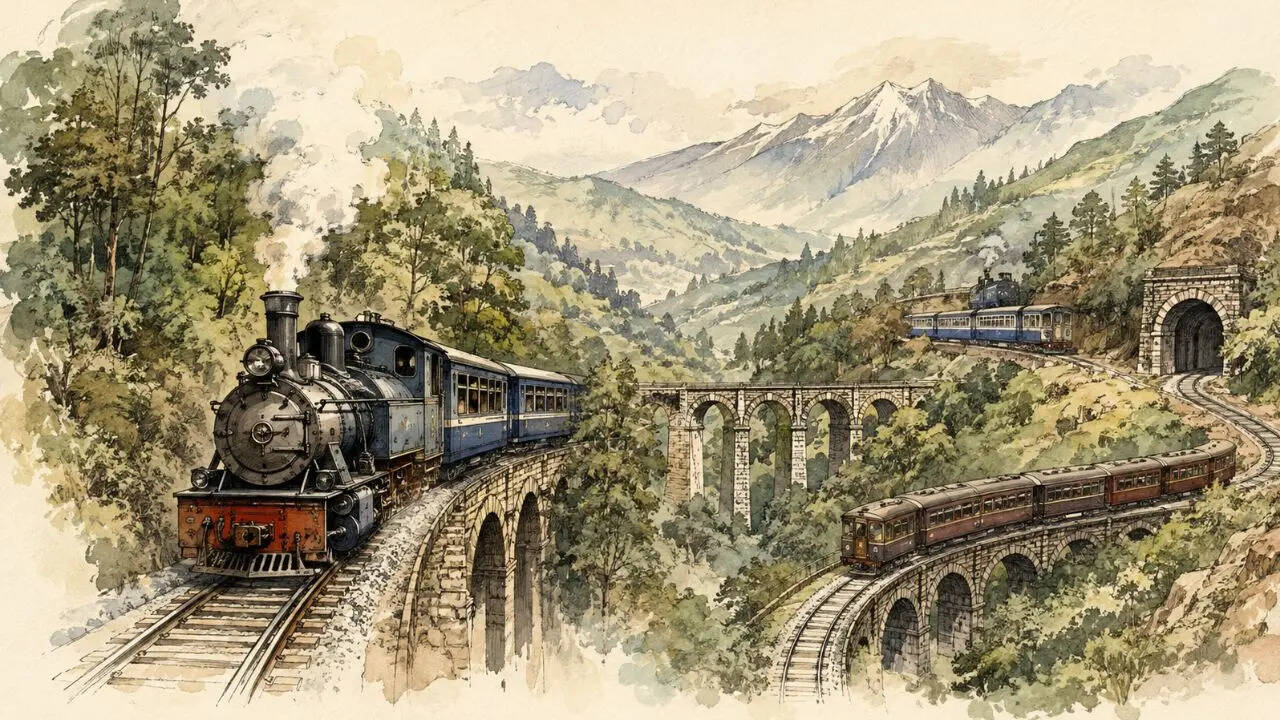
Independence Day Special: India’s Colonial-Era Railway Journeys You Can Still Take Today
- Authored by: Akanksha Arora
- Updated Aug 13, 2026, 13:05 IST
From Darjeeling’s iconic toy train to Shimla’s winding tracks, these colonial-era railways continue to carry passengers through some of India’s most breathtaking mountain landscapes.
Colonial-Era Railway Journeys You Can Still Take Today.
Every August, India remembers the long freedom struggle and everything else that came with British rule – both good and bad. Little do we know that one thing that the British left behind is still working, still carrying passengers, and is still loved by travellers: The old railway lines built through hills, forests and mountains more than a hundred years ago. These were not built for tourism but to move goods, soldiers, and officials, and to help the British escape the summer heat by reaching hill stations faster. Today, several of these lines are still running, and three of them are even UNESCO World Heritage Sites. Here is a look at some of the most popular colonial-era railway journeys you can still ride today.
The Darjeeling Himalayan Railway – The Original “Toy Train”
This is probably India’s most famous heritage railway. Built between 1879 and 1881, the Darjeeling Himalayan Railway (DHR) covers a distance of 88 km from New Jalpaiguri to Darjeeling in West Bengal. It was the idea of Sir Franklin Prestage, who wanted a small, narrow-gauge line that could handle the steep, winding hills where a normal train could not go.
The train climbs from around 100 metres above sea level to about 2,200 metres at Darjeeling. To do this on such a narrow track, engineers built six zig-zags and five loops, the most famous being the Batasia Loop near Ghum. Ghum station, on this route, is the highest railway station in India, at 2,258 metres.
In 1999, UNESCO named the DHR a World Heritage Site, calling it the first and still the finest example of a hill passenger railway anywhere. Today, diesel locomotives run most services, but vintage British-built steam locomotives still pull special “joy rides” between Darjeeling and Ghum.
The Nilgiri Mountain Railway – Asia’s Only Rack Railway
The idea for a railway up to the cool hills of Ooty was first suggested in 1854, but it took nearly forty years of debate before construction actually began in 1891. All of this happened under Swiss engineer Niklaus Riggenbach. The line reached Coonoor in 1899 and finally Ooty in 1908.
What makes the Nilgiri Mountain Railway (NMR) special is its use of the Abt rack-and-pinion system, a set of extra teeth fitted between the rails that let the train grip the track on very steep slopes. It is the only rack railway in India and one of the steepest in Asia, climbing a gradient of about 1 in 12.5 between Mettupalayam and Coonoor. The full journey covers 46 km, rising from 326 metres to 2,203 metres, and passes through 16 tunnels and around 250 bridges.
The Kalka–Shimla Railway – Built for the Summer Capital
When Shimla became the summer capital of British India, the government needed a faster way to reach there. Hence, the construction of the Kalka-Shimla Railway began in 1898 under engineer Herbert Septimus Harington, and the line officially opened on 9 November 1903, inaugurated by Viceroy Lord Curzon himself.
The numbers here are staggering for a line just under 96 km long: It passes through 103 tunnels and crosses more than 800 bridges. The longest tunnel, Barog, stretches for 1,144 metres and was, at the time it was built, the longest tunnel in the world. Many of the bridges use a multi-arch “gallery” design, similar to old Roman aqueducts – the bridge near Kanoh is considered one of the highest of its kind anywhere.
The Matheran Hill Railway – A Businessman’s Personal Project
Not every colonial railway was built by the government. The Matheran Hill Railway near Mumbai was the personal project of Abdul Hussein Adamjee Peerbhoy, whose father, Sir Adamjee Peerbhoy, funded the entire construction. Sir Adamjee, a well-known Mumbai businessman, loved visiting the hill station of Matheran and wanted an easier way to get there.
Planning began in 1900 and the construction started in 1904, and the line opened to the public in 1907, connecting Neral to Matheran over 21 km of narrow, two-foot gauge track. The journey is slow, at about 12 km/h, and passes through forest, past viewpoints like Panorama Point, and through the route’s only tunnel, nicknamed the “One Kiss Tunnel” because it is just long enough for a quick kiss between the entrance and exit. The railway is currently on UNESCO’s tentative list for World Heritage status.
Travel News – Find latest news and tips based on Indian and World travel including top 10 travel destination, tourism information, how to reach visit and more at Times Now.
Latest News


Senior Copy Editor at Times Network, Akanksha Arora covers Lifestyle, Culture and everything that falls under its big umbrella. When not writing, she … View More
Original source: https://www.timesnownews.com/lifestyle