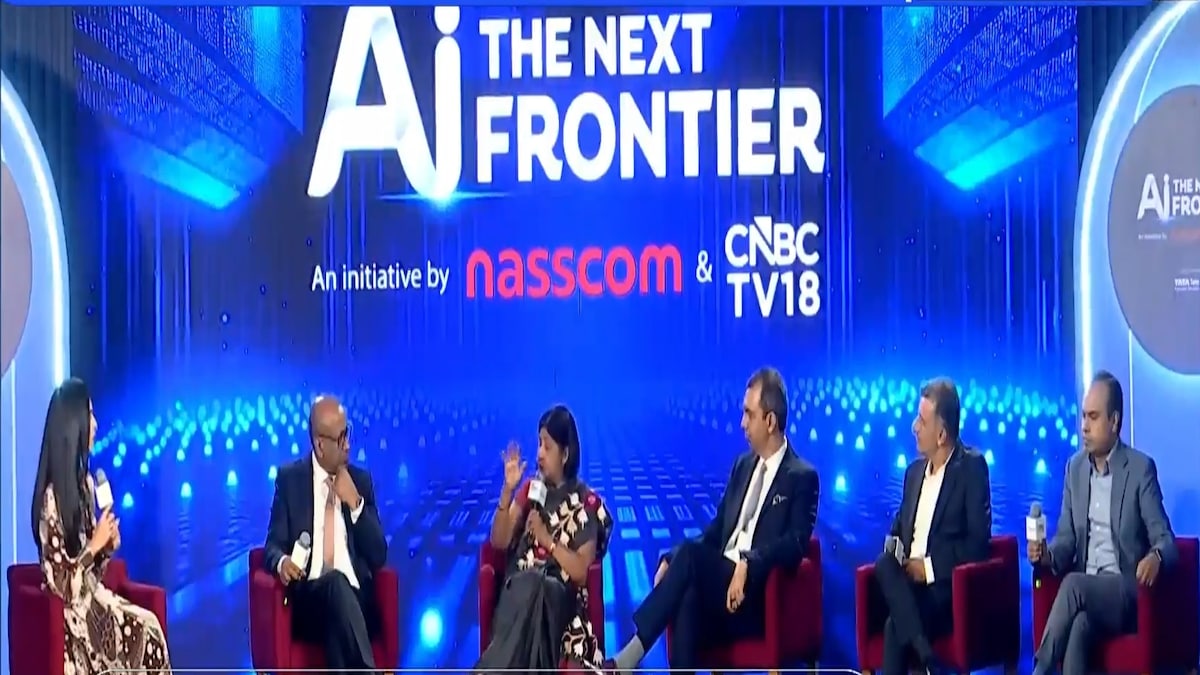
Indian IT’s next big opportunity? Making AI actually work for businesses
As powerful AI models become widely available, industry leaders say Indian IT’s edge could lie in something harder to replicate — decades of knowledge about how global businesses actually work.
Microsoft India and South Asia President Puneet Chandok said the proliferation of powerful AI models is making access to the models themselves less of a differentiator. The bigger opportunity for Indian IT companies, he said, lies in helping enterprises make those models useful in the context of their businesses.
“Some of these frontier models that I’m working with, they’re like brilliant strangers,” Chandok said during a discussion hosted by NASSCOM and CNBC-TV18. “Can you get me a familiar friend?”
That could create a significant new value pool for Indian IT services companies because they already have deep domain knowledge and decades of experience working with global enterprises.
Enterprise context could become the moat
Chandok said the growing number of frontier AI models available to businesses would make it difficult for any one model to remain a lasting competitive advantage.
“No client is going to bet the farm on one model,” he said, noting that Microsoft’s Foundry platform already has 11,000 models.
“The models will not be your differentiator. That’s not the moat anymore. It’s your ability to get these models to work for you,” Chandok said.
For Indian IT services companies, that means their existing enterprise relationships could become increasingly valuable.
NASSCOM President Rajesh Nambiar said Indian technology companies have accumulated considerable knowledge of global businesses through decades of working with enterprises.
“The enterprise context which the services companies have today are valuable so much,” Nambiar said, pointing to the industry’s experience with global corporations since the Y2K era.
He said this knowledge could help Indian companies play an important role in the application and “harnessing layer” of the AI ecosystem, where enterprises need to turn increasingly capable models into practical business systems.
From services to platforms and blueprints
The opportunity could also change what enterprise customers buy from IT services companies.
TCS Chief Officer of AI & Services Transformation Amit Kapur said customers could increasingly seek a combination of services, platforms, products and outcomes rather than traditional technology outsourcing alone.
“The same enterprise customer can also engage with you to say that, ‘I want to build my own platform for my own sovereign needs for the future, but I want to borrow the blueprint from you,’” Kapur said.
Such blueprints could themselves become intellectual property for technology companies, even when they are not sold as conventional software products.
This could create a broader spectrum of offerings, from traditional services and engineering to reusable blueprints, platforms and products.
For Indian IT companies, the shift would mean moving up the value chain without necessarily abandoning the services model that has traditionally driven their global businesses.
Enterprise AI still needs trust and integration
Salesforce President and CEO Arundhati Bhattacharya said the rise of frontier AI models does not remove the need for enterprise software, engineering and services.
She said enterprises need much more than access to an AI model when deploying the technology in real-world business environments.
“Whenever you’re deploying something new, there has to be governance, there has to be auditability, there has to be observability,” Bhattacharya said.
Enterprise systems also typically involve multiple legacy applications, databases and technology architectures. AI systems therefore need to work within existing environments rather than operate in isolation.
That makes integration, governance and reliability particularly important as companies move from AI experimentation to production deployments.
FDE could open another opportunity
Chandok said the shift could also create a large opportunity in forward-deployed engineering, or FDE, where technology teams work closely with customers to implement and adapt AI systems.
Such work requires a combination of domain knowledge, process redesign and engineering capabilities, he said.
“This is the ’90s moment for IT services,” Chandok said, comparing the opportunity with the period when Indian technology companies built large businesses around the implementation and integration of enterprise technology.
The comparison is significant for an industry that grew by helping global companies adopt technologies ranging from enterprise software to cloud computing.
As AI adoption moves from pilots to more complex deployments, Indian IT companies could once again find themselves playing the role of implementation and transformation partners — but with a greater emphasis on AI engineering and business context.
The model may matter less than what sits around it
The proliferation of frontier models could ultimately make it harder for enterprises to rely on a single AI provider.
That could favour technology services companies that can help businesses select the appropriate models, connect them to proprietary data, integrate them with existing systems and put the necessary governance frameworks around them.
The competitive advantage, therefore, may not come from owning the most powerful AI model. It could come from understanding how to make multiple models work reliably within complex enterprise environments.
For Indian IT services companies, that makes enterprise context a potentially more important asset than access to frontier models as the next phase of AI adoption takes shape.
This is the edited excerpt of the discussion.
Q: Rajesh, I want to start by talking to you. ₹15 lakh crore gone in market cap erosion since the 2024 peak. What is the market not appreciating about the story? Indian IT, as Salil Parekh told me in our interview recently, Indian IT abhi zinda hai. Why is the market not appreciating that?
Rajesh Nambiar: It is absolutely zinda hai, but I think it’s important for us to note a couple of things. One, if you ask anybody in the room, and if you look at the last quarter results of all the companies, the top one included, the medium ones, of course, grew. You know, when you look at the top ones, they had about 3% year-on-year growth. The medium tier, many of the companies which actually did fairly well, had 9-12% growth, and the smaller ones actually had even higher growth.
But more importantly, when you go back and look at the order books, almost all of them had their largest order book ever in the history of this industry. So they’ve all been doing really well. On the contrary, as you rightly mentioned, all of them had a headwind from the stock market point of view.
I do not know how the stock market valuation happens, so I can’t really comment on what they do, but I can always tell you one thing: they always price for the worst case, and then when they look at the terminal value, they want to make sure that whatever they’re seeing on the order books, whatever the story that we’ve been sort of saying for the last one or two years holds good for the long term.
I know that they’re sort of looking at these numbers and occasionally you’ll find that because of the green shoots that we produce as an industry, there’s suddenly a sort of a shoot-up of our numbers and so on.
So I think quarter-on-quarter, if they are able to put the proof points on the board, I personally believe that – will you see an aberration? Absolutely, yes. I think there is going to be a bit of an aberration, as you see that this industry will go through bad times before it gets better, as I always say. So I think we’re going through that turf at this point in time.
And people always ask me, “Will the industry pivot?” The industry has nothing to pivot here. I think the individual companies will pivot. Will all the industry players pivot? Probably not. 80% of them will pivot. Maybe some of them will not pivot, but the opportunity, the TAM that we’re talking about, for the services companies to truly cross the chasm, if you may, that’s for real, and I don’t believe that the markets have actually priced it in yet.
Q: Amit, let’s talk to you now in terms of recalibrating growth. And as I said, you know, is the era of double-digit growth something behind us? Do we need to recalibrate ourselves into appreciating the fact that at least for the foreseeable future for the industry, for companies like yours, it’s likely to be low single digit? And what does that then mean for the next five years as far as this sector is concerned?
Amit Kapur: If we look at how things are shaping up, we look at a few transitions, and possibly our industry is experiencing one right now. And it’s a transition of two pivots. I think that was also spoken about in the first presentation, of what’s under pressure and what’s new. And the growth of opportunity in the new is something that we have been reporting quarter-on-quarter. It’s been the last three quarters we’ve been reporting, and that’s a mark of confidence and conviction, the path that we have taken, the path that we have chosen.
The transition on anything to do with operations is expected to be pushed for efficiency and productivity always, with or without AI. That has always been the candidate, and it will always remain a candidate. But the pivot towards new opportunity is what we are seeing more and more.
What used to be an industry known for effort—largely, our industry has always been known for how much effort we have put in—I think that pivot is moving from effort to intelligence. Our industry is getting redefined for intelligence, our industry is getting recalibrated for intelligence, and that’s the transition that we are all experiencing right now, but a huge opportunity ahead of us.
Q: If you’re making this transition to intelligence, what then happens as far as pricing is concerned? You’re moving now to outcome, and everybody’s talking about the outcome model and outcome pricing. What does it mean in terms of pricing deflation at this point in time, and, you know, how quickly are you likely to see this model shifting? And two, on the headcount front as well, as we move into this agentic future that everybody is talking about, what will it mean essentially as far as the current model of headcount is concerned?
Amit Kapur: If we look at the operating model, headcount has been part and parcel of an operating model to deliver services to a customer enterprise, deliver services in an output, in an effort or an outcome-based model. It’s been a combination of all three. The percentage variation has been very different.
Now, when you look at the operating model shift, you’ll have a human and AI agent collaborate and coexist in different capacities, in different natured roles, and different skill sets. The ability to price for outcome becomes more profound now because you are committing to what the end experience the customer will gain, rather than the effort that you will put in.
But, hand on heart, I don’t think the industry has transitioned to an outcome as yet. We are clearly seeing a shift of effort moving to output, but a very small percentage is still moving to outcome. But that’s a big opportunity in front of us.
Q: And the timelines that you believe that you are likely to see the inflection point as far as this shift is concerned?
Amit Kapur: Tough to predict. I think if we go back in history, we always take inspiration from history. So if you go back in history, when the mobile era was introduced, the consumers had huge excitement around it, enterprises took a long, long time to come around that space. I don’t think so it will be any close to that lead time, but there is a lead time that is always expected from consumer excitement to being ready for enterprise-grade.
Q: Arundhati Bhattacharya, every headline has been screaming about the SaaS-pocalypse. Now, how do you, sitting at Salesforce, deal with this?
Arundhati Bhattacharya: I think that narrative has already been proven false.
The thing is, we are all in a stage of transition, and let me make this comment regarding this outcome-based pricing. When this outcome-based pricing really starts working, they want to go back to the licence-based pricing, because the outcomes are so many, they don’t like it then. Then they want to go back to the earlier one. But having said that—on the SaaS-pocalypse, you have to understand one thing. The frontier models, you just can’t put them somewhere and expect the entire enterprise problems to be solved, okay?
Whenever you’re deploying something new, there has to be governance, there has to be auditability, there has to be observability, there has to be, you know, the various regulatory and other compliances have to be correctly recorded.
Not only that, in the architecture that you already have, you don’t have a clean slate. You’re putting in something where something else is already working. So, putting all of that together in order to have the best outcomes, it needs a lot of engineering. It’s not something that happens on its own, neither is it something that, you know, any of the frontier models will resolve on their own.
And therefore, the requirement for companies such as either ours or even the service companies, that requirement still remains. And the fact is, the industry is beginning to realise that that piece of it is still very, very important.
And therefore, I don’t really think the SaaS-pocalypse stuff was sort of—I don’t know, it was talked up, maybe, a little because there was so much investment going into the other companies, and they had to take it out from somewhere. And probably, we were sitting ducks on it, but whatever it is, I don’t think that narrative really makes sense. And I’ve not been seeing that in actual on-the-ground requirement or even in the order books. Like Rajesh said, we are not seeing that anywhere.
Q: The narrative was built by the stock markets, but, you know, you’re right in saying that you did see these massive amounts of capital going into companies like OpenAI, Anthropic, and, of course. But you know, what I do want to understand from you is what are you seeing in terms of demand? Because I understand that you’re in a silent period, so you cannot comment or make any future projections, but look at your agentic ARR, up 200%. What is the sense that you’re getting in terms of demand at this point in time?
Arundhati Bhattacharya: So, you know, let me just talk about our own company. We are, by the way, customer zero. Like Noshir said, we are not holding back. We are willing to cannibalise ourselves. We are customer zero on our own platform.
And even there, if you see, I had started with my own vertical with a project for creating 3x productivity. In a matter of 90 days, I had 99 applications, okay? Where, in certain cases, they were giving as much as 27x productivity. Some cases, it was lower, it was as much as 1.5, but it depended from case to case.
So, the fact remains that there is definitely a huge amount of demand, but I think even if there is demand, people have a lot of queries still. The queries on trust, queries on security, queries on cost. There is something that has evolved called tokenomics. Okay, so that’s an entirely new field of expertise.
Q: We’ve gone from token maxing now to token impacting. Token impacting is the buzzword today.
Arundhati Bhattacharya: That’s right. So, that’s an entirely new area, and in fact, Noshir didn’t mention some of the roles. Some of the roles are in that area. How do you maximise the usage of tokens in order to ensure that you get maximum impact and lowest, costs?
Q: Puneet, you know, as I was saying, the only person on this panel who doesn’t have a stock problem is Puneet. Microsoft is still holding up, but, you know, the massive capex spends that we’re seeing globally at this point in time, almost $700 billion-plus dollars between the hyperscalers put together, almost $200 billion for Microsoft alone. Now, when we look at this capex build-out, and I’m asking this in the context of what the opportunity is for this sector here in India, how does this sector benefit from this kind of massive capex build-out that we’re seeing happen globally? Where does the value creation for this sector lie when we talk about this capex build-out?
Puneet Chandok: Listen, I think first up, the reason for the amount of investments that you’re talking about is—and we were having this discussion outside—this is unlike anything else we’ve seen in our lives. It’s the most consequential technology of our lifetimes. And a lot of this capex is going into manufacturing intelligence, and intelligence has always been linked to biology. We’ve always carried intelligence in our small heads. For the first time, we’re making compute become cognition, right? For the first time, we’re manufacturing intelligence.
So, that is the race we’re on, and that’s the reason the investments will continue to go on. To your question on where the value is, and I was with a client recently and he said, “Some of these frontier models that I’m working with, they’re like brilliant strangers.”
I said, “Can you explain this to me?”
He said, “They’re brilliant strangers. They know everything about the world. They know nothing about me. Can you get me a familiar friend? Can you get me a child who grows up in my organisation, understands my context, the knowledge turns, what does good work look like, and then get that to answer questions or do work for me?”
Which is where the new value pool is, and Noshir spoke about, right? Which is translating this enterprise ontology, the enterprise context into these frontier models, and getting these models to work for you on your own terms versus the other way round.
Watch accompanying video for full conversation.

Original source: https://www.cnbctv18.com/technology/