Murf AI launches Falcon 2, takes aim at OpenAI, ElevenLabs with lower-cost voice model
Murf AI is stepping up its global voice AI ambitions with Falcon 2, which the Bengaluru-based startup says combines lower latency, voice quality and cost. The company is also exploring a Series B fundraise towards the end of the year, while an IPO remains on the longer-term roadmap as it builds out its voice-agent stack.

The company said Falcon 2 ranks ahead of OpenAI’s Realtime and ElevenLabs’ Flash and Turbo models for naturalness on the independent Artificial Analysis Speech Arena, while also delivering lower latency and cost.
Murf said Falcon 2 can begin generating audio in under 100 milliseconds and is priced at $0.01 per generated minute. By comparison, the company said ElevenLabs’ Flash and Turbo models are priced at $0.05 per generated minute.
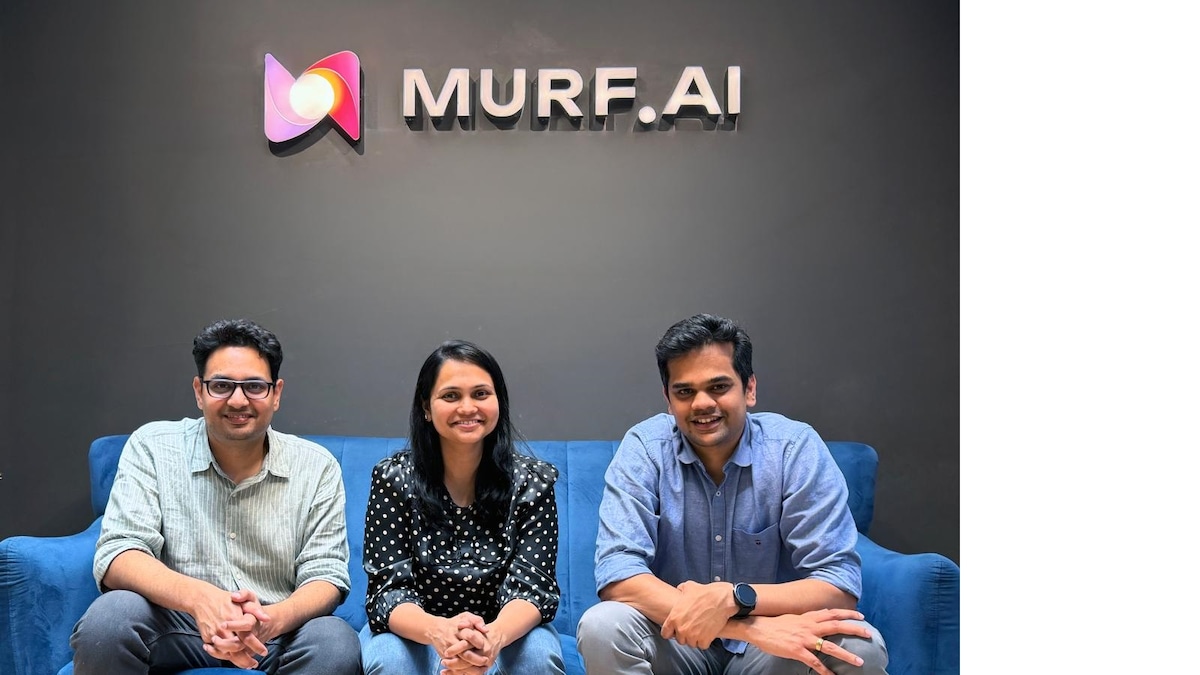
The launch comes roughly six to seven months after Murf introduced Falcon 1 in private beta. According to co-founder and CEO Ankur Edkie, the biggest improvement in Falcon 2 is voice quality, while the company has retained the low latency and cost profile of its predecessor.
“We are still the most cost effective and the lowest latency model out there globally,” Edkie told CNBC-TV18.
Murf’s focus is on the text-to-speech layer of voice agents — the technology that converts an AI-generated response into spoken language after an underlying system has processed what a customer has said.
The company is targeting enterprises deploying voice agents for customer support, outbound sales calls, banking and financial services, healthcare and appointment booking.
Breaking the voice AI trade-off
For Murf, the central pitch behind Falcon 2 is that enterprises should not have to choose between natural-sounding speech, speed and cost.
“Traditionally in this industry, what we’ve seen is that there’s always been a trade-off between these three,” co-founder and COO Sneha Roy said. “We wanted to really break this trade-off.”
Murf said Falcon 2 was developed around a lightweight proprietary architecture designed to improve inference efficiency without relying primarily on increasing model size.
The company said its India-based engineering and research teams have focused on improving contextual understanding, pronunciation and the way the model handles pacing and emphasis.
The model also supports 150-plus voices across more than 35 languages, including 12 Indian languages, according to the company.
Roy said the company is seeing demand from sectors including BFSI, healthcare and e-commerce, although Murf does not intend to focus on a single industry because its technology sits underneath multiple voice-agent applications.
Cost becomes critical at scale
The economics of voice AI become particularly important when enterprises deploy agents across millions of customer interactions.
At Murf’s quoted price of $0.01 per generated minute, one million minutes of generated speech would cost $10,000, compared with $50,000 at the $0.05-per-minute price cited by the company for ElevenLabs’ Flash and Turbo models.
Edkie said the company has also focused heavily on the cost of running the underlying infrastructure.
Murf has deliberately continued using smaller, commodity GPUs rather than relying heavily on high-end GPUs, he said, arguing that this helps the company manage infrastructure utilisation when customer demand fluctuates.
“The main innovation” from Falcon 1 to Falcon 2 was improving quality without increasing the amount of compute required, Edkie said.
Murf’s founders said this approach also allows the company to offer competitive pricing to enterprises while maintaining healthy operating margins.
Another key feature of Falcon 2 is its enterprise deployment architecture.
Murf said Falcon 2 can be deployed on-premise for organisations that do not want customer data leaving their own infrastructure. The company is currently exploring such deployments with BFSI customers in India and the US.
Under the on-premise model, Murf deploys a synthesised version of the model on the customer’s servers and receives usage information rather than customer data, according to Roy.
The company also offers data-redaction options for customers using its online deployment.
The emphasis on data control could become increasingly important as banks, healthcare companies and other regulated businesses experiment with AI-powered customer interactions.
Murf sees US, India as key markets
Murf said Falcon is already being used by customers in the US in real-world voice-agent deployments.
The company also has a broader multilingual ambition. Falcon 2 supports more than 35 languages, with the founders saying the model currently covers 12 Indian languages.
The company plans to add more languages based largely on customer demand rather than pursuing every long-tail language proactively.
Murf’s API documentation also positions Falcon specifically for real-time applications such as conversational AI, voice agents and virtual assistants.
From Falcon 1 to Falcon 2
Falcon 1’s biggest limitation was not speed or cost, according to Edkie, but naturalness.
Murf used customers from the Falcon 1 private beta to test Falcon 2, with the feedback helping the company improve voice quality.
“We wanted to really hit the nail on the competition that was doing better than us, which was largely on the voice quality metric,” Edkie said.
With Falcon 2, the company believes it has closed that gap enough to make a broader push into enterprise deployments.
Artificial Analysis currently tracks Murf models across quality, speed and pricing metrics, although its rankings are dynamic and depend on the benchmark methodology and available evaluations.
Murf AI has raised $11.5 million so far from Elevation Capital and Matrix Partners, now Z47, according to Edkie.
The company has raised a Series A and is considering a Series B, although discussions are likely to begin only towards the end of the year, Edkie told CNBC-TV18.
An IPO, however, remains some way off.
Edkie said the company still has significant room to expand its product offering, particularly in the broader voice-agent stack, before considering a public listing.
“We want to build out the whole stack,” he said, adding that there are still significant gaps to solve in the agent space.
For now, Murf’s bet is that the next phase of voice AI will be won not merely by producing the most human-sounding voice, but by making that voice fast enough, cheap enough and reliable enough to operate at enterprise scale.
Original source: https://www.cnbctv18.com/technology/