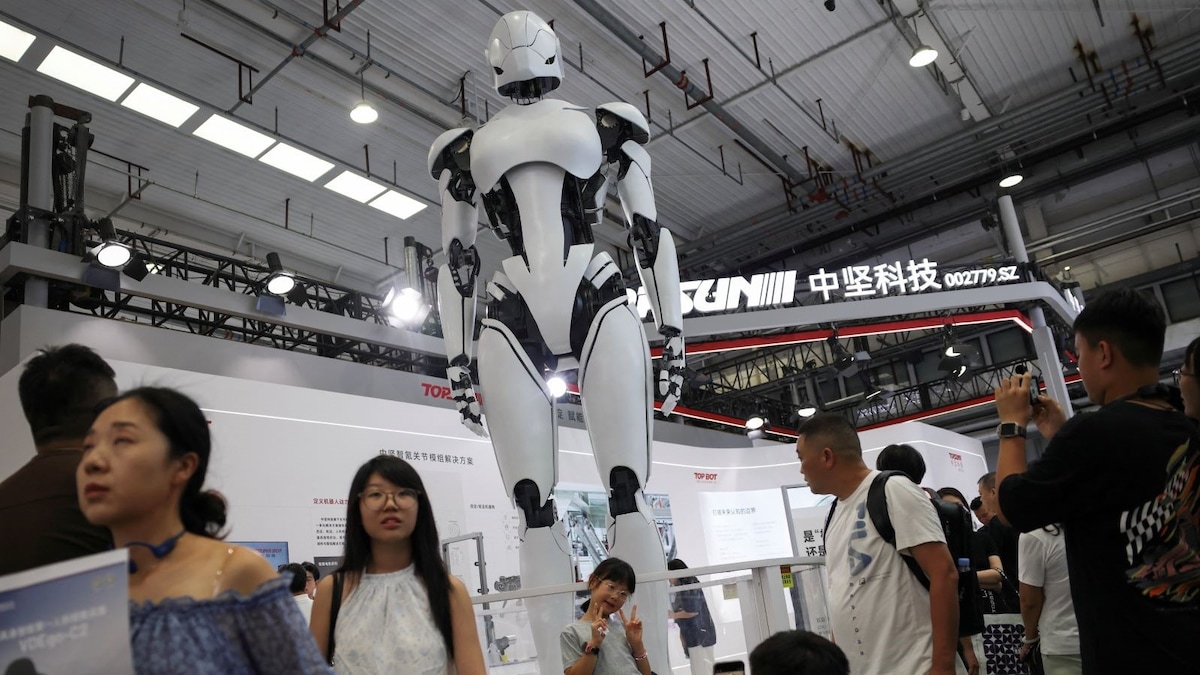
Humanoids to robot chefs, all that’s unique at World Robot Conference 2026 in Beijing
China’s 2026 World Robot Conference in Beijing has brought together more than 300 exhibitors and over 2,000 robotic products, with the focus shifting from flashy demonstrations to practical applications in everyday settings.
From dancing and boxing humanoids to robot chefs, quadrupeds and industrial machines, the conference is showcasing how robotics is moving beyond demonstrations and towards real-world applications.
The four-day event, which began on Wednesday, features more than 150 products making their global debut. Spread across four exhibition halls covering around 50,000 square metres, the conference has also attracted major state-owned enterprises and technology developers exploring how robots can be deployed in real-world environments.
The event includes a new section dedicated to centrally administered state-owned enterprises, with 49 central SOEs showcasing 12 robotics-related application scenarios.
From dancing humanoids to robot chefs
Among the attractions at the conference are humanoid robots capable of dancing and boxing, agile quadruped robots and specialised machines designed for tasks such as cooking, welding, lifting and parcel sorting.
Robots can box, dance, sort parcels, and even play the piano. At the 2026 #WorldRobotConference in Beijing, more than 300 exhibitors and over 2,000 exhibits show what’s now reality.#ChinaTech #Robots #WRC #AI pic.twitter.com/Q6GjKXo8n0
— China Xinhua News (@XHNews) August 21, 2026
???????? Almost no foreign faces at Beijing’s World Robot Conference this week.
Hundreds of Chinese firms packed the halls with humanoids, sorting robots, and new hardware. Officially, it’s global. On the floor, it feels much more self-contained.
U.S. export controls, FCC…
— Mario Nawfal (@MarioNawfal) August 20, 2026
A robot consumption street has also been created at the venue, allowing visitors to see robotic systems preparing food and drinks. One humanoid robot even became an unexpected talking point after appearing to ‘throw a tantrum’ when a remote-control connection failed.
世界机器人大会一幕:机器人癫痫发作,遥控失效,关电源都很困难!8月19日,2026世界机器人大会在北京开幕。 pic.twitter.com/SJYgxXVmC8
— 希望之聲 – 中國時局 (@SoundOfHope_SOH) August 19, 2026
While such demonstrations have drawn crowds, the larger focus of WRC 2026 is on taking robotics technology beyond exhibition floors and into workplaces and everyday settings.
China unveils a multi‑tasking smart robot for parcel sorting
China has introduced a multi‑purpose intelligent robot designed for parcel sorting and logistics operations during the World Artificial Intelligence Conference (WAIC 2026) in Shanghai.
The robot is capable of… pic.twitter.com/THYiUHXZUD
— China Now (@ChinaNow24) July 21, 2026
Robots move closer to everyday application
The conference has been structured around four key themes — product launches, procurement, developer engagement and public access.
The aim is to connect robotics companies and developers with industries, businesses and potential users who could adopt the technology.
Organisers have also introduced a programme allowing innovation teams from around the world to access mass-produced humanoid robots, quadruped robots and dexterous robotic hands for real-world trials at no cost.
Emergency response is another area receiving attention, with the conference releasing application requirements for embodied intelligence in emergency scenarios.
It has also highlighted 10 robotics innovations and 10 high-value application scenarios involving central SOEs.
Push for global robotics development
Alongside these demonstrations, WRC 2026 has launched the Development Initiative on Intelligent Robots for the Positive and for Good. The initiative aims to encourage greater international cooperation in robotics development.
ALSO READ | TTD tests robotic dog with AI and LiDAR to track leopards in Tirumala
The growing emphasis on deployment reflects a broader shift in the robotics industry. Rather than simply demonstrating what robots can do, companies and developers are increasingly focusing on where the machines can be used effectively and whether they can deliver measurable value in factories, workplaces and everyday life.
Original source: https://www.cnbctv18.com/technology/