The Battle India Won Against A European Empire That History Forgot: Colachel, 1741
In 1741, a young king, his fishermen and a lucky cannonball broke the Dutch East India Company at Colachel, then turned the defeated commander into the builder of Travancore’s army.
Every schoolchild in India can recite the defeats – Plassey, Buxar, the slow surrender of a subcontinent to European trading companies. Almost none can name the day an Indian kingdom beat one of those companies outright and drove it into permanent retreat. It happened on a stretch of the Tamil Nadu coast in the summer of 1741, at a fishing harbour called Colachel, and it remains one of the most remarkable and least taught victories in the country’s history. It has no place in the popular memory that a European sea power could be broken by a South Indian king and his fishermen, and yet that is exactly what occurred.
The Company That Wanted The Pepper
To understand the battle, you have to understand the prize. In the early eighteenth century, the Malabar coast, in present-day Kerala, was carved up among a scatter of small kingdoms, and it grew the pepper that Europe could not get enough of. The Dutch East India Company, then among the most feared commercial powers on earth, had built its fortune on controlling such trade, buying spices cheap through exclusive treaties and selling them in Europe at ruinous mark-ups. What it needed was monopoly, and what stood in its way was a young, ambitious king.

Pepper Profits Put Marthanda Varma On A Collision Course With The Dutch
Marthanda Varma had come to the throne of Travancore in 1729 and set about doing something Indian rulers of the region rarely managed. He unified. Through the 1730s he absorbed the smaller principalities around him, building a single, centralised state where there had been a patchwork, and he refused to honour the trade terms the Dutch had struck with the kingdoms he was swallowing. To the Company, this was intolerable. A strong, independent Travancore threatened the entire architecture of Dutch profit on the coast. When negotiation failed, as it was always likely to, the Company reached for force.
The Blockade and The Landing
The Dutch commander Julius Valentyn Stein van Gollenesse moved first with economic warfare, declaring a naval blockade near Colachel in late 1740, ordering his ships to turn back vessels bound for Travancore and choke the kingdom’s lucrative coastal trade in textiles and taxes. When the squeeze failed to bring the king to heel, the Company escalated to a landing. Troops came ashore under Eustachius De Lannoy, a capable Flemish soldier in Dutch service, and began pushing inland towards the Travancore capital at Padmanabhapuram. On paper it looked like the familiar story, disciplined European firepower advancing on an Indian court that would sooner or later capitulate.
Fishermen, Fake Cannons and A Lucky Shot
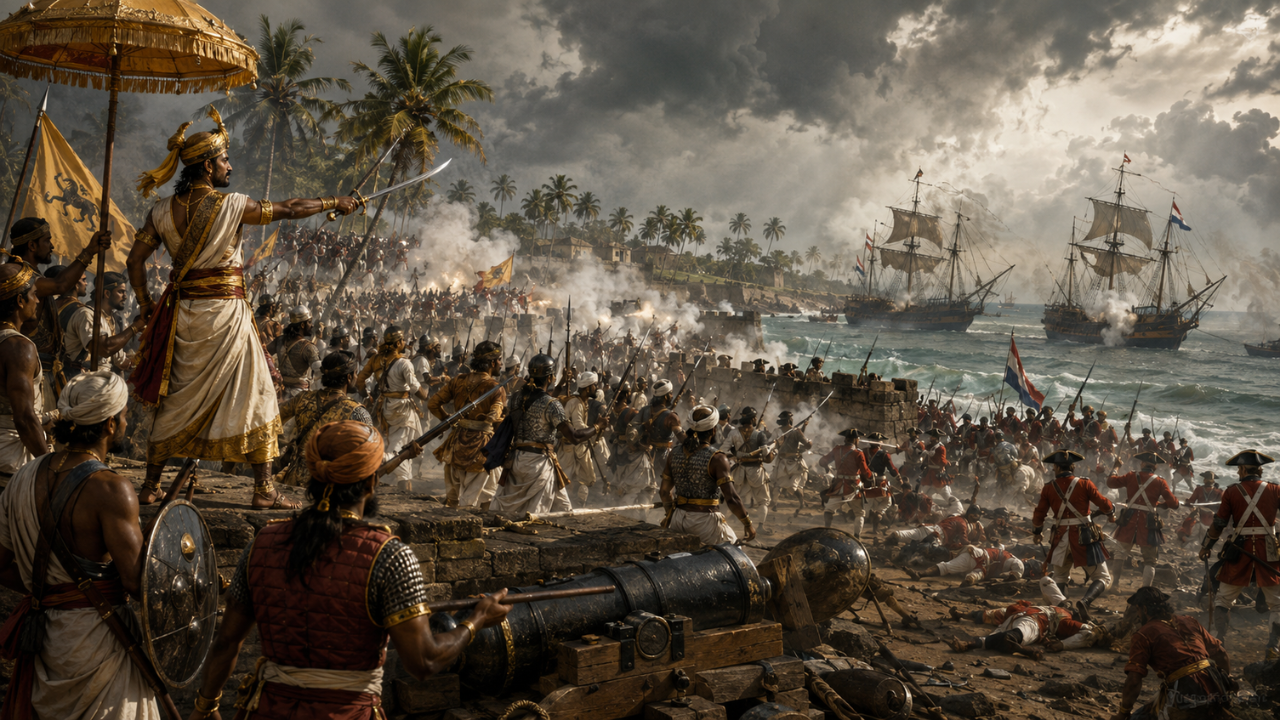
What followed was not the walkover the Company expected. Marthanda Varma raced south with his forces and hemmed the invaders in against the coast, and his most unlikely allies proved among his most valuable. The Mukkuvar fishermen of the shoreline, who knew those waters as no European ever could, harried the Dutch by sea, damaging and sinking boats under cover of darkness, intercepting messengers, and cutting the thread of supply and communication on which the landing party depended. On the beach, by tradition, the defenders mounted cut sections of palm trunk on bullock carts so that, seen from the Dutch ships offshore, they resembled a long line of heavy artillery, a bluff that helped keep the naval guns wary and at bay.
Mukkuvar Fishermen and Travancore Forces Helped Break Dutch Power At Colachel
Then came the moment that decided everything. On 5 August 1741, a Travancore cannonball, fired from a recently acquired gun, struck a barrel of gunpowder inside the Dutch stockade. The explosion tore through their position and destroyed their ammunition and food stores at a single stroke. Cut off from resupply by the fishermen and now stripped of powder and provisions, the garrison had nothing left to fight with. Within days it surrendered. Dutch records place the surrender on 7 August, while some historians favour 10 August as the formal date, but the result was not in doubt. The Dutch East India Company had been beaten in open battle by an Indian kingdom, and it would never recover its former standing as a colonial power on the subcontinent.
The Prisoner Who Became An Admiral
What Marthanda Varma did next is the part that lifts the story from a battle into something far stranger. Twenty-four Dutch officers were taken and held at Udayagiri Fort, among them De Lannoy himself. The king’s handling of them was hard-headed rather than chivalrous, and it should be told honestly. The Dutch had agreed to lay down their arms on the understanding that they could withdraw with their weapons, and Marthanda Varma did not fully honour that promise, imprisoning them instead. It was the calculation of a ruler who knew exactly what he had captured.
Marthanda Varma Turned Defeated Dutch Commander De Lannoy Into Travancore’s Admiral
Yet what emerged from that calculation was extraordinary. Rather than execute his most capable prisoner, the king offered De Lannoy a role in his service, and the defeated commander accepted. Over close to twenty years, De Lannoy remade the Travancore army in the European mould, introducing disciplined drill, modern artillery and firearms that had scarcely been used in the region before, and strengthening its forts. He rose to the rank of Valiya Kappithan, the senior admiral of the very kingdom he had been sent to conquer, working alongside the king’s brilliant minister Ramayyan Dalawa to turn Travancore into a genuine regional power.
The Legacy Left In A Fort
The army De Lannoy built went on to matter well beyond his lifetime. It underpinned Travancore’s continued expansion across the smaller kingdoms of the south, bringing Quilon, Kayamkulam and others under its authority, and the fortified defensive lines the kingdom raised, the famous Nedumkotta, would later help hold off even the formidable forces of Tipu Sultan. De Lannoy died in Travancore’s service, far from the country of his birth, and his tomb still stands within Udayagiri Fort, sometimes called Dillanai Kottai in his memory, the resting place of a European soldier who found his life’s true work serving the Indian king who had beaten him.
Original source: https://www.timesnownews.com/lifestyle