From Catch-Up to Control: How Treesa-Gayatri Cracked China Code to Make BWF World Championships History
- Written by: Sudipta Biswas
- Updated Aug 21, 2026, 22:17 IST
A slow start, a tactical reset, a “Come on, girls” chorus and relentless pressure at the net transformed Treesa Jolly and Gayatri Gopichand’s quarterfinal against Jia Yi Fan and Zhang Shu Xian into a landmark day for Indian women’s doubles – a win they are still processing.
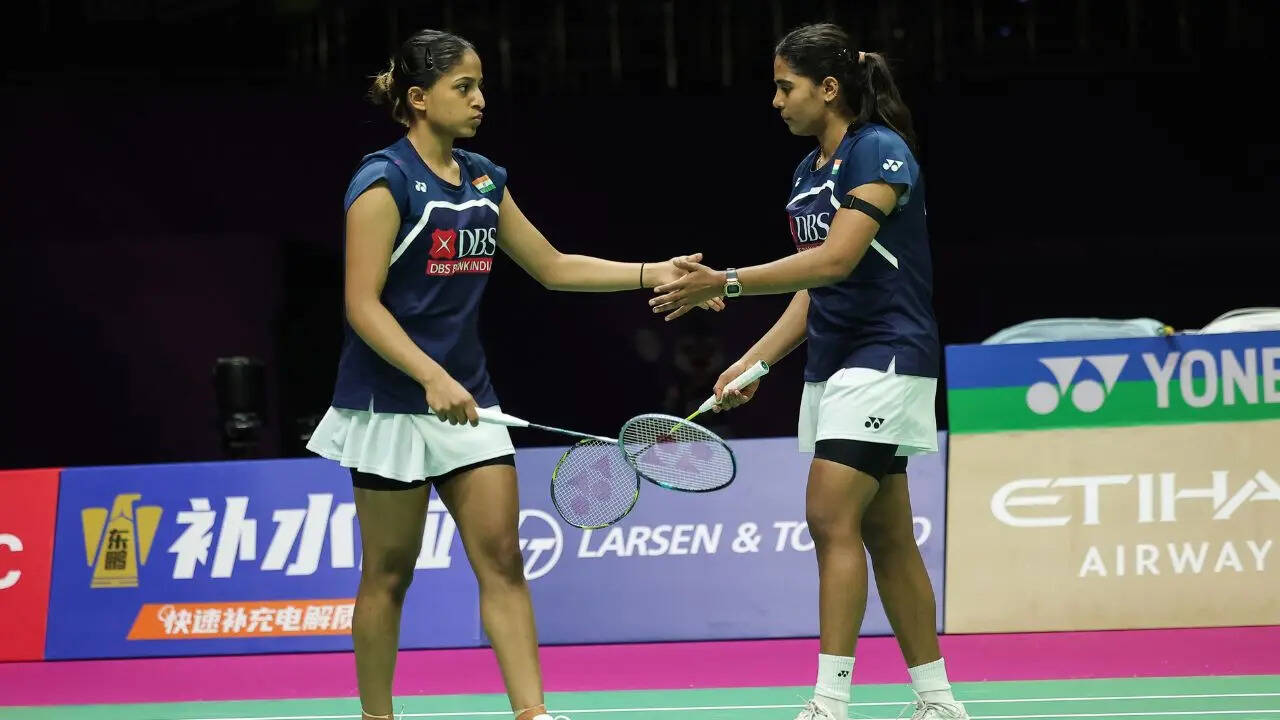
(Left to right): Gayatri Gopichand and Treesa Jolly produced one of Indian badminton’s biggest moments by assuring themselves of a medal at the BWF World Championships in New Delhi on August 21, 2026. Photo: BAI
New Delhi: Belief is key to success. But against players with greater experience and the ability to find solutions under pressure, even the strongest belief can waver. That was precisely what Treesa Jolly and Gayatri Gopichand had to overcome in the women’s doubles quarterfinals against World No. 4 Jia Yi Fan and Zhang Shu Xian at the BWF World Championships here at the Indira Gandhi Indoor Stadium.
“Until we got the last 21 points, we never felt at ease for a second. Because with those kind of players it’s like when you actually win, that time only we will actually process that you actually won. Playing against such a pair, whom we take inspiration from, it is never possible to feel comfortable until the last point,” Treesa said in a candid conversation with the media.
In the end, though, the Indian pair produced a defining moment for Indian women’s doubles. Their quarterfinal victory took them into the semifinals and assured them a medal – India’s first in 15 years, since Jwala Gutta and Ashwini Ponnappa won bronze in 2011.
‘Not over yet’
Beating a player whom they have looked up to since they started playing doubles made it a poignant moment. They took time to fathom the moment, breaking down in tears as the enormity of their achievement sank in. “Just processing this one. We are into the semifinals and being on the podium. But it’s not finished yet,” Treesa said.
Playing a pair they had never beaten and had lost to in all three of their previous meetings, there was no scope for complacency.
“We were constantly telling each other it’s not over yet, it’s not over yet because we had a huge lead in the third set but we just kept telling each other it wasn’t over yet,” said Gayatri.
Treesa had arrived at the World Championships after recovering from an ankle injury, while the pair’s season had been stop-start. But on the biggest occasion, with the home crowd behind them, they shouldered the expectations and pulled off back-to-back upsets – beating seventh seeded Rin Iwanaga and Kie Nakanishi in the Round of 16 and fourth seeded Jia Yi Fan and Zhang Shu Xian in the quarterfinals.
Such was their comeback win that it drew admiration from Jia, one of China’s women’s doubles legends, who admitted that the Indians had outplayed them with their strategy and trickeries.
“Jolly is fierce and Gayatri is very sharp minded,” Jia, the Olympic gold medallist, told the media after their exit.
The Indians have long shown they have what it takes to break into the big league. They had reached two All England Open semifinals and guided India to a historic Badminton Asia Team Championships title. But injuries have repeatedly proved to be their biggest stumbling block. They missed last year’s World Championships in Paris and Sudirman Cup, as well as the Badminton Asia Championships and Uber Cup this year, besides several World Tour events. As a result, their ranking also slipped from World No. 9 in 2025 to 39.
Now fit again, they are back in beast mode, blowing away the Chinese pair of Jia and Zhang in a game of rallies and net drops.
No easy points
In the opening game, though, playing against the drift, the Indians played catch-up. Jia and Zhang kept the shuttle low, kept the shuttle travelling space short and repeatedly forced the Indians to make errors, playing the shuttle into the net. Treesa and Gayatri struggled to retrieve, particularly at the net, and a slew of errors allowed the Chinese pair to dictate.
But Treesa and Gayatri did not lose their composure. With no easy points coming their way, they stayed patient and composed, showing an incredible ability to find ways to win points.
“We just wanted our legs to move and just to be calm and patient on the court because that’s the most important thing. They are number five on the court. That’s the most important thing for us,” Treesa said of their approach to the game.
Decoding the pattern
The second game began in much the same fashion. Jia and Zhang denied Treesa the lifts she needed to unleash her power from the rear court, while varying the pace – accelerating and slowing the rallies – to disrupt the Indians’ rhythm. They moved 5-2 ahead.
Treesa and Gayatri soon decoded the pattern. And vociferous crowd support filled them with ‘josh’ (fervour) and confidence.
“That come on, come on girls. You can do this. I think that really helped us,” Treesa noted.
They scaled up their game, with Treesa relentless in hitting her smashes while Gayatri’s willingness to engage at the net brought them back to 4-5. The next point captured the shift in the match. As Zhang tried to roll the shuttle over the tape, Treesa transitioned brilliantly from the rear court and produced a wristy flick over the net, leaving the Chinese stranded in the rear court.
Throughout the second and third games, there were many such moments — there were also moments when both the Chinese found themselves on the same line.
As Treesa and Gayatri closed the gap fast, Jia and Zhang’s frustration grew. The Indians’ defence was impeccable. When Zhang tried to bury the shuttle in the Indians’ half, Gayatri retrieved it to create a chance for a smash from an airborne Treesa.
While errors can creep into a fast game, Treesa quickly made amends by pushing deep to Zhang, their main target, followed by a cheeky Gayatri net shot that dropped at Jia’s feet.
Winning the see-saw battle
It became a see-saw battle. Jia’s smash was met by two low, body-directed attacks from Treesa and Gayatri. Three successive points helped India level the game before they edged 11-10 ahead at the interval — their first lead in the match.
After the break, the exchanges became flatter and more mid-court, and India extended their lead to 13-10 through another net battle. It proved to be a decisive moment, as Treesa and Gayatri shifted gears and began asserting their dominance more consistently.
Asked about the stage at which the momentum shifted in the match, B Sumeeth Reddy, the duo’s coach, said, “It actually happened at 10-7 when the opponents were leading. I think from there, when things changed at 11-10 and 13-10, they just could play the free game. We already had a discussion in the first game that, you know, just a two-point lead would change the whole scenario.”
Jia and Zhang’s left-right combination remained difficult to read. Their experience showed: Jia would attack with a smash while Zhang tried to take pace off the rally with a delicate net shot, hoping to catch India in the mid-court. But Gayatri was reading the game better, retrieving even Jia’s tight net attempts, while Treesa’s smashes kept the pressure on. Zhang, meanwhile, began making errors, including the long shots that handed India the final two points of the game.
The key shift was not simply Treesa’s improved smashing or her brilliant transitions from the rear court to the front, nor Gayatri’s defence against the Chinese power game. It was their growing control of the net. Once Gayatri held her ground in front and Treesa could attack freely from behind, China’s low, controlled game began to lose its bite.
For most of the first game, the Indians had been playing catch-up. Winning the second game changed that. With the crowd behind them, Treesa and Gayatri stopped reacting and began dictating.
The deciding third game made that transformation clear. Zhang attacked relentlessly, trying to rattle the Indians, while Jia continued to seek openings at the net. But Treesa’s magnificent placement repeatedly unsettled Zhang.
Yet the beginning of the game was far from ideal for Treesa and Gayatri. They trailed 1-4, but that was the last time they were trailing in the match. They went on to reel off eight straight points to move 9-4 ahead. As they exerted pressure and retrieved the Chinese pair’s every attack, the Indians soared in the match on a slew of Chinese errors. They carried an 11-5 lead into the interval and closed out the match 21-13.
Treesa brought the fire from the rear court; Gayatri gave it direction at the front. Once the two halves of their game came together, the Chinese pair had few answers.
Their feat is already historic enough to send Indian badminton fans into delirium. Treesa, however, has other plans. “The win is kind of confidence boost for both of us. This is not the ending. We came here with a goal,” she said, as they now await another China clash against reigning world champions Liu Sheng Shu and Tan Ning.
Latest News


Sudipta Biswas is a seasoned sports journalist with over a decade of experience in the Indian news media landscape. An alumnus of IIMC-Aizawl, he spec… View More
Original source: https://www.timesnownews.com/sports