The Royal Fashion Legacy India Still Wears
India’s royals had more than extraordinary wardrobes. They popularised styles, fabrics and ways of dressing that travelled from palace corridors into the wider world of fashion, many of which remain influential today.
The “Gilded Age” of Indian royalty was also a pretty spectacular fashion era. Think the evergreen chiffon saree, Indo-Western dressing or the super-elegant jodhpurs. Indian royals had chic individual styles, picking up ideas from their travels, international fashion and the worlds they moved through. Some of those looks would travel far beyond the palace.
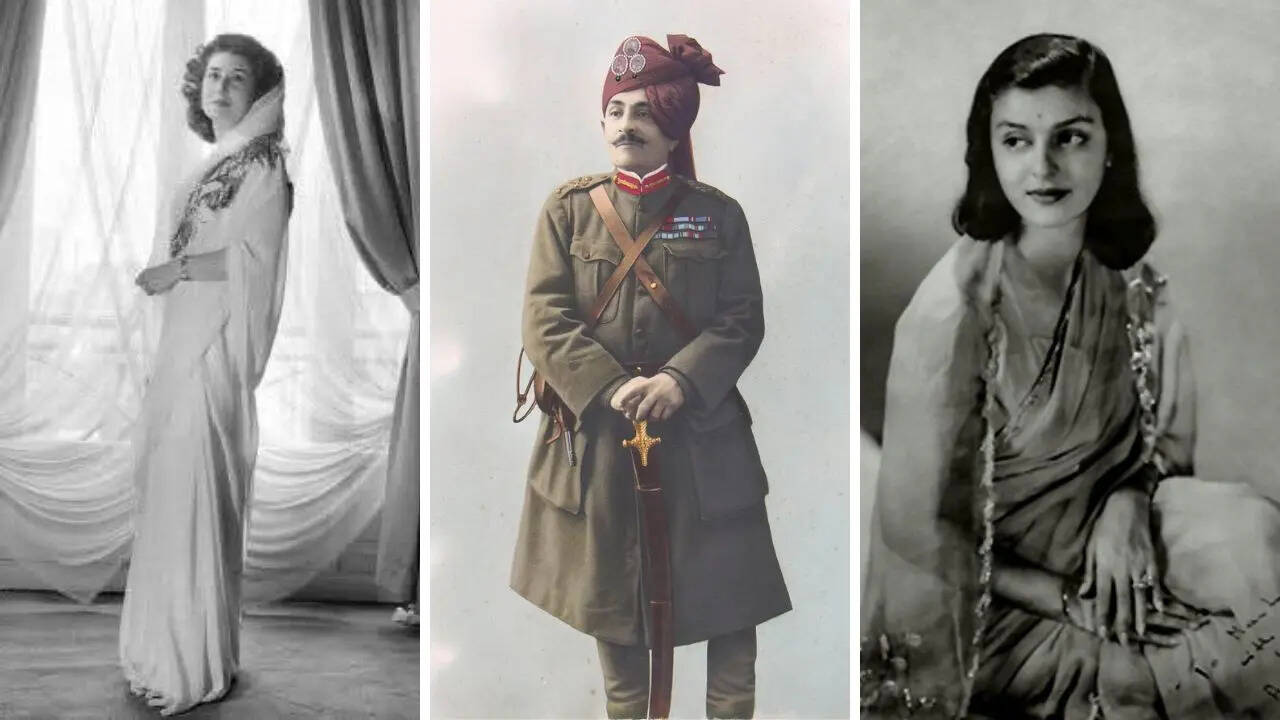
Sheer, soft and dreamy, the chiffon saree remains a favourite. Women from royal families, particularly in Rajasthan, continue to turn to chiffon sarees for celebrations, carrying forward a style that became synonymous with one of India’s most celebrated fashion icons, Maharani Gayatri Devi (1919–2009). She may have turned the chiffon saree into a cult, but it was her mother, Maharani Indira Devi (1892–1968) of Cooch Behar, who brought chiffon sarees to India.

(Left) Maharani Indira Devi of Cooch Behar with her daughter, Maharani Gayatri Devi of Jaipur. (Right) Indira Devi brought chiffon sarees to India from Lyon in France.
Indira Devi was a cosmopolitan woman who spent much of her life travelling through Europe. During a trip to Lyon in France, a city renowned for its silk production, she fell in love with chiffon and decided to have sarees made from the delicate fabric. Unlike the traditional six-yard saree, hers were nine yards long. Both mother and daughter sourced their chiffon from Lyon, while embroidery, borders and other finishing touches were done in Calcutta, now Kolkata. The designs of their sarees would only be made available to the public a year later.
Gayatri Devi, or Rajmata as she was known, often credited her mother for her own fashion sensibilities. She once said, “I learnt style from my mother. She was one of the most fashionable, most independent and most modern Maharanis ever. She always knew the best places to buy anything and she shopped all over the world.”
(Left) Princess Gauravi Kumari of Jaipur in a custom Prabal Gurung gown made from vintage chiffon that once belonged to her great-grandmother, Maharani Gayatri Devi (right).
The pearl and chiffon aesthetic associated with Gayatri Devi continues to find its way into royal wardrobes. At the May 2026 Met Gala, Princess Gauravi Kumari of Jaipur wore a pink custom Prabal Gurung hand-draped Goddess Saree Gown, made from vintage chiffon from a saree that belonged to her great-grandmother, Gayatri Devi. She paired the look with layers of pearls.
The chiffon saree was soft and fluid. The jodhpurs were made for movement. Their history goes back to the courts of Rajasthan, where they were worn by the region’s nobility and horse-mounted armies. As designer Raghavendra Rathore writes, “Their snug fit from the knee down and flared hips allowed for unrestricted movement, offering practicality and comfort to riders. These features made Jodhpurs a staple in the wardrobes of the region’s nobility and horse-mounted armies, reflecting a blend of functional design and regal style.”
It was Sir Pratap Singh, the Maharaja of Idar and Regent of Jodhpur, who made jodhpurs famous. A passionate polo player, he was not satisfied with the breeches worn while playing polo and decided to design his own version. Inspired by the churidar, the trousers had a roomier fit around the hips and thighs, making them more comfortable on horseback. The first pair was tailored in Jodhpur in 1890 from thick cotton twill cloth.
Sir Pratap Singh is credited with creating and popularising jodhpurs (left), while Queen Elizabeth II is pictured wearing the equestrian-inspired silhouette (right).
Sir Pratap’s jodhpurs caught attention when he wore them during a polo match in England, where the British took to the style. A pair of trousers designed for an Indian royal’s sporting wardrobe had found an audience far beyond Jodhpur.
The same instinct for comfort and personal style can be seen in the angarkha worn at the court of the Nawabs of Awadh during the 18th and 19th centuries. The garment came in different fabrics and styles, from muslin and chikankari in summer to brocade and velvet for festive occasions, and was worn with a churidar pyjama underneath.
Nawab Wajid Ali Shah of Awadh had a quirky take on it, and is credited with making angrakha famous. He was often depicted wearing an angarkha that exposed his left nipple. According to Impart, the angarkha is a “loose tunic tied at the side” and takes its name from the Sanskrit word angaraksha, meaning “that which protects or covers the limbs”. Author and historian Rana Safvi has written about the famous image of Wajid Ali Shah, noting that the exposed nipple was a fashion statement, rather than simply a symbol of decadence.
The angarkha went through various design changes and was worn by different kings and clans, but Wajid Ali Shah’s version remains one of the more memorable examples of how royal dress could have a little drama.
If Awadh had its angarkha, Hyderabad had Princess Niloufer, who was giving a French spin to the saree.
Princess Niloufer Khanum Sultana Farhat of Hyderabad, known for her elegant Indo-Western wardrobe and fluid chiffon sarees inspired by French fashion.
Princess Begum Niloufer Khanum Sultana Farhat (1916–1989) was playing with the concept of Indo-Western dressing long before it became a familiar phrase in fashion. Affectionately called the “Kohinoor of Hyderabad”, she was the daughter-in-law of Mir Osman Ali Khan, the last reigning Nizam of Hyderabad. Born into the Ottoman royal family and raised in France, she married Prince Moazzam Jah and brought a very different idea of royal dressing to Hyderabad.
She reportedly moved away from the traditional chaugoshiya, the four-sided veil associated with the Nizam’s court, in favour of lightweight French chiffons and georgettes. She wore them as soft, fluid sarees, often with matching veils or pallus draped over her head. The look was lighter and more relaxed than the formal court dress of the time. One could easily call it chic.
Her sarees brought together French fashion and Indian craftsmanship. Niloufer commissioned embroidery from French luxury houses, including Jeanne Lanvin in Paris, before having the fabrics brought back to India and finished with wide Banarasi brocade borders. She favoured sequins, beads, metallic embroidery and delicate embellishment, turning the saree into something closer to eveningwear.
The flowing saree, matching head veil, elaborate jewellery and Western-inspired embellishment gave her a distinct silhouette that was neither entirely Indian nor European. She could move between sarees and Western gowns with the same ease, giving Hyderabad’s royal fashion a distinctly cosmopolitan edge.
Shah Jahan Begum of Bhopal, 1872 and Sultan Jahan Begum of Bhopal, 1921. (Photos: Wikimedia Commons)
The Begums of Bhopal had a different relationship with clothes. For almost a century, Bhopal was governed by four women, beginning with Qudsia Begum in 1819 and ending with Sultan Jahan Begum in 1926. Their wardrobes had to reflect the authority of a ruler, while remaining rooted in the Muslim traditions of the court.
The Begums wore long tunics, flowing trousers, veils and richly embroidered garments, while adopting elements of Western and military dress. Their clothes were practical enough for women who rode, travelled and appeared in public, but they still had the bearing of royalty.
Sultan Jahan Begum, the last of Bhopal’s ruling Begums, was particularly conscious of how she was represented. Photographs show her in elaborate court dress and veils, as well as more structured outfits that reflected her public role. The veil, long coat, jewellery and military-inspired details became part of the visual style associated with Bhopal’s royal women.
And then there was the Bhopali batua, the small drawstring purse that became a signature accessory of Bhopal’s royal women. Made from velvet, silk and brocade and decorated with zardozi, beads and embroidery, the ornate little bags were both beautiful and practical. They carried the everyday essentials of the time, from paan and mints to ittars and small personal trinkets.
The Begums were also patrons of local crafts, supporting artisans who worked in zardozi, weaving and embroidery. Their patronage helped keep these crafts alive while giving local women opportunities to learn and earn through their skills.
Indian royal wardrobes left behind plenty to look at. Some of these styles stayed within the courts. Others travelled, were adapted and became part of fashion far beyond them.
Original source: https://www.timesnownews.com/lifestyle