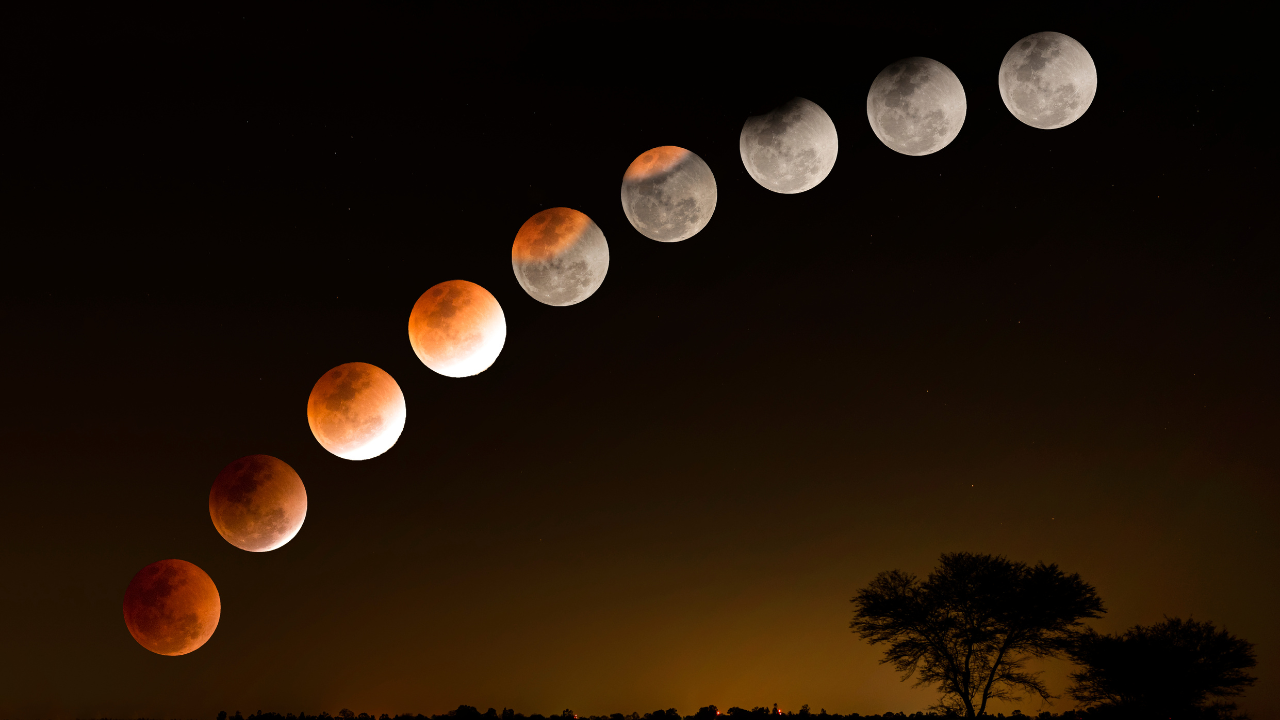
Partial Lunar Eclipse On August 27-28: Will India See The ‘Almost Blood Moon’?
- Authored by: Simran Sukhnani
- Updated Aug 23, 2026, 12:03 IST
The August 27-28, 2026 partial lunar eclipse will turn the Moon almost blood-red, but India will miss the spectacle. Here’s the timing, visibility, and where to watch.
Lunar Eclipse 2026 (Credits: Canva)
Skywatchers have another reason to look up this month. On the night of August 27 and into August 28, 2026, the Full Moon will pass through Earth’s shadow, creating one of the most dramatic lunar eclipses of the year. But there is a catch for Indian skywatchers: India will not get a view of the partial eclipse. The Partial Lunar Eclipse August 2026 is an unusually deep one, with the Moon coming remarkably close to a total eclipse. At maximum eclipse, around 93% of the Moon’s diameter will sit inside Earth’s darkest central shadow, known as the umbra, according to NASA. About 96.2% of the Moon’s area will be covered by the umbra.
That is why the event may look like an ‘almost Blood Moon.’ The covered portion of the lunar surface can take on a rusty or coppery tint as sunlight filtered through Earth’s atmosphere reaches the Moon. However, it is important to note that this is not a total lunar eclipse. A small section of the Moon will remain outside the darkest part of Earth’s shadow.
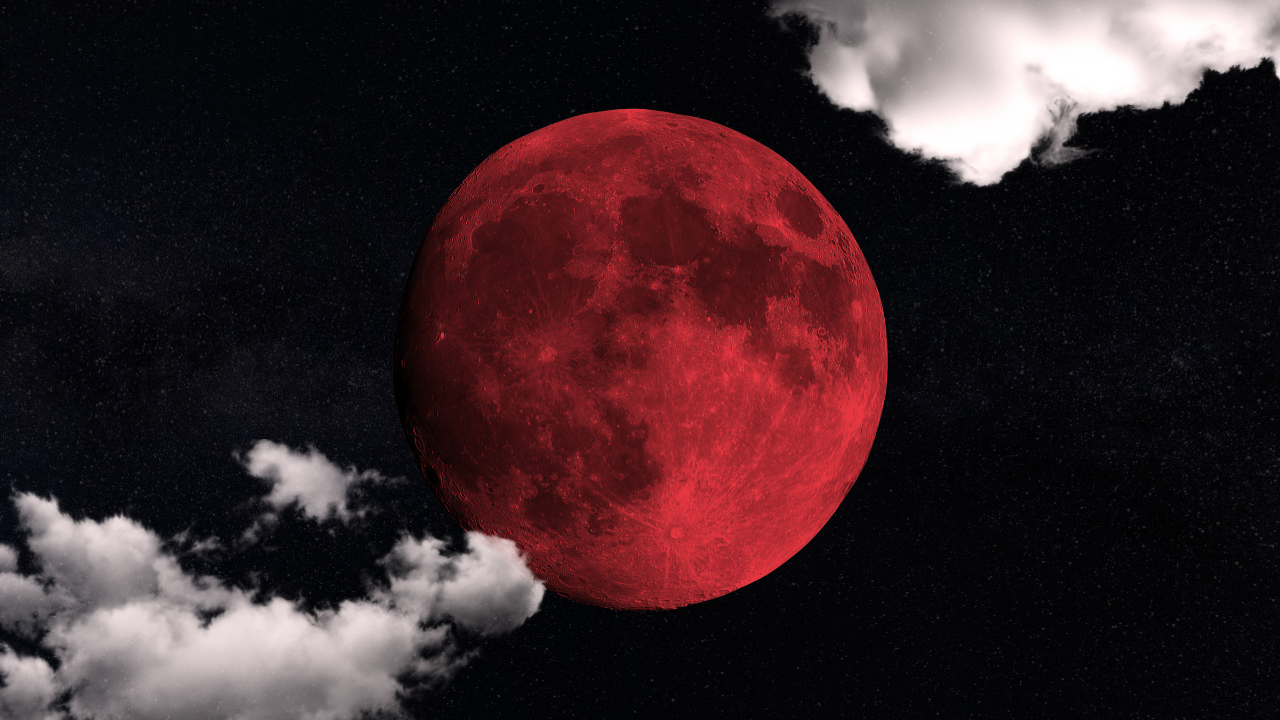
Blood moon (Credits: Canva)
Lunar Eclipse 27-28 August 2026: What Time Will It Happen?
The eclipse begins on August 28 at 1:23 am UTC, when the Moon enters Earth’s penumbral shadow. The more noticeable partial phase begins at 2:33 am UTC, with maximum eclipse occurring at 4:12 am UTC. The partial phase ends at 5:51 am UTC, while the entire penumbral event concludes at 7:01 am UTC. The partial phase itself lasts about 3 hours and 18 minutes.
Because the event stretches across different time zones, it falls on August 27 evening in some parts of the world and August 28 in others. This is why the Chandra Grahan 2026 Date and Time can appear differently depending on where you are watching from.
Where Will The Partial Lunar Eclipse Be Visible?
The Lunar Eclipse Visibility Map covers a huge portion of the globe. NASA says the eclipse will be visible from much of North and South America and parts of Europe and Africa. The regions that will be able to view it include parts of western Asia, the Pacific, Atlantic and Indian oceans, as well as Antarctica.
Major cities from which at least part of the eclipse can be seen include New York, Washington DC, Mexico City, Havana, Lima, Rio de Janeiro, Buenos Aires, London, Paris, Madrid, Rome, Lisbon, Casablanca and Johannesburg. Exactly how much of the eclipse is visible depends on the Moon’s position above the horizon at the time.
Will India See The August 2026 Lunar Eclipse?
Lunar eclipse (Credits: Canva)
For those searching ‘Where to Watch Lunar Eclipse 2026,’ India is unfortunately not on the list for this particular event. The Moon’s position and the timing of the eclipse mean the partial phase will not be visible from India. So, if you are hoping to step outside in Delhi, Mumbai, Bengaluru or another Indian city to see the Moon turn dramatically dark and coppery, this is one sky show you will have to watch through live streams or footage from regions where the eclipse is visible.
The good news is that lunar eclipses are completely safe to observe with the naked eye. Unlike solar eclipses, there is no need for special protective glasses. Binoculars or a small telescope can make the changing shadow on the lunar surface even more striking.
The Partial Moon Eclipse 2026 is particularly interesting because it comes so close to totality. For observers in the right parts of the world, it will briefly transform an ordinary Full Moon into something much stranger: almost entirely swallowed by Earth’s shadow, with only a sliver escaping the darkness.
Latest News


Simran covers books that start conversations, beauty insights, fashion moods, and stories that make people feel something. Off duty? You’ll find her c… View More
Original source: https://www.timesnownews.com/lifestyle