EXCLUSIVE: Paddy Upton Turns To Digital Twin AI To Break Language Barrier Before 2026 World Cup
- Written by: Rishav Narang
- Updated Aug 10, 2026, 13:47 IST
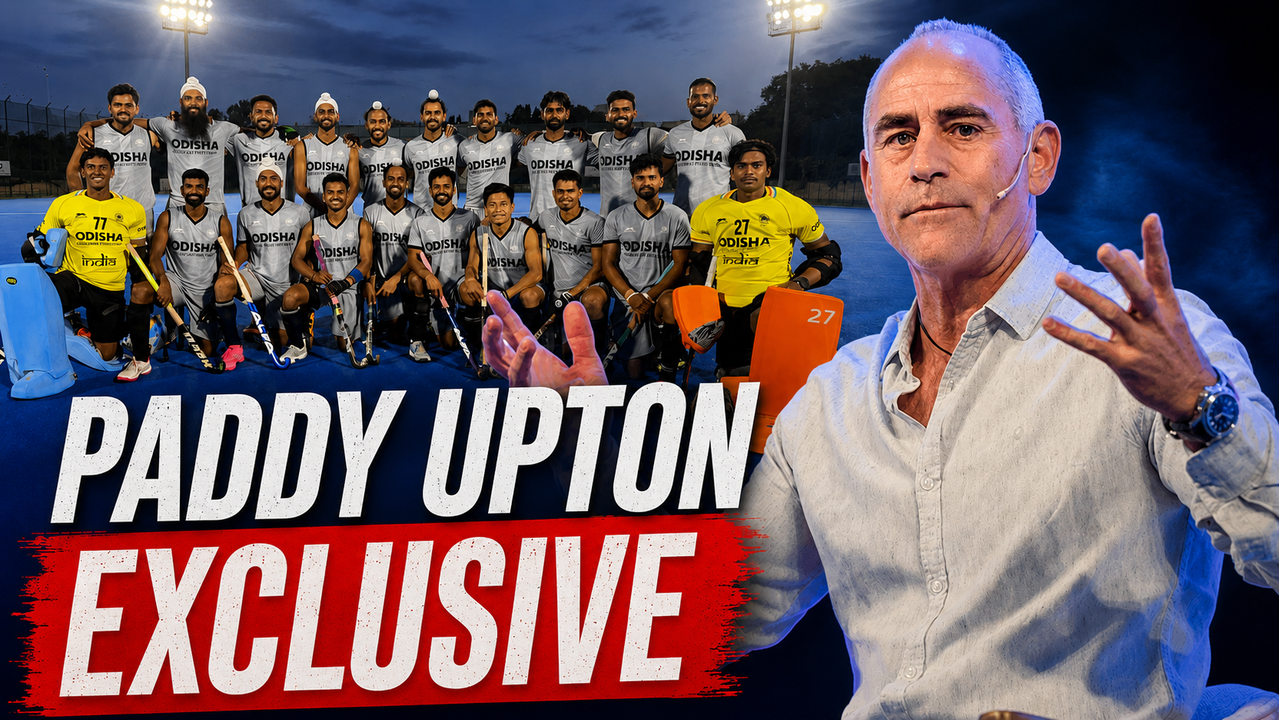
In a first for India, veteran coach Paddy Upton has turned to a digital twin AI to break the language barrier before the 2026 World Cup. Sports Now caught up with Upton, who is working with the hockey team again.
Paddy Upton has developed an AI twin model. Photo: ChatGPT
Team India is leaving no stone unturned in its bid to end its 51-year drought to win a Hockey World Cup. Back in 1975, Ajit Pal Singh’s team defeated Pakistan in the final to lift the trophy. While India have won a gold at the Olympics after 1975 (in 1980), a World Cup title win continues to elude them. With an aim to end India’s below-par run at the WCs, Paddy Upton, India hockey team’s mental conditioning coach, has gone a step further and developed a digital twin AI model of himself.
Upton, who is working as India’s mental conditioning coach, has broken the language barrier by developing the AI twin model which can communicate with the players in Hindi. In an exclusive conversation with Sports Now, Upton opened up about the AI model, his extensive experience of working in India and much more. Excerpts:
Sports Now: Can you tell details about the Digital Twin AI model you have developed to help players during the World Cup?
Upton: The initial thinking for building it was the fact that I wanted to be able to communicate with players in Hindi for those who don’t have strong English. And also to be available to all 20 players 24/7 on tour, and even when I’m not with the team.
It’s been trained—it’s not just a general AI that’s been trained like, for example, ChatGPT or Gemini or Claude on anything that’s on the internet. This has been trained only on my work, my approach, my philosophy, and my way of working. And I’ve even trained it to speak exactly like me over the last four months working with, you know, over about 600 athletes over this time.
So, yeah, the idea, and it’s again, making use of the technology that is available for us. I don’t think there’s any sports team in the world that’ll have a digital mental coach trained specifically for that purpose.
So that’s really what we’ve done. We’re just—we’re trialling it for the first time now with the team. All players are engaging with it. And the nice thing is that I have access to—and the players know that—to see and track all of the conversations they’re having. So, essentially, what we’ll be doing is using an in-person plus AI approach, so a hybrid approach. And the players are obviously free to choose whatever works best for them, but, you know, we want to just make maximum use of the technology available to us to get every advantage we can, including now in this mental space.
Sports Now: Can the AI model also communicate in languages other than English?
Upton: At this stage, we’ve set it up to communicate in Hindi and English. But it would be easy enough to be able to get it to try to speak in any language. But for now, the need within this team is only English and Hindi. But if I need it to speak in another language—Urdu or whatever it might be—it would probably take 24 hours to be able to set that up now with our abilities and capabilities around AI.
Sports Now: Paddy, you have a special connection with India, right from cricket and the IPL to badminton and chess. How has your relationship with India been?
Upton: I think when I joined the cricket team for the first time in 2008, I would never have been able to predict that I would be so involved, you know, now, what is it, 18 years later, through so many different sports, and also through, you know, a significant number of businesses, everything from big corporates to a lot of the startups and scale-up businesses.
So, India over that 18 years has, without a doubt, become my second home. And primarily because of how warmly welcomed I am each time I arrive at a new team or in a new environment in India, and also the amount of time I’ve spent there. So, it’s been a real gift to be able to have—to have been invited as a guest to now the Indian hockey party or the Indian cricket party. I still see myself as, you know, a very grateful, but still invited guest.
Sports Now: And having worked with cricketers and hockey players, what is the biggest difference between the two that you have found?
Upton: The two biggest differences—and there are, there’s a lot of similarities, but the two biggest differences are probably that hockey is such a physical game, that the players need to be really physically fit. And to get physically fit is a mental game. To be able to do the kind of training in the heat in Bangalore, to get fit, you’ve got to push your body beyond where it really wants to go. You’ve really got to move into uncomfortable territory from strength, speed, the amount of training, endurance. So when somebody is training their body for fitness, they’re training their mind as well, because the mind is normally the barrier to getting super fit. The body can always push longer, but it’s working with the mind to actually train to those levels of discomfort and keep going.
So, hockey requires that level of fitness, where cricket, you can certainly get away—you can succeed at the highest level without being that fit. Obviously, being super fit like someone like a Virat Kohli helps you at that level be even better.
And the other big difference between cricket and hockey is how much hockey players need to rely on their teammates, rely on connecting in groups with the whole team, whereas cricket is much more of an individual sport played within a team context.

Paddy Upton worked with Gukesh in 2024. Photo: FIDE
Sports Now: You have worked with the Indian cricket team, won the 2011 World Cup, with the hockey team, the Olympic bronze in Paris, and with Gukesh, the World Championship title. There must be, as a coach, there must be a satisfaction level attached to each of these achievements as part of the team or the player’s coaching staff. How do you rate each of those achievements of yours, having helped the teams or the players?
Upton: So, it’s interesting. I don’t often say this, but winning a big tournament like that, there is a huge satisfaction, but I would say there’s an equal amount of relief. Because when you’re preparing a champion individual like Gukesh or a champion team for a big tournament, you prepare to win. And that’s—so when we do win, there is an element of relief, because we had prepared for this moment. This is what we had hoped for, this is what we had expected, or we put in the effort.
I’ve always said that if you win a big tournament and you’re surprised, it means you haven’t done your work. So, I would say, you know, some of the highest moments of my life was certainly the 2011 Cricket World Cup, winning that for the first time in 28 years in Mumbai, in front of the home crowd, in Sachin Tendulkar’s—in front of Sachin’s home crowd in his last and final World Cup. So that was huge.
Right after there would be Gukesh’s win, although Gukesh’s win was so different, because the 2011 World Cup win, we could see from a few overs out that this was going to happen. But with Gukesh, it happened right in the dying moments when the game was all but a draw, the 14 games a draw, and all expectations were that they would come back the next day for a sudden-death playoff, and there was a sudden mistake by Ding. So that was—it was a different journey to the top.
But the huge part of also with Gukesh’s win was the fact that I’d never met him in person. I probably had, I don’t know, 30-40 conversations lasting an hour to an hour and a half, sometimes two hours with him, but I only ever met him in person 10 minutes after winning the World Championship. So there was something hugely special about that.
And the other—one of the highest moments of my life was the courage, the fight, the spirit, the heart, the character that I witnessed with the Indian team when they beat Great Britain in the quarterfinal, playing 47 minutes with 10 versus 11 against a team that we hadn’t beaten for four years in an Olympic knockout game. That was one of the most incredible sporting events I’ve ever been part of. And yes, that wasn’t the bronze medal winning match, but that was a—one of the most defining moments I’ve ever been part of in my life. You know, it reduced me to tears of pride and joy, as did Gukesh’s win, and as did the 2011 World Cup, but I would say my tears flowed for longer after that quarterfinal win, just because of the size of the fight that the team had to put up to literally rewrite history and defy all odds. It just showed remarkable character.
Sports Now: Paddy, you have been associated with Indian sports for 18 years, as you mentioned. Do you feel, having cricket being almost a religion in India, followed the most, do you think you as a coach come under a bit of pressure when it comes to working in cricket compared to other sports?
Upton: For me personally, no. Because pressure is just a concept that we create for ourselves in our own head. And we do that by how desperate we are for success. And having done this work for so long, while everything we do is working towards success, what’s so important is to be—to place all the value in the process, and evaluate the process, take confidence from the process, because if you do that well enough over time, you end up winning.
But it’s the attachment to winning or the fear of losing that creates so many of the mental struggles that actually hold people back in those moments. So for me personally, I don’t feel the pressure because that’s—I do feel some pressure, but not any more pressure in any environment, because at the end of the day, I put the pressure on myself.

Paddy Upton worked with India during the Paris Olympics. Photo: AP
Sports Now: You are with the team now for the World Cup. You have been with the boys during the Paris Olympics and in the Asia Cup in Rajgir as well. How firmly do you believe in this team rewriting history once again, having won a World Cup 51 years ago?
Upton: So, you know, going into this is, you know, and it’s not the first time I’ve had this experience, knowing that there’s probably five or six teams that could make the final. And even teams that make the semifinal and the final, on any given day, one team can beat the other team. So while we have prepared to be able to win this tournament, we know that there’s five or six other teams who have also equally prepared, who are also equally hungry.
And at the end of the road, one thing that’s not spoken about, I think nearly as much as what it deserves, is the influence of luck. Particularly in a game like hockey. Someone takes a shot at goal on a penalty corner to win a game, and it might hit the defender’s stick and go into the goal, or it might just hit their stick and get deflected out of the goal. It might hit someone’s foot for a PC retake, or it might go past their foot and the defender saves it. That isn’t a skill piece, that’s a luck piece.
And very often, you know, in these big tournaments, the team that wins is the team that is best prepared and has that little bit of extra luck on their side in the key moments. So, are we well enough prepared to win this World Cup? Yes. It’s just a case of now, can we show up and deliver on our preparation, and in those key moments, it will remain to be seen which side of the luck equation we fall on.
And if we’re lucky, no one will say we’re lucky. They’ll say we were really good and we had great strategy. And if we don’t win, it sounds like sour grapes to say we were unlucky. But I know, and I can tell you, that generally the team that wins is the final best prepared and has luck on their side.
Latest News


Rishav Narang is an experienced writer with nine years of experience in sports journalism. He extensively writes on cricket and covers live matches, b… View More
Original source: https://www.timesnownews.com/sports