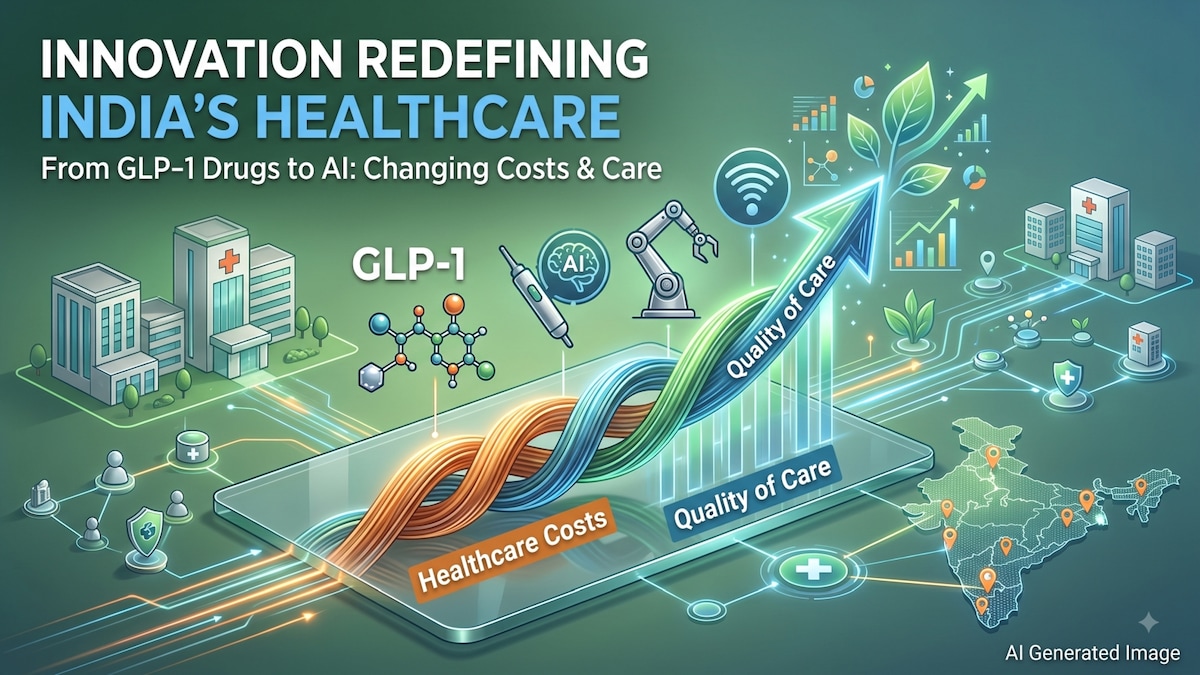
India’s next healthcare boom may not be about building more hospitals
India’s healthcare market could approach ₹12 lakh crore by 2030, but new drugs, AI, outpatient care and prevention could change where patients are treated — and where the industry makes money.
That could have a significant impact on the economics of the healthcare sector.
India’s healthcare market, estimated at around ₹7 lakh crore, is projected to reach nearly ₹12 lakh crore by 2030. Private hospitals are expected to remain a major part of organised healthcare delivery, while the sector has attracted nearly $11 billion in private equity investment since 2021.
But the next phase of growth could look different from the one that followed the pandemic. Instead of being driven primarily by more beds, hospitals and physical infrastructure, healthcare demand could increasingly be shaped by what new drugs and technologies can prevent, diagnose and treat — and where that treatment takes place.
GLP-1 drugs could change the disease burden
The rapid emergence of GLP-1 drugs is one of the clearest examples of how medical innovation could eventually affect healthcare economics.
Originally developed to treat diabetes, GLP-1-based medicines have gained widespread attention for their ability to help with weight loss and obesity. Their implications could extend well beyond the pharmaceutical industry if wider use reduces the incidence or severity of diseases associated with obesity and metabolic disorders.
Dr B S Ajaikumar, Founder and Chairman of Healthcare Global Enterprises (HCG), believes the impact could be substantial.
“GLP-1 drugs are really revolutionary drugs. They are going to change the disease pattern in the next 10 years,” Ajaikumar told CNBC-TV18 in an exclusive conversation at the Market Forum event.
He pointed to diabetes, cardiovascular disease and even Alzheimer’s as areas where the treatment landscape could evolve significantly.
The economic implication is important. If some chronic diseases can be prevented, delayed or better managed before they become severe, the demand for certain forms of hospital care could change.
That does not necessarily mean hospitals will see less demand overall. Instead, the mix of demand could shift — from treating advanced disease towards early diagnosis, prevention, nutrition, chronic disease management and longevity.
For healthcare providers, that could mean a different revenue pool over time.
More healthcare could move outside the hospital
The same shift is already visible in the way treatment is delivered.
Hospitals have traditionally depended heavily on inpatient admissions, bed occupancy, procedures and revenue generated from occupied beds. But minimally invasive procedures, better diagnostics, drug therapies and remote monitoring are allowing an increasing amount of care to happen without a prolonged hospital stay.
This creates a potentially important change in hospital economics.
If a procedure that once required several days of hospitalisation can be performed on an outpatient basis, the patient may pay less and the hospital may generate less revenue per episode. But the hospital can potentially treat more patients using the same infrastructure.
That changes the question from simply how much revenue a hospital generates per bed to how efficiently it can manage the entire patient journey.
Ajaikumar expects this transition to become more visible as technology improves and healthcare delivery expands into tier-two and tier-three cities.
He also sees the potential for technology and domestic manufacturing to bring down costs. The emergence of India-made MRI machines and other diagnostic equipment, along with the wider availability of generic medicines, could make certain forms of healthcare more affordable.
“The cost could come down, particularly when we go to tier-two, tier-three cities,” he said.
For hospital investors, this matters because average revenue per occupied bed, or ARPOB, is an important indicator of hospital performance. If more treatment shifts to outpatient settings, ARPOB alone may become a less complete measure of growth.
The larger opportunity could be to deliver more care, to more patients, at a lower cost per episode.
Cancer care shows why innovation can cut both ways
Oncology illustrates another part of the equation.
Newer treatments, including immunotherapy, have expanded the options available to cancer patients. But innovation can initially make treatment more expensive rather than cheaper.
The eventual impact depends on what happens next.
As therapies become more widely used, competition increases and domestic manufacturing expands, the cost of certain treatments can fall. At the same time, better diagnosis and more targeted therapies can change how much treatment a patient needs and when it is delivered.
For hospitals, therefore, the economic impact of innovation cannot be judged simply by looking at the price of a new drug or technology today.
The more important question is whether it changes the entire treatment pathway — including diagnosis, duration of treatment, hospitalisation, manpower requirements and outcomes.
That distinction is particularly important in India, where affordability remains a major constraint on access to healthcare.
Insurance could determine how much of this growth India can absorb
Medical innovation can change what healthcare costs, but financing determines who can afford it.
India continues to have a fragmented healthcare financing system, with a large section of the population lacking comprehensive health insurance coverage.
Vishal Bali, Executive Chairman of Asia Healthcare Holdings, pointed to the fragmented nature of India’s third-party payer system and the relatively limited penetration of health insurance compared with the country’s population.
Bali said around 570 million people are covered through some form of health insurance, leaving a substantial population without meaningful financial protection against healthcare expenses.
The distinction is important because expanding hospital capacity does not automatically translate into greater access.
A new hospital can add beds, install advanced equipment and hire specialists. But if patients cannot afford the treatment, that capacity cannot be fully utilised.
Insurance expansion can therefore have a multiplier effect on the healthcare industry. Greater financial protection can increase patients’ ability to seek treatment, which can raise utilisation, support investment and create demand for additional capacity.
But it can also create another challenge: if healthcare costs continue to rise faster than incomes, simply expanding insurance coverage may not be enough.
Why insurance alone may not solve affordability
That is where the debate moves beyond insurance.
Ajaikumar believes the most direct way to reduce the financial burden on individuals would be to move towards universal healthcare.
His proposal involves a system without restrictive limits on eligible procedures and treatments, funded partly through a healthcare cess.
The proposal is ambitious, but it highlights a fundamental problem in India’s healthcare model: expanding the market and making healthcare affordable are not necessarily the same thing.
Kaivaan Movdawalla, Sector Leader & Partner, Healthcare at EY Parthenon, argues that insurance by itself cannot solve the problem.
“Insurance is an essential condition, but not a sufficient condition for universal healthcare,” he said.
The missing piece is efficiency — ensuring that the healthcare system delivers better outcomes without allowing costs to rise unchecked.
“Quality without affordability is fraud, and affordability without quality is farce,” Movdawalla said.
That balance could become increasingly important as new and often expensive technologies enter the healthcare system.
If innovation improves outcomes but pushes treatment beyond the reach of large parts of the population, its benefits will remain limited. Conversely, aggressive cost-cutting that compromises quality would undermine the purpose of expanding access.
Private capital is moving beyond hospitals
This is also changing the role of private equity in healthcare.
The first major wave of institutional capital was closely associated with building scale, acquiring hospitals and expanding organised healthcare networks. The opportunity today is broader.
Bali said capital is increasingly being deployed across medical technology, hospital back-end systems and artificial intelligence.
“That capital, which is coming in, is being deployed across the spectrum,” Bali said.
The distinction matters because some of the biggest changes in healthcare may not require another hospital building.
An AI system that reduces administrative work, a diagnostic technology that allows earlier detection, or a medical device that lowers the cost of a procedure can potentially affect the economics of an entire healthcare pathway.
Ajaikumar said private capital is also moving deeper into the startup ecosystem, including early- and mid-stage healthcare companies.
That means investors are increasingly looking beyond the traditional question of how many hospitals or beds a particular investment can add.
They also have to ask which technologies can reduce costs, improve utilisation, expand access or fundamentally alter the way care is delivered.
AI could change the economics across the healthcare chain
Artificial intelligence is the next major test of that thesis.
AI is already being discussed across healthcare, but the investment case will ultimately depend on whether the technology produces measurable economic and clinical benefits.
For hospitals, potential applications range from administrative automation and scheduling to diagnostics, clinical decision support, patient monitoring and personalised treatment.
Some of these applications could reduce the amount of manual work required to run a hospital. Others could help doctors process larger volumes of information or identify disease earlier.
But AI will not automatically translate into lower healthcare costs.
Hospitals still have to invest in technology, data infrastructure, cybersecurity and skilled personnel. The economic benefit will depend on whether those investments produce enough improvement in productivity, utilisation, accuracy or outcomes to justify the cost.
That is why AI is potentially different from traditional hospital infrastructure.
A new hospital adds capacity in a particular location. AI has the potential to change how capacity is used across the healthcare value chain.
The next healthcare opportunity may look different
India’s healthcare sector will continue to benefit from structural drivers such as rising incomes, an ageing population, increasing insurance coverage and the shift from unorganised to organised healthcare.
Private hospitals will remain an important part of that growth.
But the definition of healthcare demand could gradually change.
A patient who once required several days of hospitalisation could increasingly be treated as an outpatient. A chronic disease that previously required years of management could potentially be prevented or delayed through better medicines and lifestyle interventions. A diagnostic process that required considerable manpower could increasingly be supported by AI. And a treatment that was once prohibitively expensive could become more affordable as competition, domestic manufacturing and scale bring costs down.
For investors and hospital operators, that means the next phase of healthcare growth may not be measured simply by the number of beds added or hospitals acquired.
It may increasingly be measured by how much better care can be delivered, to how many more people, and at what cost.
That is the central economic test for India’s healthcare sector. Innovation will create the biggest impact not when it simply introduces another expensive technology, but when it can improve outcomes, expand access and make quality healthcare more affordable.
Original source: https://www.cnbctv18.com/technology/