Anthropic tests Claude to design protein binders for drug research, here’s how it turned out
Anthropic said the experiments show how Claude can accelerate research in the life sciences by reducing the time and expertise required for certain scientific tasks.
“Many drugs work by binding to a specific target in the body and blocking or changing what it does. An important first step in the drug development process is designing a molecule that can bind tightly to its target. Traditionally, that’s meant weeks or months of expert work per target, sifting through a large number of candidates to identify the few that work,” it wrote on X.
Many drugs work by binding to a specific target in the body and blocking or changing what it does. An important first step in the drug development process is designing a molecule that can bind tightly to its target. Traditionally, that’s meant weeks or months of expert work per… pic.twitter.com/CGCNTNaKBq
— Anthropic (@AnthropicAI) August 18, 2026
The Dario Amodei-led firm said it worked with Adaptyv Bio and Twist Bioscience, which independently produced and tested Claude’s protein designs.
Claude designed 1,320 proteins
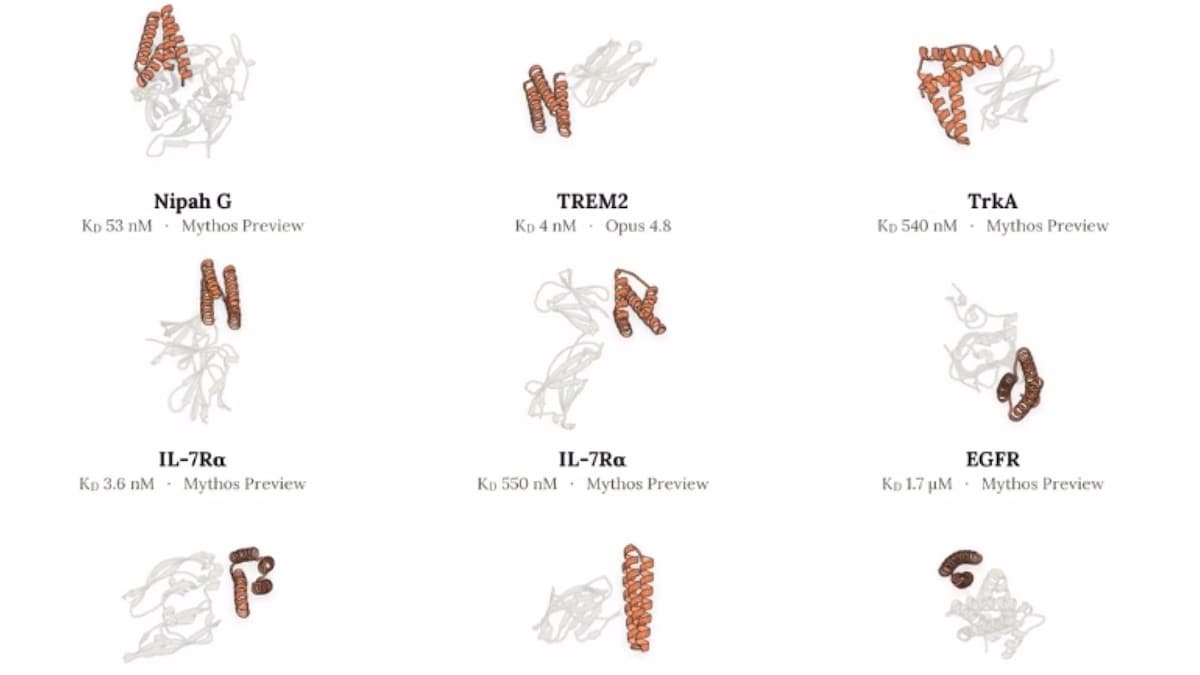
Anthropic said the experiment involved Claude Opus 4.8 and Mythos Preview, which were asked to design 30 protein binders for each of the 15 targets.
The models produced 1,320 designs in total, of which 354 binders were confirmed against 14 targets. The company said the experiment was conducted with minimal human involvement after the initial instructions were provided.
Claude selected potential binding sites, generated protein structures and sequences, ran optimisation cycles and screened candidates using specialist protein-design and co-folding models.
Higher hit rates than typical campaigns
Anthropic reported overall hit rates of 22.6% for Opus 4.8 and 26.7% for Mythos Preview when the models worked on all targets simultaneously.
When Mythos Preview focused on individual targets in separate sessions, its overall hit rate increased to 35.1%. Anthropic compared these results with the 10-15% hit rate it says is typical of protein-design campaigns today.
Claude outperformed competition results on one target
One of the experiments focused on RBX1, a target used in Adaptyv Bio’s protein-design competitions.
Anthropic said Mythos Preview achieved a 40% hit rate in single-target mode, compared with 3.7% among competition participants. Its top-ranked design also reportedly showed stronger binding than the winning design from that competition.
Claude also successfully designed binders for TNFα, a signalling protein involved in inflammation. Anthropic said Opus 4.8 designed multiple TNFα binders, including some that could bind human, cynomolgus monkey and mouse TNFα.
But the model also had limits
The experiment was not successful across every target. Anthropic said Claude struggled particularly with maltose-binding protein (MBP), where none of the 90 designs was confirmed to bind, although one showed a weak and reproducible binding signal.
The company also said the model had limited success with BBF-14, a β-barrel-shaped protein that does not exist in nature. Anthropic noted that designing a high-affinity protein binder is only the first step towards generating a drug-like molecule.
Claude also analysed chemistry data
The company also tested Claude on NMR and LC-MS data, which chemists use to analyse the structure and purity of compounds. Given raw files from a contract laboratory and a short prompt, Claude processed the NMR and LC-MS data in 23 and 19 minutes, respectively.
Its results closely matched the laboratory’s analysis, including a measured purity of 96.4% compared with 96.33% from the lab.
Anthropic says AI could speed up drug research
Anthropic said the two experiments show how AI could reduce the time, expertise and cost involved in parts of scientific research. However, the company also acknowledged the dual-use risks of increasingly autonomous biological research. It said “protein design and other dual-use research biology capabilities” remain restricted from general access while Anthropic works to provide them safely through trusted access programmes.
Anthropic said it views the work as foundational and is extending Claude’s capabilities towards running the drug-development process end-to-end across different drug modalities.
Original source: https://www.cnbctv18.com/technology/