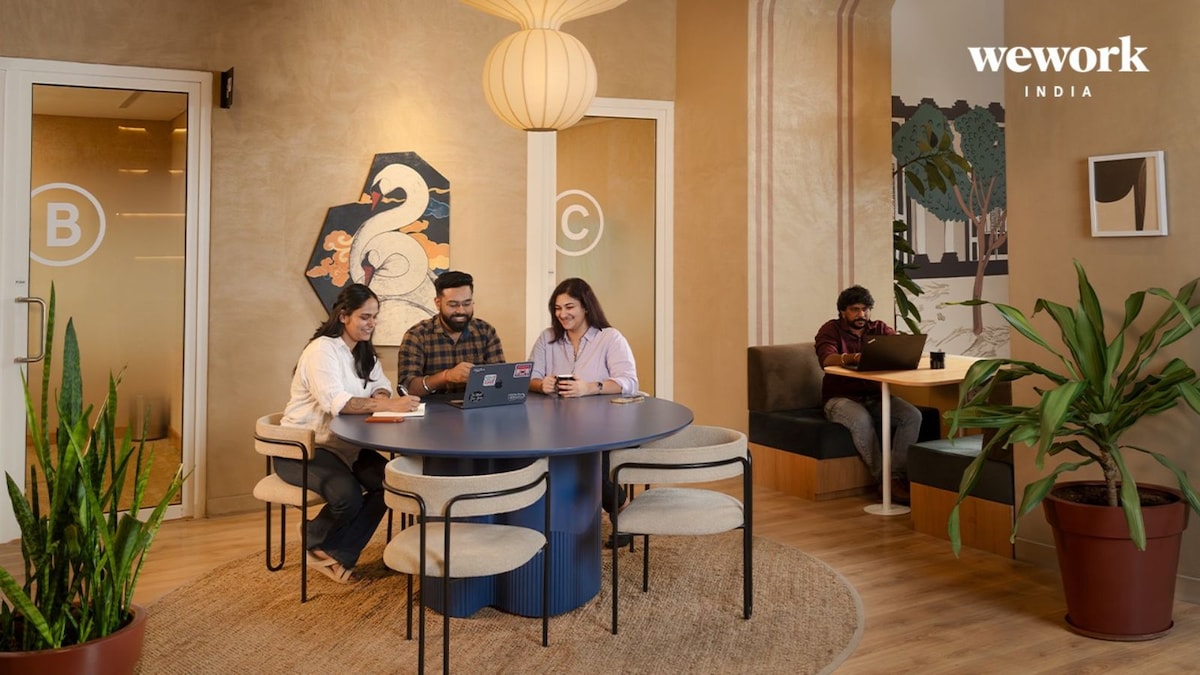
AI has changed enterprise strategy. Now it’s changing workplace strategy: Karan Virwani, MD & CEO, WeWork India
AI has already transformed enterprise strategy. Workplace strategy is now catching up. The organisations that will lead over the next decade will not necessarily be those with the largest real estate portfolios, but those whose workplaces give them the speed, agility and resilience to keep pace with continuous change.
Artificial intelligence is no longer a future trend for which businesses are preparing. It is already reshaping how enterprises invest, innovate and compete. Across boardrooms, conversations have moved beyond AI adoption to questions of execution: How do we build AI capabilities? Where do we invest? Which skills do we need? How do we organise teams for a business environment that is evolving faster than ever before?
The End of the Old Workplace Planning Model
One consequence of these decisions, however, receives far less attention. AI has fundamentally changed workplace strategy. For decades, workplace planning followed a familiar formula. Organisations forecast headcount, leased office space accordingly and expected those decisions to hold for years. That model worked when business priorities evolved gradually and organisational structures remained relatively stable.
That assumption no longer holds. AI has accelerated the pace at which businesses launch new products, enter new markets, redesign functions and build entirely new capabilities. Planning cycles are getting shorter, hiring priorities are shifting more frequently and teams are becoming increasingly fluid. The challenge for enterprises is no longer simply accommodating growth; it is building organisations that can continuously adapt.
Every one of those decisions eventually becomes a workplace decision. How quickly can a new AI team be brought together? How fast can an organisation establish operations in a new city? Can a business expand, consolidate or reorganise without waiting months for real estate to catch up? Increasingly, these questions have become just as important as location or rental economics. This is why workplace strategy has moved much closer to the centre of enterprise strategy.
What the Data Shows: Uncertainty as the New Normal
Our recent study with Redseer Strategy Consultants, AI and the Future of Workspaces in India, found that 95% of Indian enterprises expect AI adoption to accelerate over the next 18 to 24 months, while AI hiring has grown sixfold since 2019. Yet perhaps the more important finding was that organisations increasingly acknowledge they cannot predict with certainty how their workforce will evolve over the next few years.
The uncertainty is not about whether AI will create or eliminate jobs. It is about how quickly roles will change, which new capabilities will emerge and how organisations should structure themselves to remain competitive. That uncertainty changes how businesses think about real estate. Traditional office strategies were designed for stability. AI demands adaptability. This is one of the reasons flexible workspaces have become an increasingly important part of enterprise workplace portfolios. Not because organisations want less office space, but because they need workplace strategies that can evolve alongside their business strategies.
For enterprises building AI capabilities, speed has become a competitive advantage. They need to onboard specialised talent quickly, create new cross-functional teams, establish innovation hubs, launch GCCs and expand into new markets without being constrained by infrastructure decisions made years earlier.
The Workplace as an Operating Lever
The workplace has become an operating lever rather than a fixed asset. That shift extends well beyond technology companies. Banks are embedding AI across customer experience and risk management. Manufacturers are digitising operations and supply chains. Healthcare organisations are applying AI to diagnostics and patient care. Professional services firms are redesigning delivery models around intelligent automation.
While these industries may appear very different, they increasingly face the same strategic challenge: how to build organisations that can respond continuously to technological change. The workplace is becoming one of the tools that enables that agility. India’s GCC ecosystem reflects this evolution particularly well. As more global organisations establish AI, engineering, product and digital capability centres in India, they are looking beyond conventional leasing models. They need workplaces that allow them to launch quickly, scale rapidly and adjust as business priorities evolve. Increasingly, flexibility is becoming part of long-term portfolio strategy rather than a temporary solution.
The Office as a Hub for Collective Productivity
AI is also changing what organisations expect the office itself to do. As intelligent systems automate routine work, employees are spending less time on repetitive execution and more time solving complex problems, making decisions and collaborating across functions. The value of bringing people together has therefore shifted. The modern office is becoming less about individual productivity and more about collective productivity. That is influencing everything from workplace design to technology infrastructure. Meeting rooms are evolving into collaboration and decision-making environments. Offices are being designed to support faster knowledge-sharing across multidisciplinary teams. Digital experiences, smart booking systems and workplace analytics are helping organisations understand how space is actually being used and continuously optimise it.
In many ways, workplaces are beginning to operate with the same principles that underpin AI itself: using data to learn, adapt and improve over time. The economics of workplace strategy are evolving too. As enterprises continue investing heavily in AI infrastructure, cloud platforms and specialised talent, capital allocation is coming under greater scrutiny. Every investment is increasingly evaluated based on how much strategic flexibility it creates.
Real estate is no exception. Businesses are looking for workplace models that allow them to direct more capital towards innovation while retaining the ability to expand or reconfigure as opportunities emerge. They are also becoming more deliberate about with whom they can partner. Our research found that 84% of enterprises prefer working with a single workplace provider capable of delivering consistent experience across locations, while nearly three-quarters consider multi-city capability an important requirement. At the same time, close to nine in ten enterprises believe workplace quality has become increasingly important in attracting AI and digital talent.
From Workplace Metrics to Business Outcomes
These are not simply workplace preferences. They are strategic business decisions. For years, discussions around offices centred on utilisation, occupancy and cost. Those metrics remain important, but they are no longer sufficient. The more important question today is whether a workplace helps an organisation execute its business strategy faster. That is the conversation enterprises are increasingly having.
AI has already transformed enterprise strategy. Workplace strategy is now catching up. The organisations that will lead over the next decade will not necessarily be those with the largest real estate portfolios, but those whose workplaces give them the speed, agility and resilience to keep pace with continuous change. In the AI era, the workplace is no longer just where strategy is implemented. It is becoming one of the ways strategy is executed.
Disclaimer: This is an Brand connect as part of a marketing initiative. This has no editorial input, or editorial involvement. No CNBC TV18 journalist was involved in writing, researching or editing this article. Views and opinions expressed, and ideas discussed are solely those of WeWork India, the originating organization and do not reflect the opinions, views or beliefs of the website or its affiliates.
Original source: https://www.cnbctv18.com/technology/