
How will AI impact jobs in India? Goldman Sachs economist explains
Santanu Sengupta, Chief India Economist at Goldman Sachs explains why artificial intelligence (AI) could lift India’s productivity despite job risks, with only 8-12% of jobs facing substitution.

Goldman Sachs estimates that only 9-17% of tasks performed by India’s non-agricultural workforce are exposed to generative AI.
More importantly, only 8-12% of jobs face a risk of substitution, while around 45% could benefit from AI through complementarity or augmentation. “Our main point is about 9 to 17% is the task exposure to AI. That does not translate into jobs, though,” Sengupta said.
The remaining 40-45% of jobs are expected to be largely unaffected. Manual and physical work, including much of construction, is relatively less exposed to generative AI.
Agricultural employment was not included in the analysis, although Sengupta said AI could potentially provide productivity benefits in the sector.
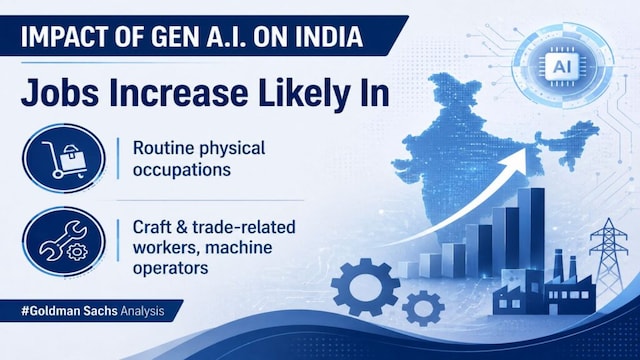
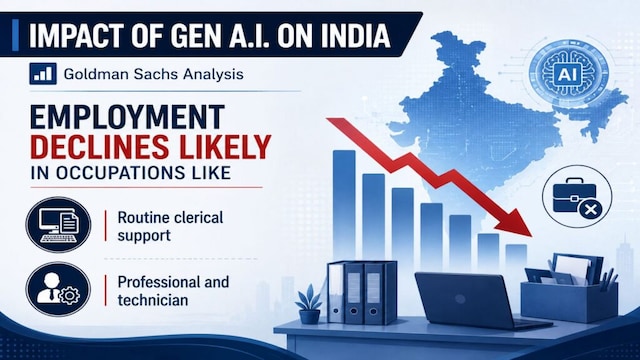
The biggest risk is likely to be in repeatable and codifiable work. Low-end IT jobs could face substitutions, while similar risks could emerge in parts of media and financial services. At the same time, AI could augment work in knowledge-intensive sectors such as healthcare, education, media and selected financial services.
Sengupta said India’s IT sector needs to be viewed in the context of its relatively small share of overall employment. IT and Global Capability Centers (GCCs) together account for only around 2% of India’s non-agricultural workforce.
While the top six IT companies have cut around 64,000 jobs from a base of 1.7 million since 2022-23 (FY23), the rest of the tech sector has added around 0.7 million jobs, taking employment to about 4.4 million.
The bigger opportunity, therefore, could come from productivity and the creation of new businesses rather than simply increasing employment in the technology sector. Sengupta compared the potential AI cycle with India’s earlier digitalisation, when the spread of mobile internet helped create the platform economy.
“Similarly, we feel that if you’re able to adopt and sequence the adoption properly… you will have a large employment effect,” he said. The key, he added, is to ensure that AI diffuses across the economy at a relatively low cost.
However, India will need to address infrastructure constraints for that to happen. The growth of data centres will bring higher requirements for electricity, cooling and water. With the economy already growing at around 6.5-7% in real terms, Sengupta said the additional power demand from AI could become significant and solving the power equation will be important.
Another risk could come from rising protectionism in overseas markets. Sengupta said if restrictions that have affected goods exports spread to services, India’s services export model could face greater pressure. AI itself, he argued, could allow India to generate more services export revenue with fewer people.
India’s large talent pool remains a key advantage in this transition. Sengupta said the continued expansion of global capability centres in India, even as AI adoption accelerates, shows that companies still value the country’s supply of skilled talent.
Watch the full conversation here

“The adoption of AI, again, I want to be clear, is still adding the dollars, probably with lesser number of people,” Sengupta said. For India, the larger opportunity may therefore lie in using AI to raise productivity across the economy while managing the uneven impact on jobs.
Catch all the latest updates from the stock market here
Original source: https://www.cnbctv18.com/technology/