Anand Vihar To Sarai Kale Khan: Delhi To Bring Metro, Rail & Bus Services At 3 Major Hubs – What To Expect
- Edited by: Mansi Arora
- Updated Aug 15, 2026, 22:02 IST
Delhi is planning to establish integrated transport hubs at crucial transit locations, including Anand Vihar-Karkardooma, Kashmere Gate, and Nizamuddin-Sarai Kale Khan, as part of the Master Plan of Delhi 2047.
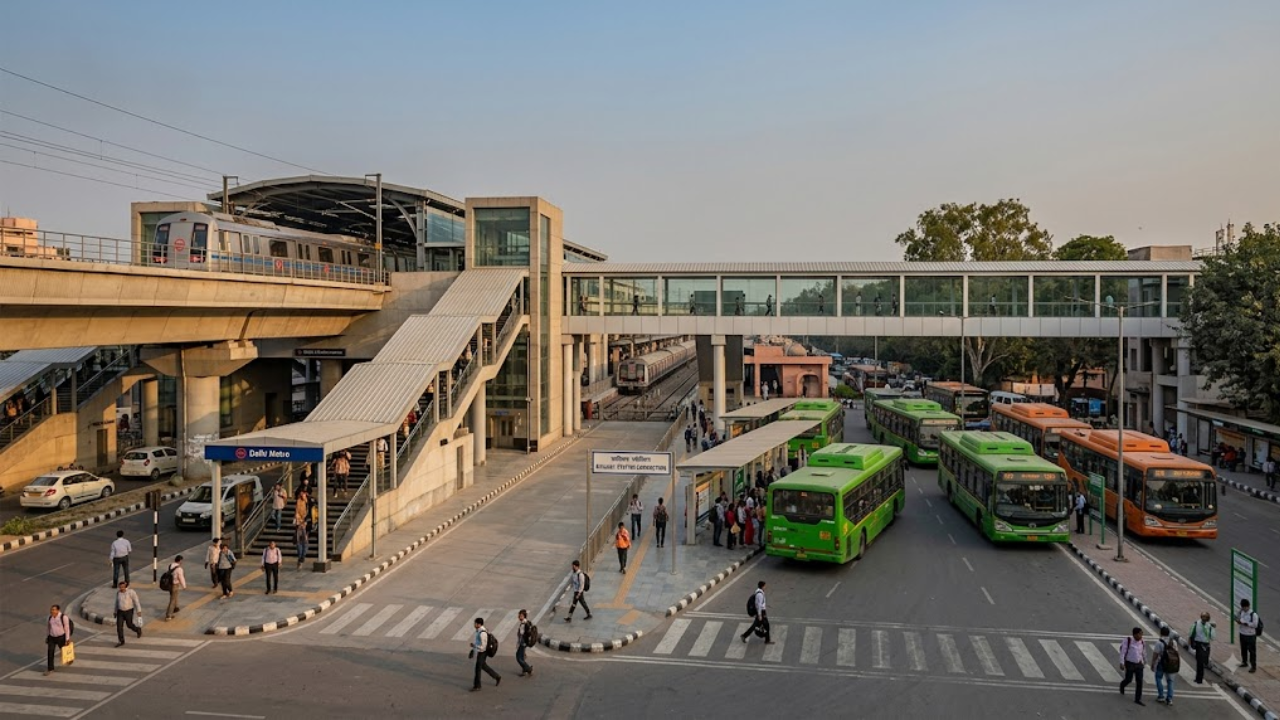
Delhi To Bring Metro, Rail & Bus Services At 3 Major Hubs (AI-image)
Delhi is set to get integrated transport hubs at key transit points, with Anand Vihar-Karkardooma, Kashmere Gate and Nizamuddin-Sarai Kale Khan identified for development as Multi-Modal Transport Hubs (MMTHs). The proposal is part of the Master Plan of Delhi 2047 (MPD 2047) and aims to bring different modes of public transport closer together, making daily commuting and last-mile connectivity easier.
The proposed hubs will integrate Metro, buses, railways, para-transit and non-motorised transport in a coordinated system. The idea is to allow commuters to switch between different modes of transport at one location instead of making separate or long transfers.
What Are Multi-Modal Transport Hubs?
Under the draft MPD, high-footfall transit points will be developed as integrated hubs where multiple modes of transport are available in close proximity. Transit agencies will jointly prepare plans for developing these hubs and may combine their land to bring different transport facilities within the same building or complex.
Where separate land parcels are divided by roads or railway tracks, they can be connected through skywalks, pedestrian bridges or subways, subject to the required approvals.
The hubs are also expected to include multi-level interchange facilities and active public spaces, including retail areas, cultural spaces and facilities designed to improve pedestrian movement and public interaction.
What Will Change For Delhi Commuters?
The biggest benefit is expected to be easier interchange between different modes of transport. For instance, commuters travelling by train could have smoother access to Metro or bus services without having to navigate disconnected transport points.
The plan also focuses on improving last-mile connectivity, while pedestrian-friendly infrastructure such as skywalks and subways could make movement between different parts of a transit hub safer and more convenient.
The government also plans to use Intelligent Transport Systems (ITS) and AI-based passenger and traffic management systems. These technologies are expected to help integrate transport data, improve enforcement and manage the movement of passengers and vehicles more efficiently.
More Areas May Be Added
The three identified locations are not necessarily the only areas that will get such facilities. According to the draft plan, additional high-footfall transit locations may also be identified for the development of MMTHs.
The plan also proposes linking Transit Oriented Development (TOD) projects within a 500-metre radius of an MMTH with the overall hub plan. This means future development around these major transport nodes will have to take the integrated transport system into account.
If implemented as planned, the MMTH model could make Delhi’s major transit points more connected, pedestrian-friendly and easier to navigate for commuters using multiple modes of transport.
Latest News


Ardent news writer with a keen eye for global affairs and geopolitical news. With passion for illuminating the complexities of global dynamics, Mansi … View More
Original source: https://www.timesnownews.com/delhi