AI compute power can be traded like a commodity soon
A weekly look at the ideas, technologies and money shaping the next phase of AI.

Happy Independence Day.
Until a few weeks ago, the arrival of AI was seen as a moment of reckoning for India that lagged behind the world’s superpowers in cutting-edge technology. That narrative has started to shift now, as the world’s largest democracy turns 80. Pivoting to the AI age at 80 may be overwhelming for any person. It’s not a lot for a country, especially one like India where the median age is still less than 30.
But it’s not just India that’s coming of age. AI, too, is. Nvidia founder Jensen Huang is projecting it not just as a technology, but as an asset class—or, more accurately, several of them. And Wall Street is ready to buy it.

Nvidia has unveiled agreements with BlackRock, Blackstone, Apollo, KKR, Brookfield and Goldman Sachs to assemble a $500 billion pipeline to finance data centres and GPU clusters. There’s more coming.
A futures market for compute power
Silicon Data, the market data firm that builds indices traders bet on, has raised $30.5 million from investors including Samsung and the Valour Atreides AI Fund. Along with the Chicago-based CME Group, Silicon Data plans to launch two Compute futures contracts on October 5, subject to regulatory review.
In plain English, businesses could soon trade contracts based on the future cost of the computing power used to train and run AI models.
Read that again: we may soon have a regulated futures market for the cost of running AI.
That sounds like a niche piece of financial engineering. I think it tells us something much bigger about how far the AI boom has come.
“For years, two companies buying the exact same GPU capacity could pay wildly different prices with no way to know who got the better deal. They will now have a benchmark to check that against,” Carmen Li, Chief Executive Officer of Silicon Data, said.
Think about oil. An airline knows it will need enormous quantities of jet fuel months from now, but it doesn’t know what that fuel will cost. So it can hedge against prices rising. AI companies increasingly have a similar problem. Their fuel is compute.
Training and running increasingly sophisticated models requires enormous quantities of GPU capacity. If that capacity becomes more expensive, building AI does too. A compute futures market would let companies manage that risk rather than simply accept whatever price the market throws at them.
CME calls compute “the currency of the AI age.” That sounds like marketing until you realise we’re now discussing derivatives based on its price.

Oil did it. Metals did it. Electricity did it. Now compute is starting down the same road.
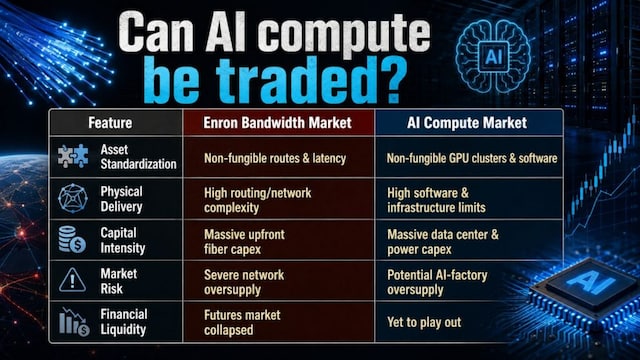
It’s important to remember that this isn’t the first time something like this has been tried. During the dot-com boom, Enron set out to build a bandwidth exchange, betting that fibre optic capacity could be traded seamlessly via futures contracts. It eventually failed.
Some unanswered questions
A megabit between New York and Chicago was never identical to one between London and Frankfurt. Similarly, an H100 cluster is not equivalent to a B200 setup, nor is a CUDA-native environment comparable to non-CUDA hardware. Latency, interconnect bandwidth (e.g., NVLink vs. Ethernet), and software optimisation prevent liquidity from concentrating into uniform contracts.
However, one can argue that if the goal is to discover a benchmark price. Carbon credits get traded despite the differences between coal and methane.
Once it matures, compute futures can replace the need for upfront capital. A startup can simply raise money to build its core product rather than spend precious capital on expensive chips. However, whether the market will mature to that point remains to be seen.
Idle oil doesn’t depreciate; chips do
Oil doesn’t depreciate while sitting underground. Extraction, storage, and transportation costs may go up or down. Demand and supply may fluctuate, but what oil or coal can do doesn’t change. That’s not true for chips.
“We know that these GPUs depreciate on only a five- or six-year schedule,” Paul Meeks, head of technology research at Freedom Capital Markets, told CNBC. “Even within technology, it’s an emerging market where we don’t get the final scorecard until probably years from now.”
In technology, obsolescence is a bigger depreciating factor than wear and tear. But if Nvidia can check supply, even if the next-generation chips are better, the existing inventory would be worth a lot more.
Will all roads lead the money to 2788 San Tomas Expressway, Santa Clara, California, USA— the Nvidia HQ?
The attempt is to make compute look like a neutral infrastructure asset, but the underlying market remains unusually concentrated. Nvidia is nearly 90% of the chip market. A handful of US hyperscalers control the largest share of data centres worldwide.
In other commodity markets, whether it’s oil, steel, or power, there are several spokes. Even the infamous diamond market, the biggest player controls only about a quarter of the global supply.
In technology, obsolescence is a bigger depreciating factor than wear and tear. But if Nvidia can check supply, even if the next-generation chips, the existing inventory would be worth a lot more.
Nvidia will want compute prices to rise, while the rest of the world will want it to go down and, preferably, cost as much as the internet. But when one company, i.e., Nvidia, has enormous influence over chip supply, networking, the software stack (CUDA), system architecture, and the upgrade cycle, will there be efficient price discovery? Wall Street seems to believe it’s possible.

While we wait for answers in India…
For India, the emergence of a market for compute comes at a time when the country is rapidly expanding its digital infrastructure. According to the Ministry of Electronics and Information Technology (MeitY), March 13, India’s total data centre capacity has risen from about 375 MW in 2020 to around 1,500 MW in 2025.
The country is also building out dedicated AI compute capacity. About 38,231 GPUs have been onboarded through 14 empanelled service providers and data centres under the IndiaAI compute capacity framework.
The infrastructure is spread across major data-centre hubs including Mumbai, Navi Mumbai, Hyderabad, Bengaluru, Noida and Jamnagar. This growing footprint opens up a significant opportunity for India.
If compute eventually develops a transparent benchmark and a liquid market around its price, India’s expanding data-centre infrastructure could give startups and enterprises another way to manage one of the biggest costs of the AI era.
Small-scale developers gain the exact same processing agility as Western hyperscalers without having to stake monstrous amounts of capital.
Indian IT services giants like TCS, Infosys, and Tech Mahindra can use compute derivatives to lock in data processing costs for multi-year enterprise client projects.
Large enterprises can rent out their idle capacity in the spot market and turn a depreciating capital expense into a liquid revenue stream.
For India, then, the AI opportunity may ultimately come down to more than building the next breakthrough model. It may depend on building enough affordable, flexible compute — and doing it fast enough to ensure that the country is not just a consumer of the AI age, but a meaningful participant in the market that powers it. The opportunity is large, but so is the competition.
Happy Independence Day, Happy Reading, and Stay Ahead of the Curve!

Original source: https://www.cnbctv18.com/technology/