Indian IT needs to spend more on R&D and tap startups to win in the AI era, says Fractal CEO
Srikanth Velamakanni wants IT firms to invest 1-2% of revenue in R&D and work with startups to build new capabilities rather than simply acquiring rivals for scale.
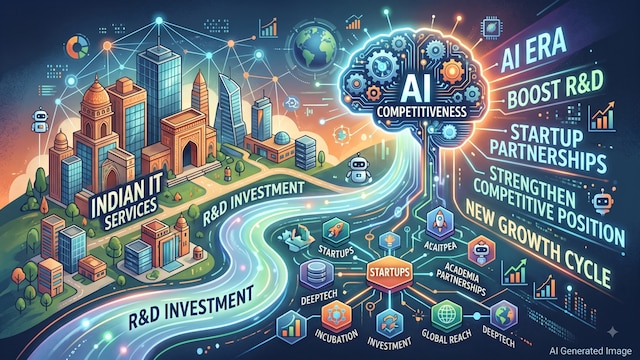
Velamakanni said large technology companies should look beyond traditional consolidation and use startups to access new technology and innovation, while investing more in R&D to build capabilities for the next phase of growth.
“The Indian IT services industry has to work more effectively with startups, whether incubate them, invest in them, take them to the world,” Velamakanni said during a discussion hosted by NASSCOM and CNBC-TV18.
He said established IT companies could give startups access to global clients and help take their technology to international markets.
Startups can strengthen Indian IT’s ‘right to win’
Velamakanni said the industry needs to focus on its “right to win” as AI changes the technology landscape.
Rather than acquiring companies primarily to add scale or revenue, large IT services firms should selectively invest in smaller technology companies with capabilities that can strengthen their position in emerging areas, he said.
“Instead of just consolidating another player similar to your size and then just adding to revenues, it will significantly add their right to win,” Velamakanni said.
He pointed to the global pharmaceutical industry, where large companies often work with startups that develop new drugs and technologies before scaling them commercially.
“I don’t think the Indian tech industry has figured that out yet,” he said.
NASSCOM President Rajesh Nambiar said the industry already has programmes that bring larger organisations and startups together, citing initiatives such as InnoTrek.
InnoTrek is a NASSCOM initiative to help Indian DeepTech startups accelerate international expansion and strengthen their presence in global innovation ecosystems.
For Indian IT services companies, deeper engagement with startups could provide access to capabilities that may take longer to develop internally.
R&D spending needs to rise
Velamakanni also called for higher R&D spending, saying both India and the technology industry need to invest more if they want to build globally competitive capabilities.
He said India spends about 0.7% of GDP on R&D, while the Indian technology industry spends around 0.5%.
The industry should eventually move towards spending around 1-2% of revenue on R&D, he said.
“There is no excuse,” Velamakanni said, arguing that India needs to raise R&D spending significantly from current levels.
Nambiar agreed that R&D spending remains a weakness for India and the technology sector.
He said Indian IT services companies have historically spent less on R&D than required, although they are increasingly recognising the need to invest in intellectual property and innovation.
However, Nambiar said R&D in the services industry should not be viewed only through the traditional product-development lens.
For IT services companies, innovation can also come from combining technology with industry expertise and the enterprise knowledge accumulated through decades of working with global corporations.
AI marks the next technology cycle
Velamakanni said the need to increase investment in innovation has become more urgent because the technology industry is entering a new growth cycle driven by AI.
The previous S-curve, built around technologies such as cloud and social platforms, is approaching saturation, while AI represents the next major technology cycle, he said.
“2026 is just the beginning,” Velamakanni said, pointing to the rapid improvement in AI models and their ability to perform increasingly complex tasks.
He said the impact of AI would extend beyond conventional technology budgets because companies could increasingly use technology to address areas of work that were previously dependent on human labour.
Tech budgets are already rising, Velamakanni said, but the larger opportunity could come from AI’s impact on wider corporate spending.
That could significantly expand the addressable market for technology companies beyond traditional IT services.
AI could reshape careers
The transition will also change the nature of work, Velamakanni said.
AI could reduce the amount of human labour required for some existing tasks while simultaneously creating new work as lower technology costs make it possible to tackle previously uneconomic problems.
“The world has an infinite number of problems to be solved, and therefore work will expand,” he said.
He said people entering the workforce should prepare for multiple careers rather than expect to follow a single profession throughout their working lives.
Velamakanni also urged young people to consider entrepreneurship as AI reduces the amount of capital required to build and operate businesses.
“Anybody who’s smart right now should think of becoming an entrepreneur,” he said.
For Indian IT services companies, Velamakanni’s message is that the AI transition requires investment in the capabilities that can drive the next phase of growth — not simply consolidation of existing businesses.
Original source: https://www.cnbctv18.com/technology/