
From selling manpower to selling intelligence: How AI is changing Indian IT
AI is pushing Indian IT away from selling human effort towards intelligence and outcomes, opening a huge opportunity for companies that can successfully make the transition.
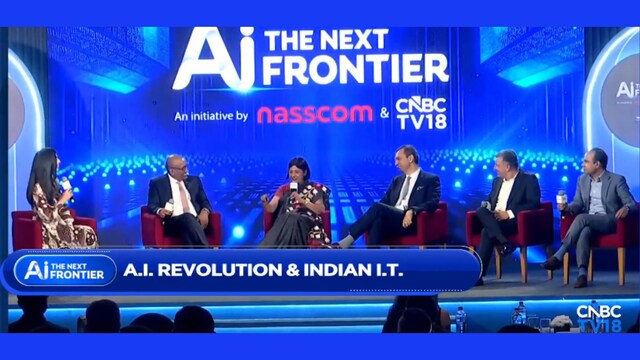
The industry faces a structural shift from selling human effort towards selling intelligence, outcomes and enterprise-specific AI solutions. While the transition is creating anxiety around growth and jobs, industry leaders see a potential $300-400 billion opportunity by 2030.
The challenge is to ensure Indian IT is positioned to capture it.
Indian IT services companies have lost around ₹15 lakh crore in market capitalisation from their 2024 peak, even as order books remain strong. NASSCOM President Rajesh Nambiar said the market had yet to fully price in the opportunity emerging from AI.
“Indian IT abhi zinda hai,” Nambiar said, arguing that individual companies, rather than the industry as a whole, would need to make the necessary pivot.
From effort to intelligence
Amit Kapur, Chief Officer of AI & Services Transformation at TCS, said the industry was moving from an era defined by “effort” to one defined by “intelligence”.
AI is changing the way services are delivered, with humans and AI agents increasingly working together. That could eventually shift pricing from effort-based models towards output and outcome-based models.
The change is already beginning to show up in company numbers. TCS ended the June 2026 quarter with an annualised AI revenue run rate of $2.6 billion, up 13.6% sequentially, compared with 2.2% quarter-on-quarter growth in overall revenue.
For Srikanth Velamakanni, Co-founder and Group CEO of Fractal, AI represents the next technology “S-curve” after the previous cycle driven by technologies such as cloud and digital.
“Companies like these have to reinvent themselves to be relevant in the new S-curve,” he said.
Fractal’s June-quarter results underline the stronger growth seen in AI-focused businesses, with revenue from operations rising 20% year-on-year to ₹912.5 crore and net profit jumping 92% to ₹72.3 crore.
Also read: AI could eventually outperform doctors in key medical decisions, JAMA paper says
India’s AI advantage
The panel argued that India’s biggest opportunity may not be in building frontier AI models, but in making those models work for enterprises.
Microsoft India and South Asia President Puneet Chandok described frontier models as “brilliant strangers” — highly capable systems that do not necessarily understand an individual company’s processes, data and institutional knowledge.
Indian IT companies can bridge that gap through enterprise context, domain expertise, data, process redesign and AI orchestration.
“The transition from this brilliant stranger to a familiar friend has to be done by the Indian IT services companies,” Chandok said.
That could become India’s “right to win” in the AI era, with services companies acting as the layer between frontier models and large enterprises.
From AI pilots to P&L
The industry is also moving into a more demanding phase of adoption.
Chandok described 2024 as the year of AI demonstrations, 2025 as the year of pilots and 2026 as the year of the P&L.
Companies are increasingly demanding measurable returns from AI rather than simply experimenting with the technology.
Arundhati Bhattacharya, President and CEO of Salesforce, said enterprises were moving from pilots towards production-ready solutions and becoming more selective about use cases.
But she cautioned that AI cannot simply be placed on top of inefficient legacy processes. Companies need to redesign and automate workflows to unlock meaningful gains.
Salesforce’s own strategy highlights the disruption. The company said its AI offerings had crossed a $1 billion annualised revenue run rate in May, while it has also been restructuring its workforce around its AI push.
Also read: Meta’s next trial may end in $1.4 trillion in damages
R&D and talent
For Indian IT, the transformation will also require greater investment in R&D and intellectual property.
Nambiar acknowledged that R&D spending remains low across India and the technology-services industry. Velamakanni said companies should invest more in modern R&D and work more closely with startups, including through incubation and acquisitions.
The workforce will also have to evolve.
Nambiar expects Indian IT to remain a net job creator, but said the pace of employee growth seen in previous cycles will not return. New roles around AI orchestration, enterprise engineering and other AI capabilities will emerge, while education and training will need to adapt.
The panel’s message was ultimately less about AI replacing Indian IT than about AI forcing it to become a different industry.
The traditional model of scaling people to deliver technology services is giving way to one built around AI, enterprise context, outcomes, platforms and intellectual property.
The opportunity may be much larger than the market Indian IT has traditionally served. But the companies that capture it will be those that reinvent themselves fastest.
Original source: https://www.cnbctv18.com/technology/

