US-Canada Tariff War Explained: Why Trade Talks Collapsed and What Happens Next
- Edited by: Rounak Bagchi
- Updated Aug 23, 2026, 04:09 IST
The US has imposed 50% tariffs on $20 billion of Canadian goods, escalating a trade dispute after negotiations broke down. In response, Canada plans retaliatory tariffs on various sectors
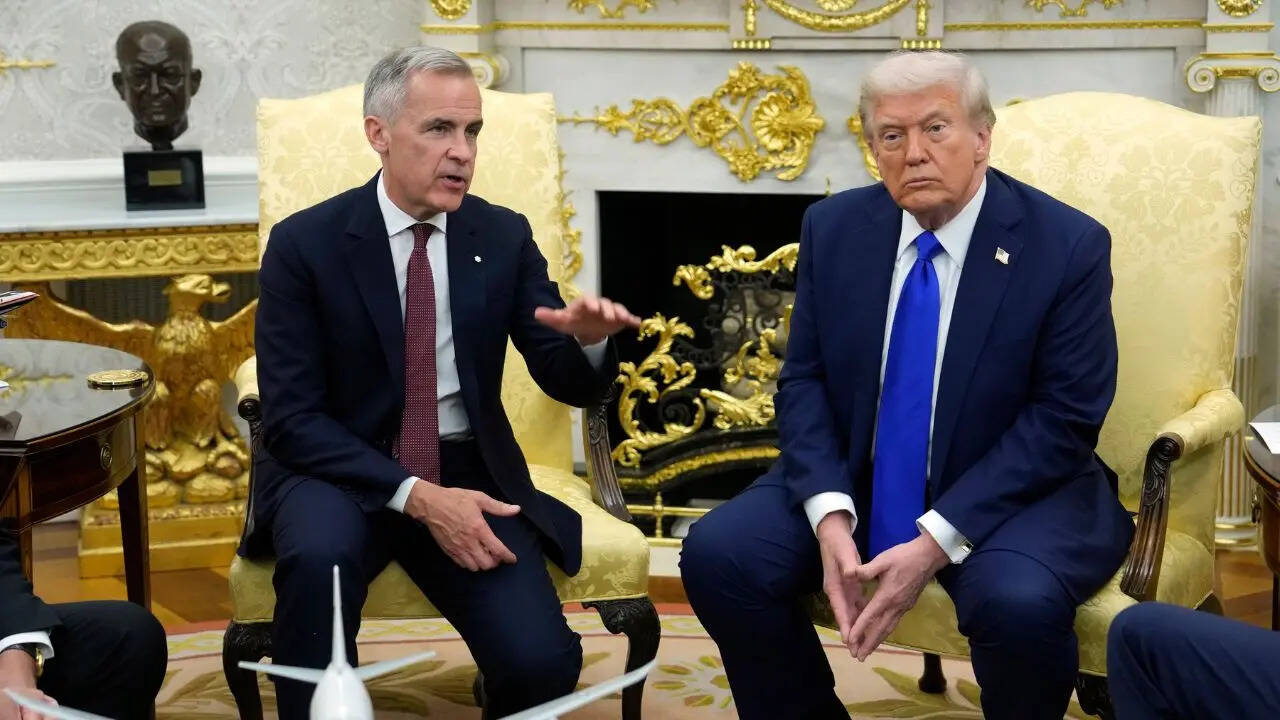
Canada Prime Minister Mark Carney and President Donald Trump during a press conference at the White House.
The United States on Saturday imposed 50% tariffs on $20bn of Canadian goods, escalating a trade dispute between the two long-standing allies after final talks to ease tensions broke down. Canada has also announced plans for retaliatory measures from September 8, with Prime Minister Mark Carney saying Ottawa would respond with tariffs targeting sectors including dairy, steel, household appliances, farming equipment, electronics and pulp and paper.
The new US duties affect about 5% of Canada’s annual exports to the US, covering products ranging from tongue depressors and hockey sticks to a wide range of industrial and consumer goods.
Speaking to Canadians in a televised 22-minute address from Ottawa, Carney said: “In the coming days, we will release the details of these new tariff measures, which will come into force the Tuesday after Labor Day.”
He said Canada had been prepared to remove its existing counter-tariffs on US aluminium, steel and motor vehicles if Washington significantly reduced its own duties.
Canadian provinces had also been encouraged to resume sales of American alcohol.
But Carney said the final US proposals were unacceptable. “They asked too much and offered too little,” he said. “We’ve recognized from the start that America has changed,” Carney added. “We recognize that sometimes, its signature is written in pencil.”
“We cannot accept what they offered and we will not give what they asked,” he said. “We were not prepared to compromise Canada’s sovereignty or undermine our key industries.” “You’re at war when you’re attacked, and we got attacked,” Carney said.
US Says Canada Rejected a Better Deal
Jamieson Greer, President Donald Trump’s chief trade negotiator, said Washington had offered to reduce tariffs on Canadian lumber, steel and automobiles. “We’re moving forward with measures that respond to Canadian retaliation,” Greer told Fox & Friends Weekend.
He said the US had offered concessions on areas that were “sensitive for them”. “And they’ve always had the best deal, and they still would have an even better deal, but they didn’t want that,” he added.
The US administration says its measures are designed to protect American workers and supply chains.
After months of negotiations, no further talks have currently been scheduled.
The breakdown came just two days after officials on both sides appeared close to reaching an agreement.
Canada Prepares Retaliation
Carney said Ottawa would “hit back” with targeted tariff measures designed to protect Canadian industries affected by the new US duties. Ontario Premier Doug Ford, whose province is Canada’s most populous, said he fully supported the government’s approach.
“The prime minister has my full support” for retaliation “tariff for tariff, dollar for dollar”, Ford said. “Everything needs to be on the table,” he added.
The dispute has also raised questions about the future of the US-Mexico-Canada Agreement (USMCA), the North American trade pact negotiated during Trump’s first term.
The three countries are due to consider renewing the agreement, but growing tensions between Washington and Ottawa have cast uncertainty over the process.
The dispute represents a significant deterioration in relations between the US and Canada, despite their deeply integrated economies and long history of political and military co-operation.
Trade in goods and services between the two countries reached about $880bn last year.
Canada shares a 5,525-mile border with the US, which remains largely unfortified. Nearly 330,000 people cross it each day, while about $2bn in trade crosses the border daily.
Around 800,000 Canadian citizens also live in the US. Canadian and American forces have fought alongside each other, including in Afghanistan following the 11 September attacks.
But Trump’s approach to Canada has marked a sharp departure from that history of close co-operation. His administration has used tariffs as part of an effort to encourage manufacturing in the US, while Trump has repeatedly suggested that Canada could become the 51st US state.
Carney said Canada had accepted that the relationship had fundamentally changed. “We will not return to our old relationship,” he said.
Economic Pressure Grows on Both Sides
The economic stakes are high for both countries. About 72% of Canada’s physical exports went to the US last year, making the American market crucial to the Canadian economy.
The tariffs could also affect American consumers because import duties are paid by US importers and can subsequently be passed on through higher prices.
The timing could prove politically sensitive for the Trump administration, with the US midterm elections approaching and voters already concerned about the cost of living.
Ryan Majerus, a partner at King & Spalding and former US trade official, said both governments would face pressure to find a way out of the dispute. “Canada likely wanted further sector-specific relief than the US was willing to offer, or Canada’s concessions did not go far enough,” he said. “Either way, I think both sides will be under immense pressure in the coming days to still find an off-ramp. But if Canada has agreed to also impose tariffs, the off-ramp may be even harder to find.”
Candace Laing, president and chief executive of the Canadian Chamber of Commerce, described the tariffs as “a body blow to North American competitiveness”. She warned that they would increase costs for American consumers while putting Canadian small businesses, investment and consumers at risk.
Trump Turns to a 1930 Tariff Law
The latest tariffs were imposed under Section 338 of the US Tariff Act of 1930, a law dating back to the Great Depression. It allows the US president to impose duties of up to 50% on imports from countries deemed to discriminate against US commercial interests.
The provision had not previously been used to impose tariffs. It does not require a formal investigation before tariffs are imposed and does not set a statutory limit on how long they can remain in place.
The law was introduced in the same period as the wider Smoot-Hawley tariffs, which are widely regarded by historians and economists as having contributed to the worsening of the Great Depression by restricting international trade.
The Trump administration turned to Section 338 after the Supreme Court ruled in February that the president had exceeded his legal authority when imposing previous broad tariffs under a declared national emergency over the US trade deficit.
That ruling invalidated those duties and opened the way for affected importers to seek refunds.
Latest News


Rounak is a journalist with over 7 years of experience covering geopolitical and international affairs. He has a keen interest in research and explain… View More
Video
Original source: https://www.timesnownews.com/latest-news