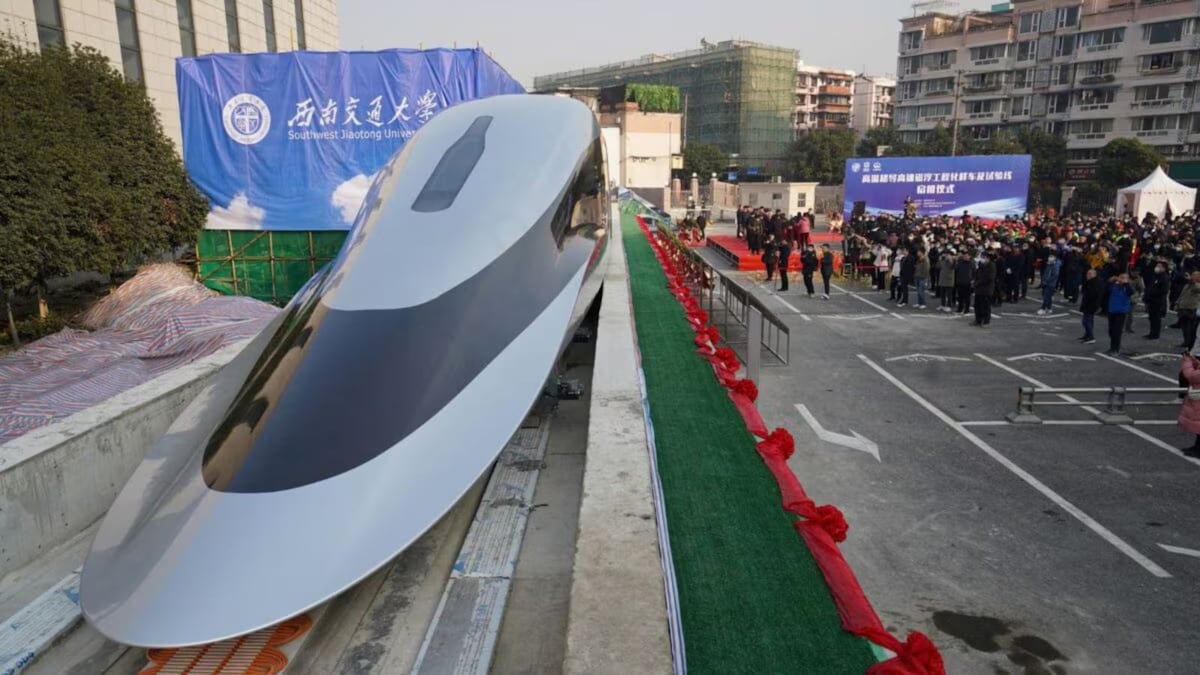
China’s Maglev test train hits record 800 kmph in just 5.3 seconds
The 1.1-tonne experimental maglev train accelerated from a standstill to 800 kmph before coming to a controlled stop over a distance of around 200 metres.
The 1.1-tonne experimental maglev train accelerated from a standstill to 800 kmph before coming to a controlled stop over a distance of around 200 metres. The test demonstrated not only its ability to reach extreme speeds but also its braking capabilities.
800 km/h in just 5.3 seconds!
China’s maglev test train just set another world record – and it did it without wheels.
The frictionless future is moving at full speed. #InnovativeChina pic.twitter.com/HPIhpsRage— Chinese Mission to UN (@Chinamission2un) August 11, 2026
How Does The Maglev Train Work?
Unlike conventional trains, maglev technology uses magnetic forces to lift the train above the track, reducing friction, according to a report in Independent. Coils along the track then generate a magnetic wave that pushes the train forward at high speed.
The latest test marked the third time in six months that the same experimental train has broken its own short-distance acceleration record. The train first reached around 650 kmph in seven seconds in June 2025.
It later improved the record by reaching about 700 kmph and then 798 kmph, while also cutting down the acceleration time.
Technology Tested At Extreme Speeds
During the trials, researchers pushed several key technologies, including high-power energy supply, electromagnetic propulsion, high-speed levitation control and emergency braking, to their limits, according to national broadcaster CCTV.
Maglev trains operating in China and Japan typically run at around 320 kmph, while China’s Fuxing maglev is the world’s fastest commercial maglev train, reaching speeds of up to 350 kmph.
Not Yet Designed For Passengers
China’s National University of Defence Technology is also experimenting with next-generation maglev systems, with one test reportedly reaching an acceleration of 697 kmph within two seconds.
For now, the technology is still at the experimental stage and is not intended for passenger travel. Researchers are studying whether the same principles could eventually be applied to rocket and fighter-jet launch systems.
Another area of research involves developing maglev trains that could travel through low-pressure or vacuum tubes. Turning these concepts into practical transportation, however, would require overcoming challenges such as the cost of building the infrastructure, passenger safety and the need for precise track alignment over long distances.
Original source: https://www.cnbctv18.com/technology/