The real-life story of Kargil hero Sqn Ldr Ajay Ahuja, portrayed by Siddharth in ‘Operation Safed Sagar’
More than two decades after Squadron Leader Ajay Ahuja risked his life to locate a downed fellow pilot, his bravery comes alive on screen in Netflix’s military drama Operation Safed Sagar, where actor Siddharth portrays the decorated fighter pilot.
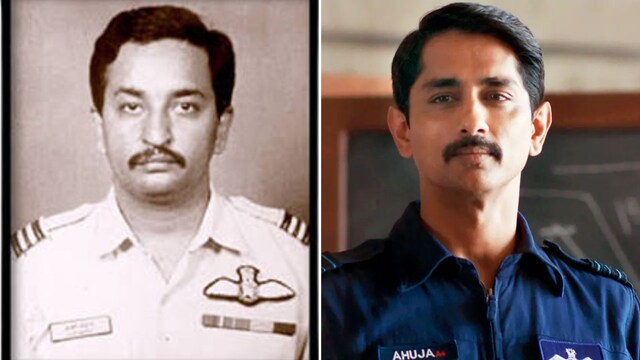
When war broke out in the frozen heights of Kargil in May 1999, those words became the defining truth of his life.
Today, more than two decades after he risked (and subsequently lost) his life to locate a downed fellow pilot, his bravery comes alive on screen in Netflix’s military drama Operation Safed Sagar, where actor Siddharth portrays the decorated fighter pilot.
Born on May 22, 1963, in Kota, Rajasthan, “Aj”—as his fellow officers called him—was defined by a steady, methodical devotion to the sky. A graduate of Saint Paul’s Senior Secondary School and the National Defence Academy, he was commissioned into the fighter stream on June 14, 1985. Over a 14-year career flying MiG-21 and MiG-23 aircraft, he logged more than 1,000 instructional hours.
By 1997, Ahuja was posted to the Bhisiana Air Force Station in Bathinda, Punjab, where he stepped into the role of Flight Commander for the No. 17 “Golden Arrows” Squadron. Specialised in high-altitude photo reconnaissance, the unit was thrust into the heart of Operation Safed Sagar when conflict erupted along the Line of Control, tasked with mapping heavily fortified enemy positions across the Batalik sector.
The mission parameters over Kargil were brutal. Ground intelligence was scarce, and Pakistani forces tucked into the sharp ridges were actively hunting Indian jets with shoulder-fired FIM-92 Stinger missiles.
On May 27, 1999, disaster struck during a routine reconnaissance run. Flight Lieutenant K. Nachiketa’s MiG-27 suffered a sudden engine flameout under fire, forcing him to eject into hostile, enemy-controlled territory below. With heavy anti-aircraft fire filling the valley, standard protocol and sheer self-preservation dictated that Ahuja turn his MiG-21MF around and return to safety.
Instead, he refused to retreat.
Also Read: ‘India’s Top Gun’ is Netflix’s most ambitious local production
Knowing full well that Pakistani ground troops were tracking the skies, Ahuja made the conscious choice to stay in the kill zone. He kept his aircraft circling over the jagged peaks, visually tracking Nachiketa’s point of fall and broadcasting exact coordinates back to base so rescue helicopters could vector into the crash site.
A Stinger missile struck his jet. Over the radio, Ahuja’s voice remained characteristically steady as he relayed his final transmission: “Hercules, something has hit my plane, possibility of missile hit cannot be ruled out, I am ejecting…”
Ahuja survived the high-altitude ejection, coming down on the wrong side of the Line of Control with a fractured knee sustained upon impact on the rocky terrain. He was alive on the ground when Pakistani troops reached him.
What followed was a gross violation of the Geneva Conventions governing Prisoners of War that sparked severe diplomatic outrage. Ahuja was captured, subjected to brutal torture, and executed in captivity. When the 10th Battalion of the Garhwal Rifles recovered his body the next day, a post-mortem revealed two fatal, point-blank gunshot wounds to his head and chest.
Flight Lieutenant Nachiketa, the man Ahuja refused to abandon in the mountains, survived his captivity and was repatriated eight days later.
Squadron Leader Ajay Ahuja became the first Indian Air Force officer to lay down his life during the Kargil War. On August 15, 1999, India’s 52nd Independence Day, he was posthumously awarded the Vir Chakra, one of the nation’s highest wartime gallantry honours.
Original source: https://www.cnbctv18.com/entertainment/