House Of The Dragon Season 3 Finale Vs The Book: Every Major Change Explained
- Authored by: Girish Shukla
- Updated Aug 11, 2026, 14:37 IST
House of the Dragon’s Season 3 finale rewrites ‘Fire & Blood’ in major ways, reshaping Tumbleton, Helaena, Rhaenyra, Alicent, Daemon and the war’s most consequential betrayals for television audiences everywhere.
House Of The Dragon Season 3 Finale Changes Fire & Blood More Than You Think (Picture Credit – HBO)
There is a peculiar pleasure in watching ‘House of the Dragon’ when you already know ‘Fire & Blood’. You recognise the destination, but increasingly, you cannot be certain which road the series will take to reach it.
George RR Martin’s book gives HBO unusual freedom because it is written as a fictional history assembled from conflicting accounts. Events are disputed, motives are uncertain and even supposedly factual moments can have several versions. Season 3 has taken full advantage of that uncertainty. Yet by the finale, ‘The Treasons of Tumbleton’, the adaptation is no longer simply choosing between Martin’s narrators. It is moving characters, combining events, inventing confrontations and fundamentally changing why some of the Dance of the Dragons’ most important moments occur.
Here are the biggest changes between the Season 3 finale and ‘Fire & Blood,’ including alterations that have been building throughout the season.
The Battle Of Tumbleton Has Been Dramatically Reconstructed
Tumbleton is one of the defining disasters of the Dance in ‘Fire & Blood’. Hugh Hammer and Ulf White, two of Rhaenyra’s dragonseeds, defect during the battle and become remembered as the Two Betrayers. Their decision helps destroy the Black army and transforms what might have been a military engagement into slaughter.
The television series keeps betrayal at the centre but rewrites the mechanics around it. Ulf’s loyalties become particularly unstable, and his dragonfire contributes to devastation that consumes fighters on both sides. The finale presents Tumbleton as chaotic rather than as a comparatively straightforward military betrayal.
The series has also spent considerably more time developing personal explanations for Hugh and Ulf’s behaviour. Martin’s history preserves uncertainty around exactly what drove the Two Betrayers. HBO wants viewers to understand, or at least debate, the men behind the infamous names.
Daemon Should Not Be At Tumbleton
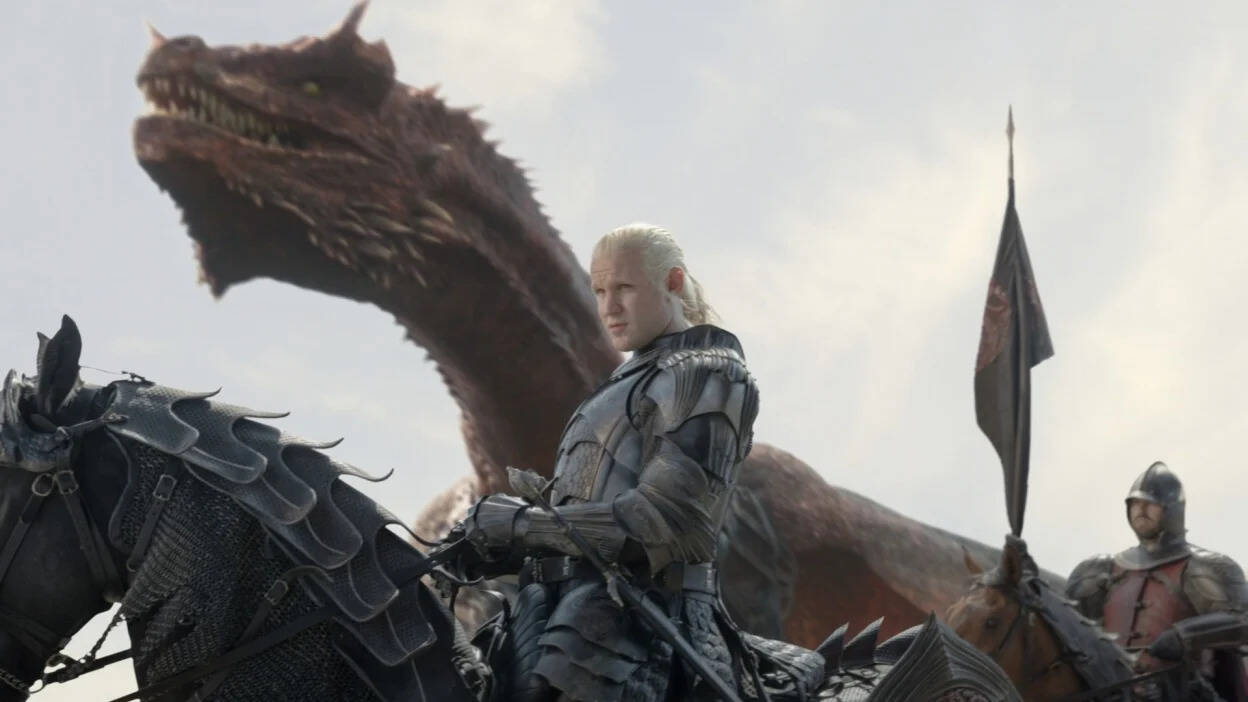
One of the clearest departures is surprisingly simple: Daemon Targaryen is at the battle when his book counterpart is not.
Martin’s chronology places Daemon elsewhere during the first Battle of Tumbleton. The series instead puts him in the middle of its destruction, forcing him to witness what dragons do when political ambitions become unrestricted warfare.
Every Major Fire & Blood Change In House Of The Dragon Season 3 Finale (Picture Credit – HBO)
It is an important character change rather than merely a geographical one. Television Daemon has spent much of the story struggling with ambition, loyalty and visions of what his family’s war might eventually produce. Tumbleton gives those questions a physical answer. He does not hear about burned soldiers and civilians afterwards. He sees the consequences.
Two Battles Of Tumbleton Are Being Rearranged
‘Fire & Blood’ contains a First and Second Battle of Tumbleton. The television adaptation appears to be pulling elements associated with different stages of those events into a rearranged chronology.
That means readers cannot safely assume that every event appearing at Tumbleton now has arrived at the same point it did in Martin’s history. The series is compressing and redistributing material to serve its own dramatic structure.
This matters because Tumbleton is not simply one battle in the book. It becomes part of the broader collapse of discipline among dragonriders, armies and competing claimants.
Ormund Hightower Gets A Different Death
Lord Ormund Hightower’s fate is another substantial alteration.
The finale gives Ormund a gruesome encounter with Roddy the Ruin amid the fighting before dragonfire finishes the sequence. The circumstances differ from Martin’s account, another indication that the television version is remixing characters and incidents associated with the battles around Tumbleton.
The result is characteristic of the finale’s approach. Familiar names and outcomes remain, but the connective tissue between them has been rewritten.
Helaena Dies Earlier
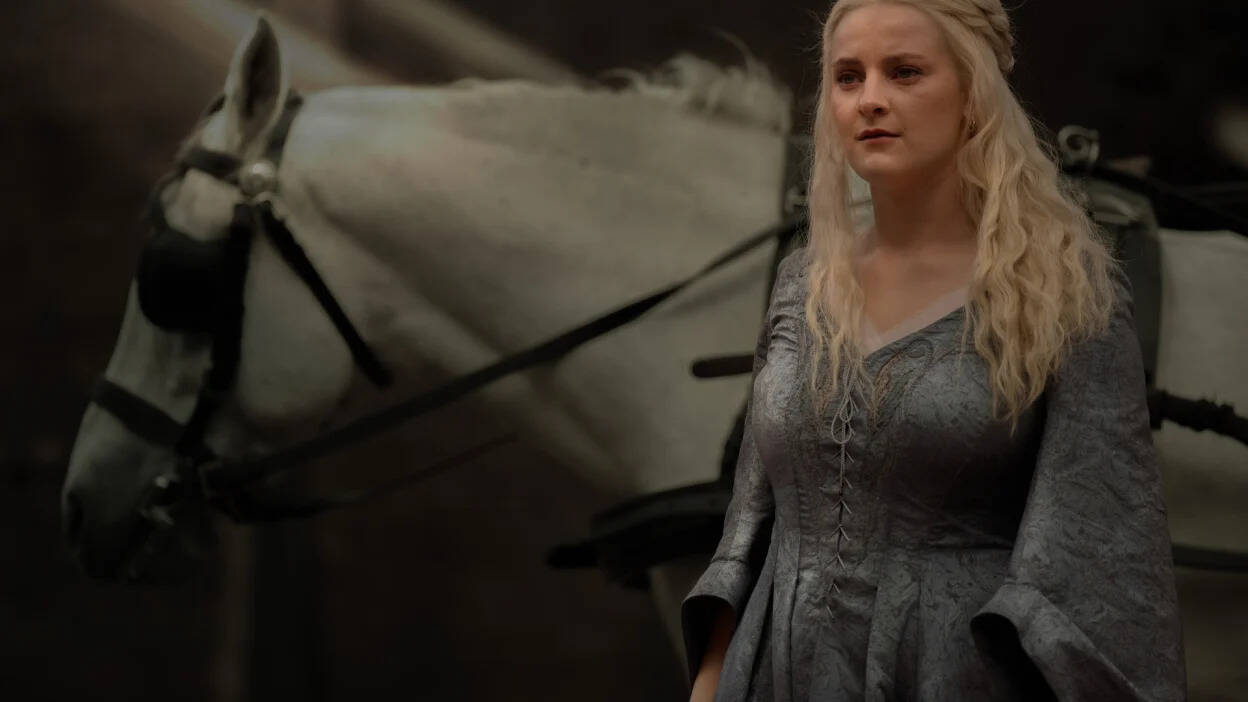
Helaena Targaryen’s death is one of the finale’s most consequential departures.
The broad outcome comes from ‘Fire & Blood’: Helaena dies after falling from Maegor’s Holdfast. But Martin places that death later in the Dance and surrounds it with circumstances the television adaptation can no longer reproduce faithfully.
In the series, Helaena is imprisoned, psychologically broken and increasingly overwhelmed by her prophetic awareness. She ultimately takes her own life. Her completed tapestry then becomes an ominous visual record pointing towards Rhaenyra’s future.
The chronology has therefore shifted substantially, and so has the emotional explanation.
Maelor’s Absence Changes Helaena’s Entire Story
One reason Helaena’s television death has to work differently is the absence of her son Maelor.
In Fire & Blood, Maelor is central to later tragedies surrounding Helaena. The series removed the character, which means the chain of events connecting her grief, her family and her eventual death necessarily changes.
This is a useful example of how one apparently small adaptation choice can ripple through an entire narrative. Removing Maelor did not simply reduce the number of Targaryen children. It forced the writers to reconstruct one of the war’s most tragic arcs.
Rhaenyra and Helaena Have A Relationship The Book Never Gave Them
The series makes Rhaenyra much more directly involved in Helaena’s suffering.
Helaena’s captivity, conversations with Rhaenyra and the harsh treatment she receives create a personal connection between the two women that does not exist in Fire & Blood in the same way.
That change also makes Helaena’s death politically dangerous for Rhaenyra. Instead of being merely another tragedy occurring during her rule, it becomes something viewers can associate directly with the increasingly authoritarian queen they are watching.
Rhaenyra Killing The High Septon Is Entirely New
Perhaps no scene announces the adaptation’s independence from Martin more clearly than Rhaenyra’s confrontation with the High Septon.
The television version has her demand religious recognition for her rule. When the High Septon refuses to anoint her, she orders his execution. This storyline does not occur in ‘Fire & Blood’.
It dramatically changes the nature of Rhaenyra’s fall.
Martin certainly depicts an increasingly paranoid and ruthless ruler, but the show is giving that deterioration a religious dimension. Rhaenyra is not simply demanding obedience. She is beginning to believe that history, prophecy and divine necessity validate her personally.
Rhaenyra Declaring Herself The Prince That Was Promised Is A Show Invention
The culmination of that development comes when Rhaenyra identifies herself with the prophecy of the Prince That Was Promised.
This is not something she does in ‘Fire & Blood’.
The change matters because ‘House of the Dragon’ has made Aegon the Conqueror’s dream, the ‘Song of Ice and Fire’, a major connective thread between the prequel and ‘Game of Thrones’. Martin’s historical text does not place prophecy at the centre of Rhaenyra’s political psychology in this manner.
The show now appears to be turning something once presented as inherited responsibility into personal conviction. That is a darker proposition.
Helaena’s Prophetic Tapestry Is New
The tapestry Helaena completes before her death has no direct equivalent performing this function in ‘Fire & Blood.’
It appears to foreshadow Rhaenyra before the Iron Throne amid images of fire, blood and destruction.
Television Helaena has long possessed an explicit prophetic ability that Martin’s historical account never confirms in such concrete terms. The tapestry takes that idea further by giving her visions an artefact that survives her.
In effect, Helaena leaves behind a warning.
Alicent Poisoning Aemond Is A Radical Departure
Alicent’s relationship with her children has been heavily rewritten since the first season, but the finale takes that divergence much further.
The television storyline has Alicent poison Aemond before leaving, followed by her retreat into the woods as events around her family collapse. Nothing equivalent occurs in Martin’s history.
Book Alicent remains a political figure whose fate is tied to the consequences of the war. The television adaptation instead increasingly presents her as someone horrified by the conflict she helped enable and attempting desperate acts against members of her own family.
It is one of the show’s most substantial character rewrites.
Aegon and Aemond’s Harrenhal Confrontation Is New
The finale also constructs a confrontation between Aegon II and Aemond at Harrenhal.
Aegon challenges his brother and ultimately demands that Aemond assist him in reclaiming power. The sequence is not lifted directly from ‘Fire & Blood.’
The series has spent considerable time making the brothers’ hostility personal, particularly after Aemond’s role in Aegon’s injuries. Martin’s account gives historians outcomes and rumours. Television requires faces in rooms together.
Here, the show writers choose confrontation.
Nettles Has Effectively Been Replaced By Rhaena
Not every finale change begins in the finale itself.
One of Season 3’s largest deviations concerns Nettles, one of the most memorable dragonseeds in ‘Fire & Blood’. In Martin’s book, Nettles claims Sheepstealer and eventually develops an extraordinarily important relationship with Daemon.
The television version instead gives the Sheepstealer storyline to Rhaena Targaryen.
That is more than character consolidation. Nettles becomes central to Rhaenyra’s distrust of the dragonseeds and to the final phase of Daemon’s story. Giving her narrative position to Daemon’s own daughter completely changes the emotional geometry of what is to come.
Criston Cole and Aemond’s Break Has Been Rewritten
Season 3 also changes how Criston Cole and Aemond separate politically and militarily.
Their relationship and eventual divergence do not unfold in precisely the fashion described by Martin. The show builds its own interpersonal conflict around the pair, continuing its preference for turning disputed historical movements into explicit character decisions.
House Of The Dragon Season 3 Finale Rewrites Tumbleton Helaena and Rhaenyra (Picture Credit – HBO)
It means that even when characters eventually arrive at familiar positions, their reasons for being there may be entirely different.
Aegon’s Journey After Rook’s Rest Is Largely Invented
Aegon II’s movements following his catastrophic injuries at Rook’s Rest have also been expanded and reconfigured for television.
According to comparisons with ‘Fire & Blood’, significant portions of his Season 3 journey are inventions rather than direct dramatisations of Martin’s account.
This has allowed the series to keep Aegon emotionally present even during a portion of the war when the historical narrative treats him very differently.
The Battle Of The Honeywine Has Been Omitted
Another notable change is something viewers do not see.
The Battle of the Honeywine, an important engagement associated with Daeron Targaryen’s emergence in ‘Fire & Blood’, is absent from the season’s adaptation of events.
Omissions like this matter because battles in Martin’s history frequently establish reputations. Removing or postponing one can change how a character enters the story and how audiences understand their importance.
Gwayne Hightower’s Fate Has Changed
Gwayne Hightower is another character whose television trajectory diverges from the source.
The series has rewritten his fate rather than following the path laid out in ‘Fire & Blood’.
It fits a wider pattern in Season 3: secondary characters who function primarily as names within Martin’s sprawling chronicle are being given different dramatic functions once they become recurring television personalities.
Corlys Velaryon’s Kidnapping Is A Television Invention
Season 3 also creates a kidnapping storyline involving Corlys Velaryon that does not originate in ‘Fire & Blood’.
Again, the reasoning is recognisably televisual. Historical texts can tell readers that alliances shifted or fleets moved. A drama wants characters placed under immediate pressure, making decisions audiences can watch unfold.
Corlys’s expanded jeopardy gives the Sea Snake a more active personal storyline while altering the mechanics of Martin’s war.
Alys Rivers Becomes Something More Explicitly Supernatural
The finale also pushes Alys Rivers further into the supernatural.
The series presents her nature and connection to Harrenhal much more directly, including the revelation that she is cursed and bound to the castle.
‘Fire & Blood’ surrounds Alys with rumours. She is described through competing stories involving witchcraft, visions, age and mysterious origins. Martin deliberately refuses to tell readers exactly what she is.
The television adaptation is gradually replacing that uncertainty with mythology of its own.
Why All These Changes Matter
It would be easy to reduce the conversation to whether ‘House of the Dragon’ is “faithful” to ‘Fire & Blood’. That is becoming the less interesting question.
Martin wrote a book in which history itself is unstable. Mushroom says one thing, Septon Eustace another, Grand Maester Munkun records something else, and the reader is left deciding how much faith to place in any of them. That structure practically invites adaptation.
But Season 3 crosses an important threshold.
Removing Nettles, bringing Daemon to Tumbleton, accelerating Helaena’s death, inventing Alicent’s attack on Aemond, transforming prophecy into Rhaenyra’s personal doctrine and rewriting Tumbleton are not merely choices between contradictory accounts. They create a different version of the Dance.
That could ultimately prove to be the season’s most interesting achievement.
‘Fire & Blood’ asks us to wonder what really happened when nobody who recorded history could agree. ‘House of the Dragon’ now offers another possibility entirely: perhaps the version we are watching is simply one more unreliable history of the Targaryens.
In a story about a dynasty destroying itself because everyone believes their version of the truth, that may be the most fitting adaptation choice of all.
Latest News


Seasoned Editor and Author with over a decade of experience in literary journalism, author interviews, and publishing trends. Known for curating impac… View More
Original source: https://www.timesnownews.com/lifestyle