US Pulls Key Warship From Pacific for Iran War — Why China Could Benefit
- Edited by: Rounak Bagchi
- Updated Aug 15, 2026, 23:06 IST
The US Navy is relocating the USS George Washington from the western Pacific to the Middle East
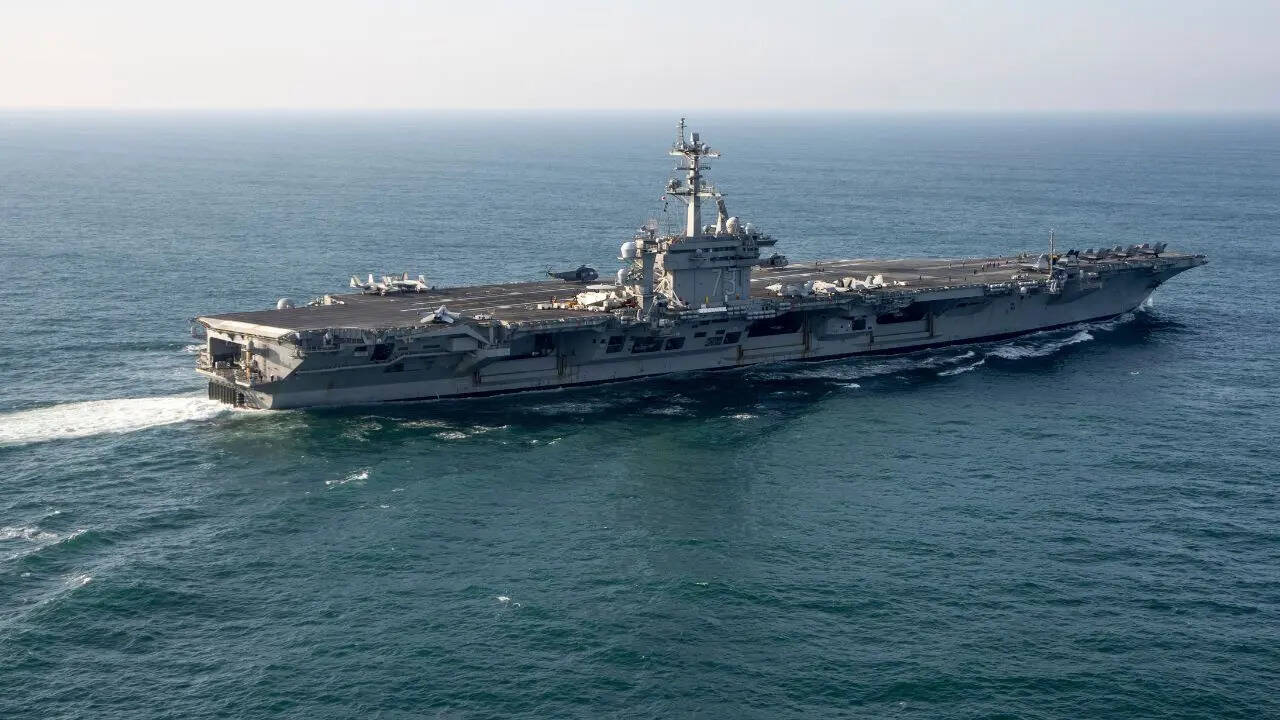
The USS George Washington aircraft carrier.
The US Navy is moving an aircraft carrier from the western Pacific to the Middle East as the war with Iran puts growing pressure on its fleet and raises concerns about the US military presence in Asia. The USS George Washington is expected to replace the USS Abraham Lincoln in the Middle East, where the Lincoln’s deployment has been extended beyond its planned return in May to support operations against Iran.
The move will leave the western Pacific without one of the US Navy’s key warships, although that gap could be brief if another carrier is deployed to the region in the coming months. Analysts say the move highlights the strain caused by the open-ended operations with Iran, including concerns about the mental health of sailors and shortages of supplies aboard the long-deployed Lincoln.
The deployment also comes as China has stepped up military activity in the region.
“The administration says that the Pacific is supposed to be the most important behind the Western Hemisphere,” Greg Poling, director of the Southeast Asia Program at the Center for Strategic and International Studies, told ABC News. Instead, he said, the US was “doing the exact opposite” of its previously stated aim of reducing its military involvement in the Middle East.
Poling said US allies in the Pacific were unsettled by what he described as the unpredictability of the Trump administration.
Beijing, meanwhile, “is quite happy with US distraction, with the frustration of US allies and partners”, he said.
China regards the US military presence in the region as a threat to its rise and an obstacle to its ambitions towards Taiwan, the self-governing island Beijing claims as its territory.
The US has argued that the Pacific is too important economically and strategically to lose.
China Sees Opportunity
The departure of a US aircraft carrier does not mean China is expected to invade Taiwan, Bryan Clark, a former Navy submariner and defence analyst at the Hudson Institute, told ABC News. But its absence gives Beijing another opportunity to demonstrate its military strength, he said. “They’re using this as part of the narrative to demonstrate to the Philippines, to Japan, to Indonesia and others that the U.S. is not the big dog in the western Pacific anymore,” Clark said. “They would just prefer that countries in the region decide that China is the bigger power and the US is not able to guarantee their security anymore.”
China conducted naval exercises with Indonesia this week and has recently shown signs of increased military activity involving Japan and the Philippines, both key US allies that have territorial disputes with Beijing.
Earlier this month, China held military drills near Scarborough Shoal in the South China Sea, which is claimed by both China and the Philippines.
Last month, a Chinese guided-missile destroyer conducted a live-fire exercise off Japan’s southernmost island of Okinotori.
US officials have sought to reassure allies that Washington remains committed to the region. Adm Frank Bradley, head of US Special Operations Command, visited Manila on Thursday and told Filipino counterparts that US special operations forces were ready to increase joint exercises. He is also expected to visit Japan.
Evan Sankey, a policy analyst at the Cato Institute, said aircraft carriers provided psychological reassurance to US allies. Their absence, he said, “adds to the general sense that the U.S. is distracted by events in the Middle East.”
Growing Pressure on US Carriers
President Donald Trump has relied heavily on US aircraft carriers during military operations in his second term. The USS Gerald R Ford returned home in mid-May after an 11-month deployment, the longest since the Vietnam War. During that deployment, it supported US operations against Iran and the capture of Venezuela’s then-leader, Nicolás Maduro.
The Ford suffered a fire in a laundry space that forced it to return to the Mediterranean for repairs and left hundreds of sailors without places to sleep.
The USS Abraham Lincoln, meanwhile, has spent more than 240 consecutive days at sea, a record for the ship. Democratic lawmakers have called for investigations and greater transparency over conditions aboard the carrier.
The US Navy has 11 aircraft carriers and normally deploys two or three at a time, Clark said. It could soon have four deployed if the USS Theodore Roosevelt leaves San Diego for the Middle East, allowing the George Washington to return to the Pacific.
But increased deployments would create another problem: maintenance. The US has only two shipyards capable of carrying out major carrier maintenance, meaning more ships could soon be waiting for repairs. “We’ll end up with a maintenance debt that needs to be paid for the next few years,” Clark said. “We’ll probably have less carrier presence than we’ve had in the previous years because carriers will be lined up to get into the shipyard.”
Latest News


Rounak is a journalist with over 7 years of experience covering geopolitical and international affairs. He has a keen interest in research and explain… View More
Video
Original source: https://www.timesnownews.com/world
