US National Debt Surpasses $40 Trillion for the First Time
- Edited by: Sagar Kar
- Updated Aug 20, 2026, 04:43 IST
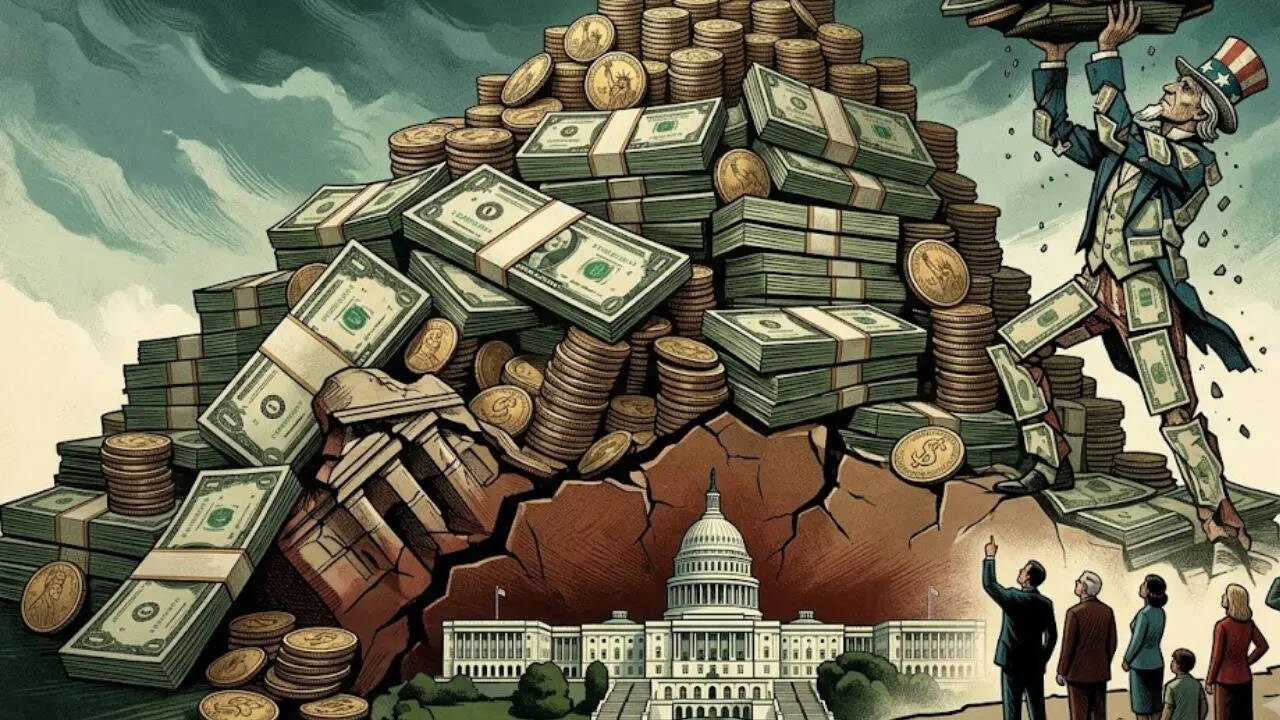
The United States’ gross national debt has surpassed $40 trillion for the first time, reflecting a troubling financial landscape shaped by decades of borrowing and rising costs. Future borrowing is projected to exceed $2 trillion in 2026, largely to cover existing debts rather than new initiatives.
The government is set to borrow more than $2 trillion in 2026 alone. (Image: AI generated)
America’s gross national debt crossed $40 trillion this week. It’s the first time the number has ever gotten that high, and it lands at a moment when the country’s finances already look shaky.
Decades of borrowing brought US here. Rising military costs, expensive social safety net programs, and Trump‘s tax cuts have all piled onto a debt load that keeps climbing without much resistance from Washington.
Where this year’s borrowing is going
The government is set to borrow more than $2 trillion in 2026 alone. Some of that covers the ongoing war in Iran. A big chunk also traces back to the sweeping tax cuts Republicans passed in 2025. And here’s the part that stings most: about half of everything the US borrows this year isn’t paying for new programs at all. It’s just interest, money owed to the investors who already hold American debt. That interest bill keeps growing, which digs the hole deeper still.
Is this actually a crisis, or just what a massive economy looks like when it borrows to grow? People disagree, and honestly, the disagreement tends to break down along political lines that shift depending on who’s in charge. Republicans, for what it’s worth, tend to get loudest about deficits precisely when they’re not the ones running things.
None of this is risk free, though. The US is still the biggest economy on the planet, but that status isn’t guaranteed forever. If investors start demanding higher interest rates on US bonds, or if confidence in America’s ability to pay its bills starts slipping, the dollar’s position as the world’s go to reserve currency could take a hit too.
Both parties built this
It would be easy to pin the debt on one side of the aisle, but that’s not really accurate. Health programs, stimulus checks, disaster relief, and the everyday costs of keeping the government running have all required more and more borrowing, under presidents from both parties, for years.
Trump has talked a big game about fixing this. Back in 2016, on the campaign trail, he claimed he’d eliminate the entire national debt within eight years through better trade deals and faster growth. Instead, the debt has doubled since he made that promise.
His second term hasn’t gone much better on this front. Two of his administration’s biggest tools for controlling spending have basically fizzled. The Department of Government Efficiency, which Elon Musk led early on, promised $1 trillion in federal savings. What’s actually materialized is a little over $200 billion, and even that figure is shaky. The Government Accountability Office said this month the department’s numbers can’t really be trusted, calling them unreliable and lacking transparency.
Tariffs backfired, and the Iran war isn’t helping
Then there’s the tariff plan. The administration had hoped sweeping import tariffs would bring in serious revenue. That fell apart when the Supreme Court ruled several of the tariffs illegal, and the government ended up having to refund more than $160 billion to companies that had already paid up.
Treasury Secretary Scott Bessent had a target: bring the deficit down to 3 percent of GDP by 2028, from over 6 percent when Trump took office. Last week, he admitted things are heading the wrong way instead.
Speaking with Newsmax, Bessent laid out why. Military spending tied to the Iran war has pushed costs higher. The tariff refunds wiped out earlier progress on shrinking the deficit as a share of GDP. And the war itself has driven up energy prices at home, which has slowed economic growth and eaten into the tax revenue gains the administration was counting on.
Latest News


Sagar is a journalist with an interest primarily in geopolitics and American domestic politics. Before joining Times Now, he wrote for Republic and Sw… View More
Original source: https://www.timesnownews.com/business-economy