From Colonial India to Celine: The Secret Life Of The Cummerbund
From its South Asian origins to British military dress and black-tie culture, the cummerbund has travelled through fashion history and now returns as couture’s unexpected statement accessory.
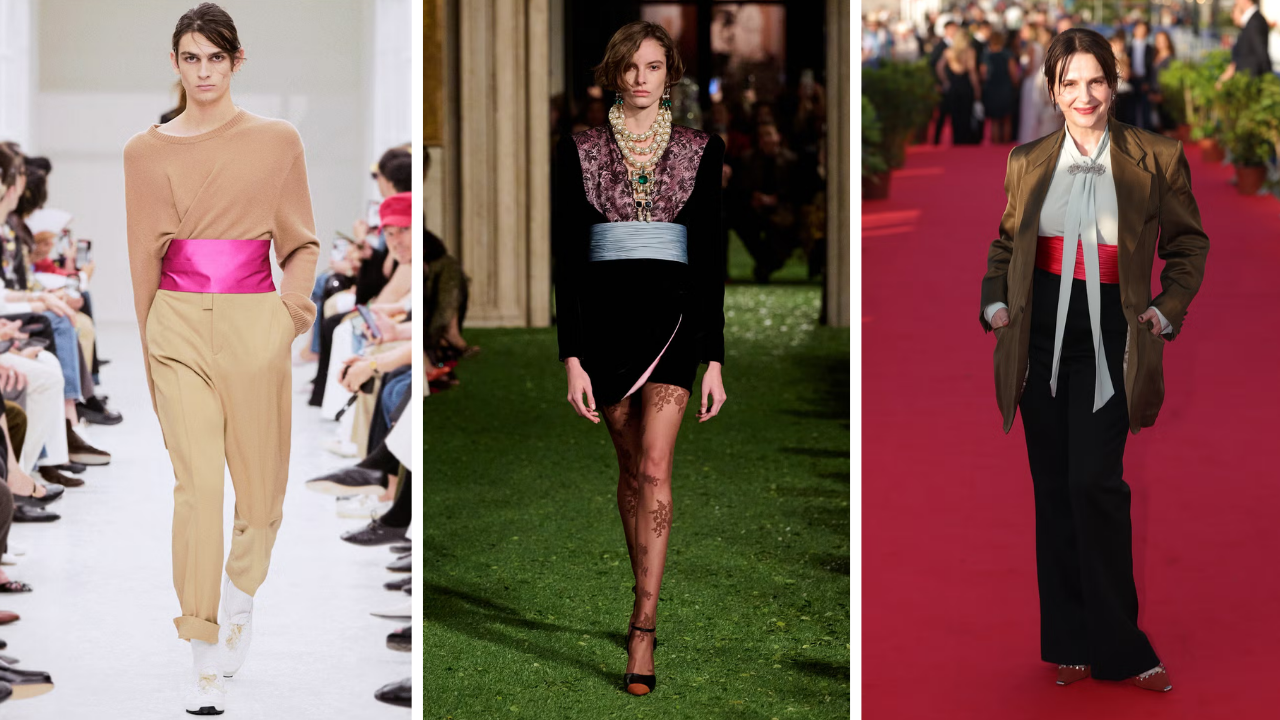
For decades, the cummerbund occupied a very particular corner of fashion: black tie, dinner jackets and impeccably formal evenings. But in 2026, that old dress-code staple is stepping out from beneath the tuxedo and onto the runway. The fashion directors and gurus are styling it with balloon trousers, denim and dresses, turning the once-demure waist sash into fashion’s newest statement accessory?
Here’s how 2026 is reinventing the cummerband. At Celine, designer Michael Rider recently recast the traditional waist sash in rich plum and Barbie pink, pairing it with balloon trousers and the house’s now-recognisable jazz shoes. At Valentino, Alessandro Michele pushed the idea even further, placing wide satin cummerbunds over chiffon, minidresses and even blue skinny jeans. Issey Miyake approached it with a sportier sensibility, while Polo Ralph Lauren kept closer to its formal roots. Everyone is already calling it the ‘It’ belt of the season. Suddenly, the cummerbund is not hiding beneath a dinner jacket. It has very well become the outfit. And that makes its history considerably more interesting. Because what happened behind the scenes is not known to many.
The History Of Cummerbund
Before it was a tuxedo accessory, it was a kamarband. The word itself gives the first clue. ‘Cummerbund’ comes from the Hindi kamarband, ultimately derived from Persian: kamar meaning waist and band referring to something tied or fastened. The term entered English centuries ago, in the early 17th century, long before anyone thought of it as the obligatory accessory to a tuxedo.

History of Kamarbandh (Credits: Instagram)
Across South Asia, the kamarband was a practical and decorative waist sash. It could be worn over traditional clothing, and depending on its construction and wearer, it could have a very practical purpose too, creating a place to tuck small objects or even a weapon. It was not one single garment belonging to one single class or occasion; the broader tradition of wrapping fabric around the waist had many forms and uses.
Then Came The British To Own It
During the 19th century, British military officers stationed in India encountered the lightweight waist sashes worn locally. In the heat, a broad sash offered an appealing alternative to the heavy waistcoat that was part of European dress. The precise circumstances of its adoption are debated, but the essential transformation is clear: a South Asian waist garment was absorbed into British colonial dress and eventually reinterpreted as something entirely different.
This is where the cummerbund’s story becomes more complicated than a simple tale of fashion inspiration. The British did not invent the garment. They encountered an existing South Asian tradition, adapted it for their own circumstances and then carried their version back into Western society. Fashion history is full of such journeys, although it often remembers the final destination better than the place where the journey began.
The Journey Of The Sash
Once the sash travelled into Britain, it began shedding its utilitarian identity. By the late Victorian period, versions of the garment had entered evening dress, eventually becoming associated with the dinner jacket and the emerging conventions of black tie. The accessory was particularly useful sartorially: it concealed the point where the shirt disappeared into the trousers and created an uninterrupted horizontal line around the waist.
What Makes Cummerbund The It Belt History (Credits: Instagram)
Then it was time for the pleats. Those little folds became part of the cummerbund’s visual language, helping transform what had once been a practical sash into an unmistakably formal accessory. In the rigid grammar of black tie, everything had its place. The jacket, the shirt, the bow tie, the trousers, and the cummerbund, positioned precisely at the waist.
It was elegant because it was controlled. For years, designers have been dismantling the idea that individual garments belong to only one category. Sneakers entered tailoring, pearls left the jewellery box and moved onto baseball caps, brooches migrated from inherited jewellery collections to oversized coats, scarves became belts and ties became accessories rather than rules. The cummerbund fits perfectly into this mood because it already has a strong visual identity. Put one beneath a tuxedo jacket and it behaves, put one over jeans and suddenly it has an attitude.
What’s The New Cummerbund About
The new cummerbund is not trying to make everyday clothing more formal, it is making formalwear less formal. And like everything else cinched, the waist is having its moment. There is also something wonderfully contemporary about the cummerbund’s return. Fashion has spent years playing with volume, enormous trousers, oversized jackets, exaggerated shoulders, long coats and silhouettes that deliberately obscure the body. The cummerbund does the opposite. It creates a clear visual interruption at the waist. It frames and tells the eye exactly where to look. And unlike a conventional belt, it does more than merely holding the trousers up, it changes the proportions of whatever is worn underneath it.
That is why its appeal extends beyond menswear. Valentino’s recent styling demonstrates how easily the accessory can become part of a more feminine silhouette, sitting over dresses and skirts to create definition where a conventional belt might feel predictable. The cummerbund, in other words and totality, has stopped being about the tuxedo, it has now become about the waist.
From Colonial Relic To Couture Prop
There is an irony in all of this. A garment that travelled from South Asian dress into British military culture, then into European eveningwear and finally into American formal culture has now returned to the fashion conversation as a symbol of experimentation. Its history is not a straight line, it is a loop. And perhaps that is why the cummerbund feels so right for fashion now. It is already a garment that has survived by changing context. It has lived all forms and phases, it has been practical, it has been ceremonial, it has been aristocratic, it has been prom-night formal, it has been almost forgotten and now it is couture.
Celine Cummerbund and Jazz Shoes (Credits: Instagram)
The most interesting part of its comeback may be that designers are not pretending the cummerbund never belonged to black tie. They are leaning into that history and then deliberately breaking it. So, wear it with jeans, or over a dress, wear it with a sweater, or wear it with something that makes absolutely no historical sense. That is the point. Fashion does not always revive old clothes because it wants to return to the past. Sometimes, it brings them back precisely so we can see how differently they can behave in the present. The cummerbund has spent more than a century being told where it belongs and that’s finally changing. This season, it has finally decided to leave the room, and, naturally, fashion followed.
Original source: https://www.timesnownews.com/lifestyle