
Small SIPs Take A Hit: Rs 1,000 And Below Accounts Fall By 1.4 Million
- Written by: Vikas Kumar
- Updated Aug 20, 2026, 14:13 IST
Accounts in the Rs 1,001-3,000 range increased by 0.5%, while those in the Rs 3,001-5,000 and Rs 5,001-10,000 brackets grew by 2.8% and 5%, respectively.
(Representational Image)
The small-ticket systematic investment plan (SIP) accounts have taken a fall in the last financial year as the market volatility has hit the segment. SIP accounts with monthly contributions of Rs 1,000 or less fell by 1.4 million in 2025-26, even as higher-ticket accounts continued to grow, according to data from the Securities and Exchange Board of India (Sebi).
SIP accounts with higher ticket sizes, meanwhile, continued to grow across all slabs, albeit at a slower pace and from a much smaller base.
As per the SEBI data, accounts in the Rs 1,001-3,000 bracket rose 0.5 per cent to 33.5 million in FY26, while those in the Rs 3,001-5,000 bracket grew 2.8 per cent to 14.4 million.
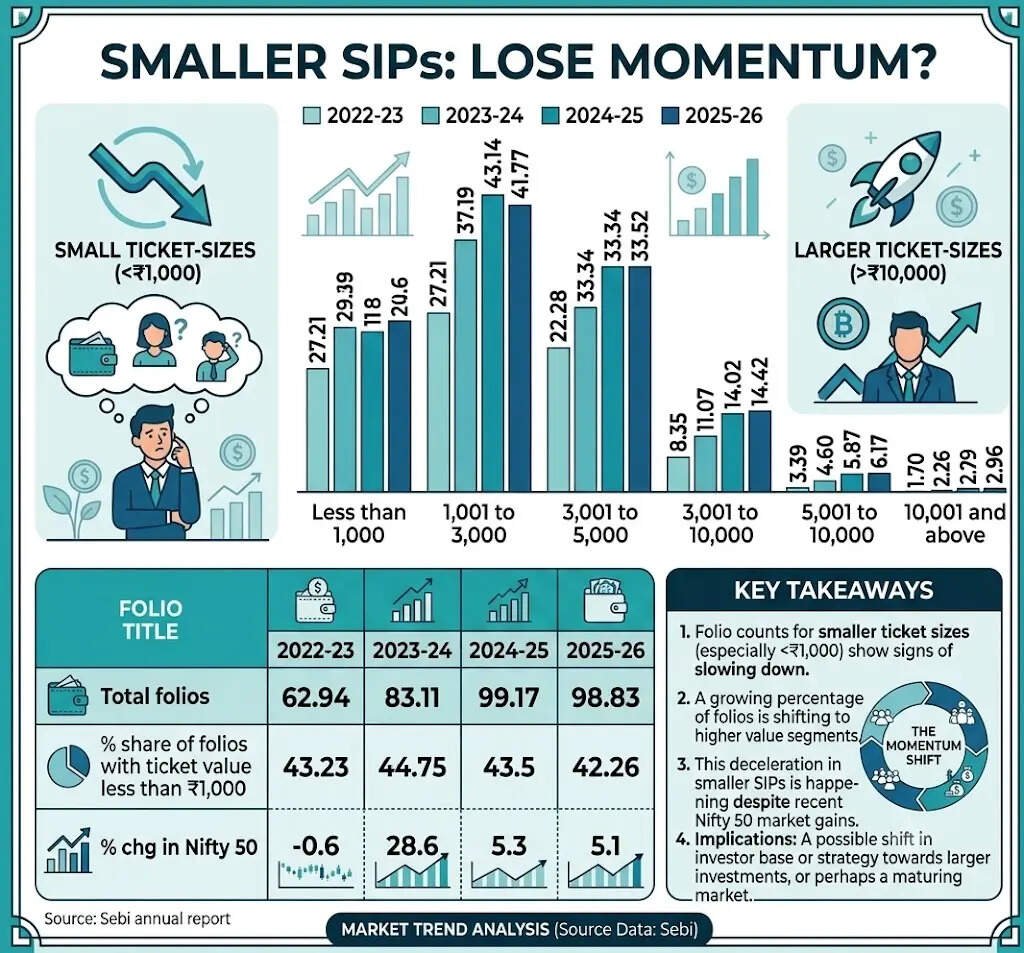
SEBI SIP data
Further, the Rs 5,001-10,000 segment expanded 5 per cent to 6.2 million, while accounts with monthly contributions of more than Rs 10,000 grew 5.9 per cent to 3 million.
Decline in SIP folio numbers
The SEBI data said the industry had added 1.61 crore SIP folios in FY2024-25 and 2.02 crore in FY2023-24. It has registered an annual growth of 19.32% and 32.06%, respectively.
The decline during FY2025-26 was led by SIPs in the Rs 501 to Rs 1,000 range while the folios in this category fell by 13.86 lakh, or 4.33%, to 3.06 crore. It was the only ticket-size category to register an absolute decline during the year.
Smaller cities add more new SIP accounts
As per the SEBI data, in 2025-26, investors in B-30 cities prematurely terminated 379.16 lakh SIP accounts, compared with 260 lakh in T-30 cities. The B-30 cities also saw higher new SIP registrations, at 389 lakh, compared to 267 lakh in T-30 cities.
In proportional terms, the B-30 cities saw more new SIPs as well as premature terminations than T-30 cities in FY 2025-26.
Smaller cities beyond the top 30 (B-30) added new SIP accounts at a faster rate than the top-30 (T-30) cities between FY 20219-20 and FY 2025-26.
Latest News


Vikas Kumar is Deputy Editor (Business) at Times Now driving coverage across policy, economy and markets. He possesses nearly a decade of experience i… View More
Original source: https://www.timesnownews.com/business-economy