Exclusive: How Leadership Is Changing As Accountability, AI And Cybersecurity Redefine The Price Of The Chair
- Authored by: Sakshi Bajaj
- Updated Aug 21, 2026, 17:46 IST
An exclusive interaction that explores how AI, cybersecurity and rising accountability are redefining leadership.
‘The Price Of The Chair’
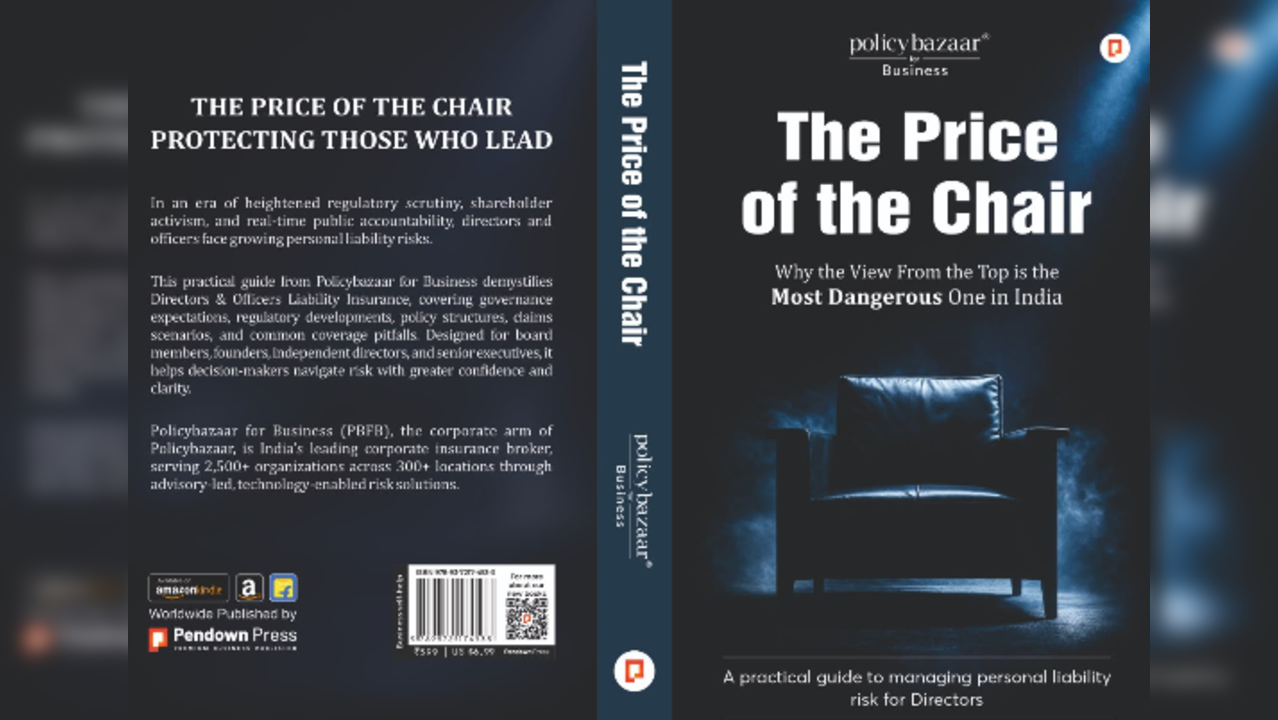
In an exclusive conversation with Times Now Digital, Evaa Saiwal, Head of Cyber & Liability Insurance at Policybazaar for Business and author of ‘The Price Of The Chair’ shares her thoughts on how leadership is changing as accountability, AI and cybersecurity redefine ‘The Price Of The Chair.’
Q. As times have evolved, has ‘The Price Of The Chair’ also changed? What is the real “price” of being in the chair today?
A. Yes, The price of the chair has changed because the expectations from directors and senior leaders have expanded considerably. Boards continue to be responsible for strategy, growth and financial performance, but they are now operating in an environment of greater regulatory, shareholder and public scrutiny. The Companies Act, 2013, stronger regulatory enforcement and evolving stakeholder expectations have also made the responsibilities of directors much more clearly defined. The important change is that accountability today is not limited to the outcome of a decision. There is increasing focus on the process behind it, what information was available, whether adequate questions were asked, whether risks were considered and whether appropriate oversight was exercised. This also means that individual directors and officers can face regulatory investigations, shareholder actions or legal proceedings even where there is no allegation of deliberate wrongdoing. That is the context in which D&O insurance has become an important part of corporate governance. It does not remove a director’s responsibility or accountability. It provides financial protection when directors and officers have to defend actions and decisions taken in their professional capacity.
So, the real “price” of the chair today is the greater degree of responsibility and personal accountability that comes with the position.
Q. What is crucial for the next generation of directors to bring to the table ?
A. In my view point the next generation of directors will need to bring independent judgement, a broader understanding of risk and the willingness to ask difficult questions. The scope of board responsibility has expanded significantly. In addition to financial performance and strategy, boards today are expected to understand areas such as cybersecurity, data protection, ESG, AI, regulatory compliance and other emerging risks. This does not mean that every director needs to become a specialist in each of these areas. What is important is that directors understand the implications for the business, seek expert advice where necessary and are able to challenge management constructively. One of the points we make in “The Price of the Chair” is that oversight is an active responsibility. It is not enough for boards to receive information and simply take it on record. They are expected to question, probe and satisfy themselves that the appropriate processes and controls are actually working. As the nature of risk continues to change, I believe this ability to exercise informed and independent judgement will become even more important for directors.
Q. Has responsibility for each leader overtaken the title/role?
A. I would say that responsibility has become much more closely linked to the role. A directorship has always carried fiduciary and legal responsibilities. What has changed is the extent to which those responsibilities are now examined and enforced. Directors are increasingly expected to demonstrate that they exercised reasonable care, diligence and independent judgement rather than relying entirely on the functions responsible for a particular issue.
This becomes particularly relevant because most business risks do not remain within one function. A cybersecurity incident can have operational, financial and regulatory consequences. A disclosure issue can affect investors and shareholders. A whistle-blower complaint can develop into a broader governance matter.
The role of leadership is therefore not to personally manage every such issue, but to ensure that appropriate oversight exists and that material issues are being addressed properly. This is an important distinction in the book as well: personal exposure does not arise only from making a wrong decision. It can also arise where directors fail to ask appropriate questions, challenge management or demonstrate adequate oversight. In that sense, the title and the responsibility can no longer really be separated.
Q. What are the biggest challenges for a leader today?
A. Today, leadership comes with far greater personal accountability. Directors and senior executives are not only responsible for business outcomes but can also be held personally accountable for the decisions they make. With increasing regulatory scrutiny around governance, disclosures and compliance, the cost of getting a decision wrong has gone up. Leaders are expected to act quickly, but a decision that later comes under question can potentially lead to shareholder claims, regulatory action or allegations of negligence or breach of fiduciary duty.
Q. How do you see AI changing organisational structures, jobs, leadership roles and the skills required for the next generation of leaders?
A. AI will change organisations at multiple levels. At a structural level, I think we will see leaner teams, greater automation and in many roles, a shift from people executing tasks themselves to people working alongside technology. I don’t necessarily see this simply as AI replacing jobs. It will certainly make some roles smaller or redundant, but it will also change existing roles and create new ones. The more important question for organisations will be which decisions can be automated and which still require human judgement and accountability. For leaders, that distinction becomes particularly important. As AI becomes embedded in all business areas leaders cannot treat it purely as a technology matter. They will need to understand how it is being used, the quality and limitations of the underlying data, and the potential regulatory, ethical and reputational consequences. The Price of the Chair makes a similar point- as AI becomes part of corporate strategy, expectations around board oversight, governance and disclosure will continue to increase. So I think the skills required from the next generation of leaders will also change. AI can provide information and recommendations at extraordinary speed; leadership will still be responsible for deciding what to do with them.
Saying so, AI may change how decisions are made, but it does not remove accountability for those decisions. If anything, it makes good judgement and effective oversight more important.
Q. Data protection is increasingly a boardroom responsibility. Do you think Indian business leaders are sufficiently prepared to take accountability for data breaches and cybersecurity risks?
A. Indian businesses have become significantly more conscious of cybersecurity and data protection, although the level of preparedness varies considerably across organisations. Historically, cybersecurity was largely managed as a technology issue. That approach is changing because the consequences of a cyber incident can extend well beyond IT. There can be business interruption, financial loss, regulatory action, data protection obligations and reputational consequences.
As discussed in The Price of the Chair, the regulatory focus is also increasingly on governance, whether cyber risk was adequately understood at the leadership level, whether appropriate controls were in place and whether management was being challenged on the organisation’s preparedness. For boards, therefore, preparedness should cover both prevention and response. It is important to understand not only the organisation’s cybersecurity controls, but also its incident response plan, responsibilities during a breach, regulatory and customer communication, business continuity and financial preparedness.
Insurance forms one part of this framework. Cyber insurance can support the organisation in managing the financial and response costs associated with an incident. D&O insurance addresses a different exposure and may become relevant where directors or officers face allegations relating to their governance or oversight of cyber and privacy risks. The book is also clear that D&O is not intended to replace specialist cyber insurance.
The objective for boards should therefore be broader cyber resilience – having the governance, technology, response capability and financial protection necessary to manage an incident effectively if one occurs.
Latest News


Sakshi Bajaj is a seasoned Associate Editor with over 15 years of experience in broadcast journalism. She has anchored, scripted, produced shows and w… View More
Original source: https://www.timesnownews.com/business-economy