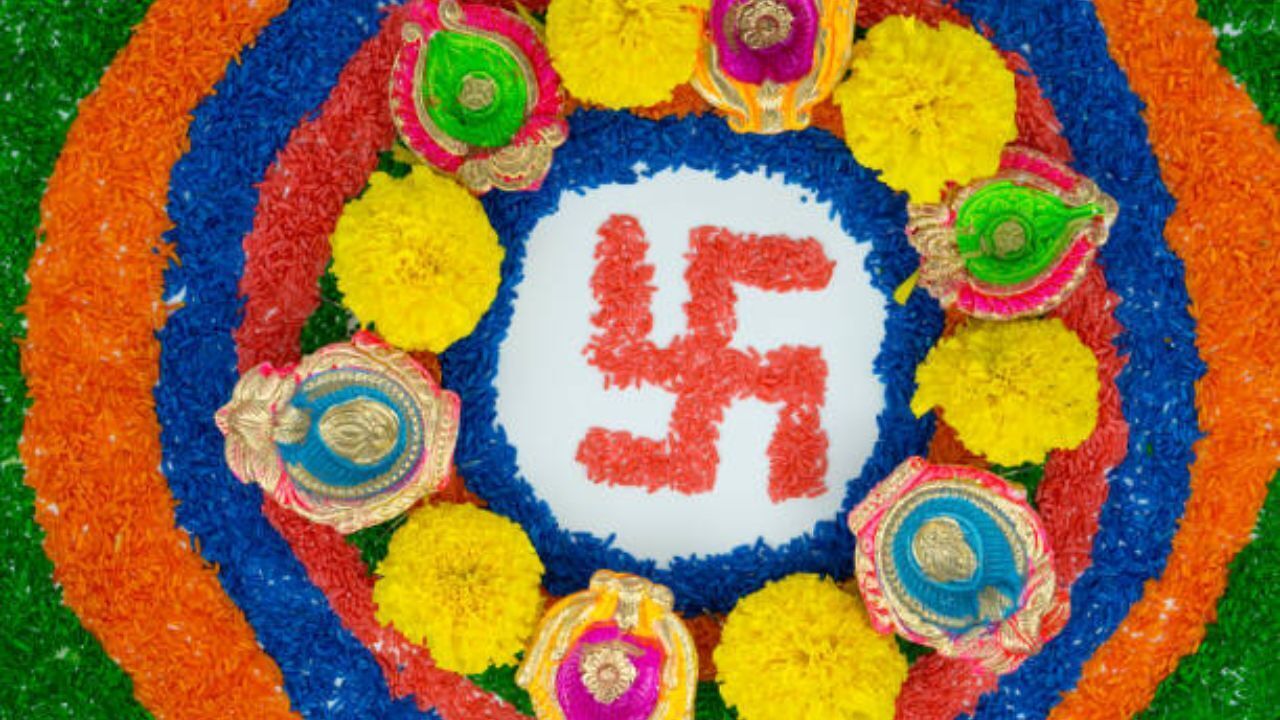
The traditional Hindu swastik features four bent arms and four dots, with each element carrying symbolic meanings linked to prosperity, well-being and spiritual beliefs. (Image Credits: iStock)
\n\nDiwali falls on Sunday, 8 November this year, and homes across India will soon be marked with rangoli, diyas, and the swastik, one of Hinduism’s oldest and most recognisable auspicious symbols. Here’s how to draw it correctly, and what each part of it stands for.
\n\nInstead of drawing a simple plus sign that cuts through the middle, visualize a central point representing the Brahma-bindu. You will build the symbol outward from this center using four separate strokes so the lines never cross through one another.
\n\nFrom near your central point, draw four separate lines extending outward. One going up, one down, one left, and one right. At the end of each line, draw a short line bending at a right angle, moving in a clockwise direction. This clockwise form is the traditional orientation for the Hindu swastik.
\n\nOnce the arms are complete, add one dot in each of the four spaces between the arms. Some traditions also add a dot in the very centre.
\n\nA detail many people get wrong: the lines should…
Original source: https://www.timesnownews.com/lifestyle