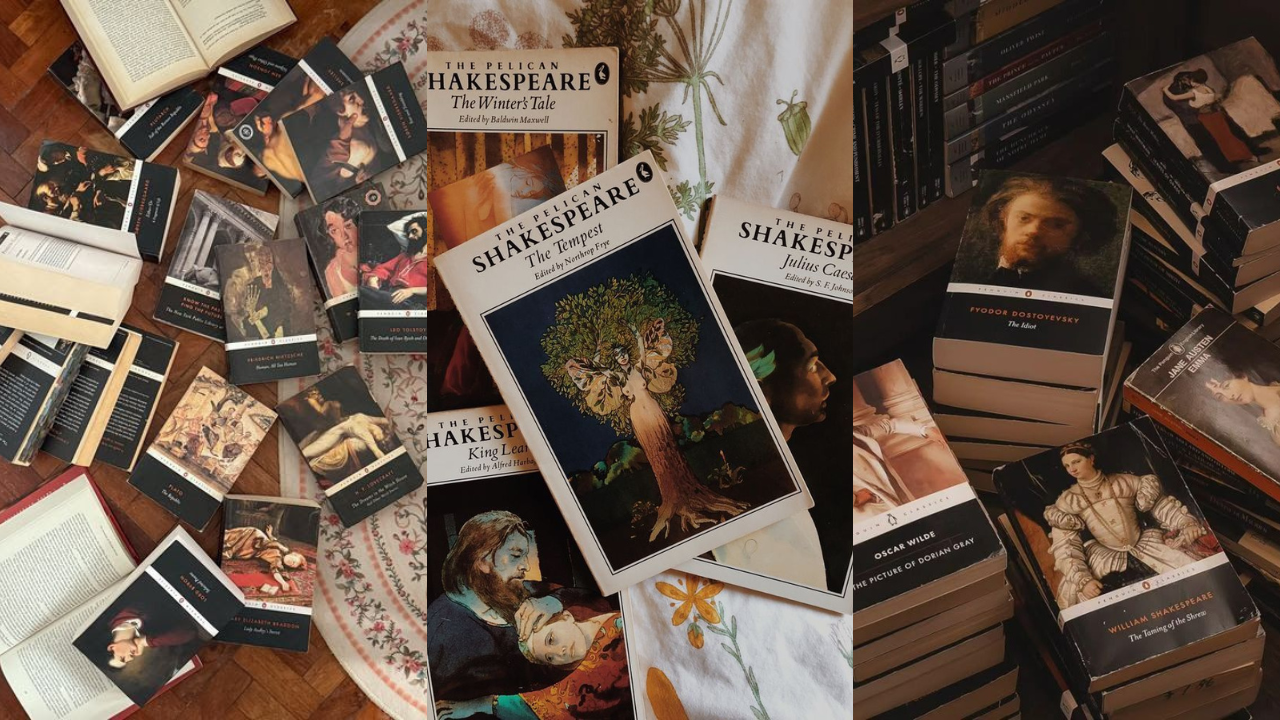
The Classics Were Meant to Disturb Us but We Turned Them Into Status Symbols
Books that once got their publishers convicted now arrive gilded, introduced and pre-approved. Somewhere between the courtroom and the coffee table, whatever made them worth prosecuting quietly went missing.
Most Indian middle-class homes of a certain vintage had a glass-fronted showcase in the drawing room, and behind the glass sat a row of books nobody touched. A boxed Shakespeare in imitation leather. A set of Russian novels bought from a travelling salesman on monthly instalments. Encyclopaedias acquired at real sacrifice by a father who had not himself finished school. The glass was wiped every week. The spines never cracked.
Nothing about that was dishonest. The shelf was an aspiration made visible, put there for a child who might go further than the parents did, and a good many children did. But it established a habit the country never quite shook off, which is the treatment of certain books as objects to be owned rather than opened. The habit has simply moved house. It now sits in the hardbound gift set, the boutique hotel lobby stocked by an interior designer, and the photographed shelf.
Somewhere behind that glass, statistically, sat a book that once put somebody in a courtroom.
They Were Evidence Before They Were Furniture
In January 1857, Gustave Flaubert stood trial in Paris alongside his printer and his publisher, charged with offending public morals through the serialisation of ‘Madame Bovary.’ The prosecution’s objection was not that Emma commits adultery. It was that Flaubert declines to condemn her for it. He was acquitted. Charles Baudelaire, prosecuted by the same man later that year over ‘Les Fleurs du Mal’, was not.

Madame Bovary
James Joyce fared worse. When ‘Ulysses’ was appearing in instalments in an American literary magazine, its editors Margaret Anderson and Jane Heap were prosecuted under the Comstock Act, convicted in 1921 and fined, and the magazine was ordered to stop printing. No American publisher would touch the complete text. Sylvia Beach brought it out from her Paris bookshop in 1922, producing a book that could not legally cross into the United States.
Penguin went to trial over ‘Lady Chatterley’s Lover’ in 1960, where prosecuting counsel asked the jury whether it was a book they would wish their wives or their servants to have.
Four titles that now appear in gift editions with gilded edges. Every one of them was, within living memory or just outside it, a criminal matter.
What Canonisation Costs
Elisabeth Ladenson has tracked this arc across a century of obscenity trials, from Flaubert through to Fanny Hill in 1966, and her subject is precisely the transition: works first prosecuted as filth and subsequently canonised as masterpieces. The legal history is the visible part. The quieter part is what safety does to a book once it arrives.
Kafka, writing to a friend in 1904, set the bar at its most extreme. A book, he said, must be the axe for the frozen sea within us. He was twenty. It is an adolescent formulation, and it is also more or less correct about why the form exists at all.
Crime and Punishment
A classic, though, is not encountered that way. It arrives pre-authorised. It comes with an introduction explaining its significance, a study guide summarising its themes, and an exam question waiting at the end. By the time most people meet ‘Crime and Punishment’, they already know it is important, which is the single most effective way to ensure it does not disturb them. Importance is a sedative. A book you are told to admire cannot ambush you, and ambush was the whole design.
The Complaint Is Also A Status Move
There is an obvious objection to everything above, and it belongs here rather than in a footnote.
Sneering at the decorative bookshelf is itself a bid for position. The person pointing out that you have not properly absorbed the Dostoevsky on your shelf is making a claim about themselves, not about Dostoevsky. Beautiful editions are not the enemy of serious attention, and never have been. Books have been bound in leather and stamped in gold for as long as anyone has had the money to commission it, and plenty of those volumes were also thoroughly worked through by their owners.
Ladenson makes a sharper version of the same point about our own moment. Censorship has not gone anywhere. It has only acquired a more comfortable vocabulary, and what was once prosecuted as obscene now gets quietly filed as inappropriate.
Classics Arrive Pre-Authorised, With the Danger Sanded Down by Syllabus
Which suggests the problem is not really that people display books they have not finished. It is that the specific titles we have agreed to treat as decorative are the ones that were built to be dangerous, and that we have collectively decided the danger has expired. A copy of ‘Madame Bovary’ on a coffee table is not a lie about its owner. It is an assumption about the book, and the assumption is that it can no longer do anything.
The useful move is smaller than a lecture about performative shelves. Take one title you have long treated as settled, something assigned at school or bought for the cover, and go at it as though nobody had ever told you it mattered. No introduction, no study guide, no received opinion about its themes. If it was once worth prosecuting somebody over, there is something in it that a syllabus has been carefully sanding down for a century.
Most of the time, it is still there.
Original source: https://www.timesnownews.com/lifestyle