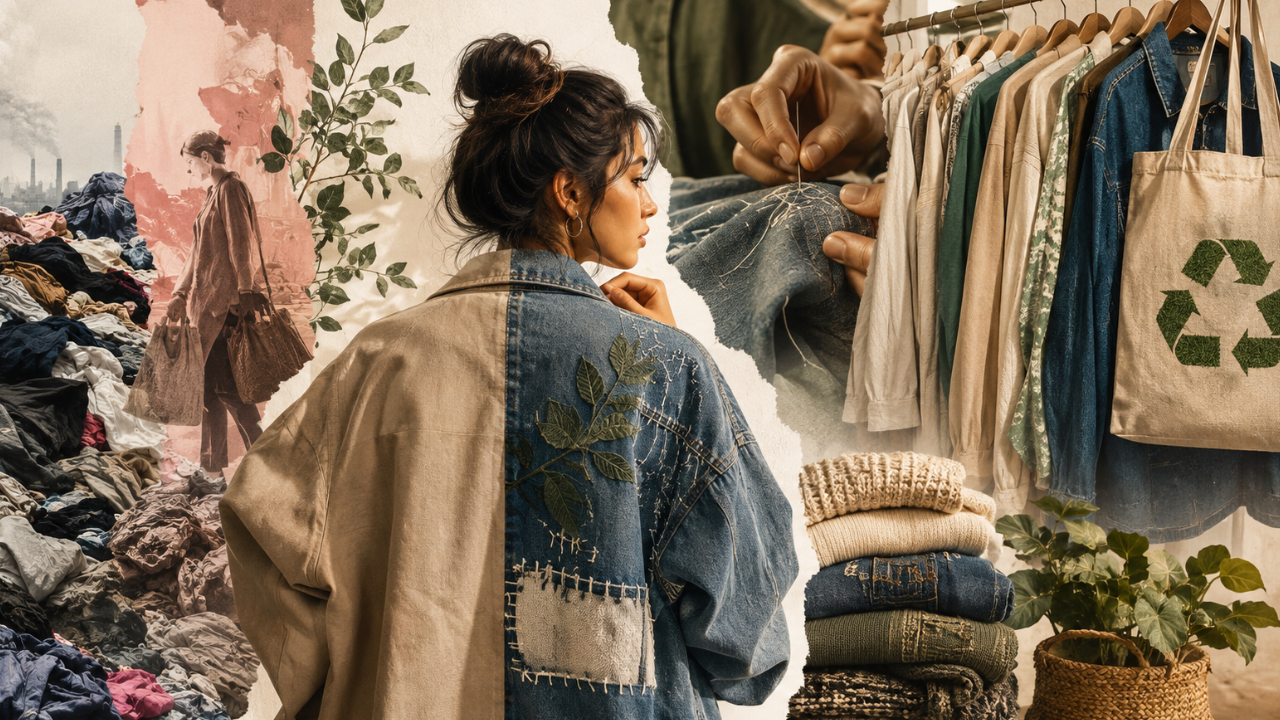
Fast Fashion is Attempting a Sustainability Makeover
Fast fashion is catching up to the language of sustainability. The Gen Z-induced thrifting boom gets the credit. But the intent must be cross-questioned.
Some of the most poshly-packaged, mass market brands have spent decades in the business ingraining the disposability of clothes into consumer conscience. Now, they’re attempting to bluff an Uno reverse.
Repair workshops, resale platforms, customisation services and clothing collection schemes are slowly but surely mushrooming their way into the mall-bound retail experience. This in itself is counterintuitive. Because why would a retailer whose business depends on selling more clothes encourage customers to repair the ones they already own? The answer is significantly more complicated than your favourite fast fashion store simply ‘going green’.
Fast Fashion is Speaking Thrift
Because the customer has changed, and that’s exactly what they want to hear. As a young millennial, it was cool to not care; as a twenty-something Gen Z, it’s a hate crime against yourself. There was a time when thrifting was something you did on the sly when you couldn’t afford to walk into a mall and buy your latest fit off the rack. Today, the ecosystem has evolved into not only it’s own aesthetic, but also a distinct personality type. And Gen Z has proudly been the primary driving force. The global secondhand apparel market is projected to reach $393 billion by 2030, with much of this generation and some up-to-date millennials expected to drive more than 70% of market growth. The appeal is evident: buying a garment or reworking it into something no one else owns can say much about personal identity whilst also honouring the sanctity of the planet.

Thrifting is the new cool (Credit: Unsplash)
There is also the less romantic reason – money. Inflation has made getting dressed more expensive even as social media keeps the pressure of flaunting a wardrobe that feels fresh, ever-present. Thrifting, repairs and adjacent activities ensure one can participate in the fashion-scape, without paying full retail prices. But like any ‘ideology’ at play, there are those on either end of the spectrum and then there are the ones on the fence. The latter refers to the innumerable fast fashion shoppers who buy into a ‘trending’ piece for its accessibility, while also telling themselves that they would in fact, buy vintage if they could. And this paradox is exactly what fast fashion giants may be using to green wash themselves.
GlobalData retail analyst Neil Saunders tells AP that the mending programmes at play in select fast fashion stores, put a “halo on the brand”. This ‘halo’ helps on-the-fence consumers performatively participate in ‘going green’ while achieving very little in terms of impact. Kate Fletcher, professor of sustainability, design and fashion systems at Manchester Metropolitan University, speaking to AP, corroborates this: “The fashion sector’s primary source of impact is due to the overproduction of pieces and growing volumes of garments created. Repairing a garment in store happens in addition to these growing production volumes, not instead of them.”
We Hate to Say Tokenism…
But it smells an awful lot like it.
These repair programs at play are very much a work in progress in some international markets – emphasis on ‘some’. This really expresses how sparingly these fast fashion giants are willing to cast their nets of sustainability. For instance, Uniqlo’s ‘RE.UNIQLO STUDIO’ offers repairs, decorative Sashiko mending, embroidery and creative restyling. An AP report however ascertains that this measure is only available in 75 of the Japanese casual wear brand’s 2,500 stores worldwide. The same goes for Zara’s ‘Pre-Owned’ platform. Launched in 2022, it allows customers to resell, repair and donate their Zara buys, but only in 17 of the almost 100 countries the brand operates out of. Primark’s ‘Love It For Longer’ programme is no different. It offers free workshops teaching customers how to replace buttons, zips and make other basic mends on their clothes. But again, in only 9 of the 17 countries it operates in.
The stats on these ‘green’ measures speak for themselves (Credit: Primark, Uniqlo)
These initiatives exist and won’t be hard to find if you’re in one of these in-demand first world sustainability hotspots. But the numbers are telling. Coming closer home, India seems to be completely left out of the narrative save for a few makeshift measures. H&M India sells repair patch kits under its ‘Take Care’ initiative and some Zara India stores offer clothes-collection containers for reuse, donation and recycling. But this is alarmingly too little for a country whose fast fashion industry sits at $10 billion, projected to cross the $50 billion mark by 2031, as per multiple reports.
The Zara X Galliano Case Study
This very iconic crossover sadly, is a gleaming example of the performatively sustainable strides of fast fashion. Designer John Galliano entering a 2-year partnership with Zara to ‘re-author’ its archives is a big move to bridge the gap between affordability and couture. But the timing happens to be suspiciously convenient. As per a European Parliament report, “In September 2025, the European Parliament approved new rules under which EU countries should set up schemes that would make sure producers of clothing, accessories, hats, footwear, blankets, linens, curtains, and optionally mattresses, cover the costs for collecting, sorting, and recycling their products.” It adds: “As from 2026, the destruction of unsold clothes, shoes and accessories will be banned in the EU.”
John Galliano’s Zara era may have pretty potent undercurrents (Credit: Instagram)
Beyond the whole hullabaloo around Galliano becoming the ‘designer of the masses’, this collaboration is actually feeding two birds with one scone. Galliano is getting into “deconstructing and reconfiguring (old lines) into new seasonal expressions and creations,” as shared by Zara in their official announcement. This could very well be referring to Zara’s deadstock which is typically disposed of in convenient but environmentally debilitating ways. This, as per internet chatter, potentially rids the fast fashion giant of the responsibility to dispose of their deadstock – because they’re now ‘repurposing’ it through “archival reconstruction”. It also catapults their already-sky high demand in the global market by attaching Galliano’s name to their foreseeable collections. Hence proved: greenwashing can feel chic too.
It’s in no world a crime to teach someone to mend a hole or rework a pre-loved garment. The question here is about these choices being token gestures or a decided (and painfully glacial) move towards structural change. The latter would be the preferred pick though it doesn’t come without its own Pandora’s box. That’s because the respective rationales propping up fast fashion and circular fashion are, at their core, poles apart. The irony of the crossroads fast fashion houses currently find themselves at isn’t lost on them. Neither should it be on the consumer.
Original source: https://www.timesnownews.com/lifestyle