For Gen Z, What Does Freedom Really Mean?
Family memories, Kashmir, protests, empathy, free thought, and identity shape how Indian Gen Z defines freedom, revealing a generation that sees independence as something lived, questioned, and constantly evolving.
As India approaches another Independence Day, the younger generation is beginning to look at freedom beyond the familiar stories of celebrated freedom fighters and political victories. With the agency that comes from living online and access to the world 24×7, Gen Z is doing more than simply consuming these narratives; it is reshaping them on its own terms, questioning what independence means in 2026 with the confidence of a generation that has grown up with an edit button always within reach.
As we live through times where everything becomes increasingly ‘Gen Z’ in nature, from the Prime Minister’s Instagram updates to Parliament’s carefully chosen idioms, it feels only fair to ask what freedom truly means to the young. Nearly 8 decades after the ‘rulers’ were forced to leave, the question is no longer only about political independence. It is about what freedom means in an age where dissent flows in from every direction, and protests can appear almost too casual to take seriously, until they suddenly cannot be dismissed at all.
To understand that shift, a modern-day Gen Z vox pop was conducted, not on the streets with a microphone, but through Instagram messages. Young Indians were asked what independence means to them and whether they genuinely feel free. The answers were thoughtful, emotional, conflicted, hopeful, and, at times, unintentionally hilarious in the distinctly Gen Z way.
“I don’t want us to inherit only the trauma” – Surbhi Kaul, Editor, 23
Surbhi’s understanding of Independence Day is deeply tied to her identity as a Kashmiri Pandit. “A lot of the way I look at Kashmir comes from listening to my elders,” she says. “When I see them get emotional talking about how Lal Chowk looks and feels today, or about changes they never thought they would witness, I get emotional too.”

Indian Independence
For her, freedom is much more than just a historical event but something inherited through stories of loss and displacement. She describes growing up with a Kashmir she had never personally known, yet one that existed vividly through the memories of her family. “My generation has inherited the trauma,” she sighs, “but I don’t want us to inherit only the trauma. I want us to inherit the hope too.”
What steals the spotlight here is the tenderness of that distinction. For Surbhi, Independence Day is not only about celebrating freedom but about recognising what freedom has meant to those who came before her and what it might still mean for those trying to reconnect with a home they were forced to leave behind. And perhaps that is the first thing Gen Z brings to this conversation: the understanding that history is not finished simply because it is printed in textbooks.
“Freedom begins with the freedom to think” – Aakansha Sharma, Freelance Filmmaker, 27
Aakansha’s response moved away from territory and memory and focused instead on thought itself. “Independence, first and foremost, means the freedom to think freely and to have open dialogue with other people’s thoughts,” she says. She connects this directly to India’s freedom struggle. The leaders and revolutionaries remembered in history were not merely fighters; they were thinkers, writers, speakers, and people shaped by education. “An independent nation can only remain independent when its citizens develop the ability to think,” she says. “And that comes from education.”
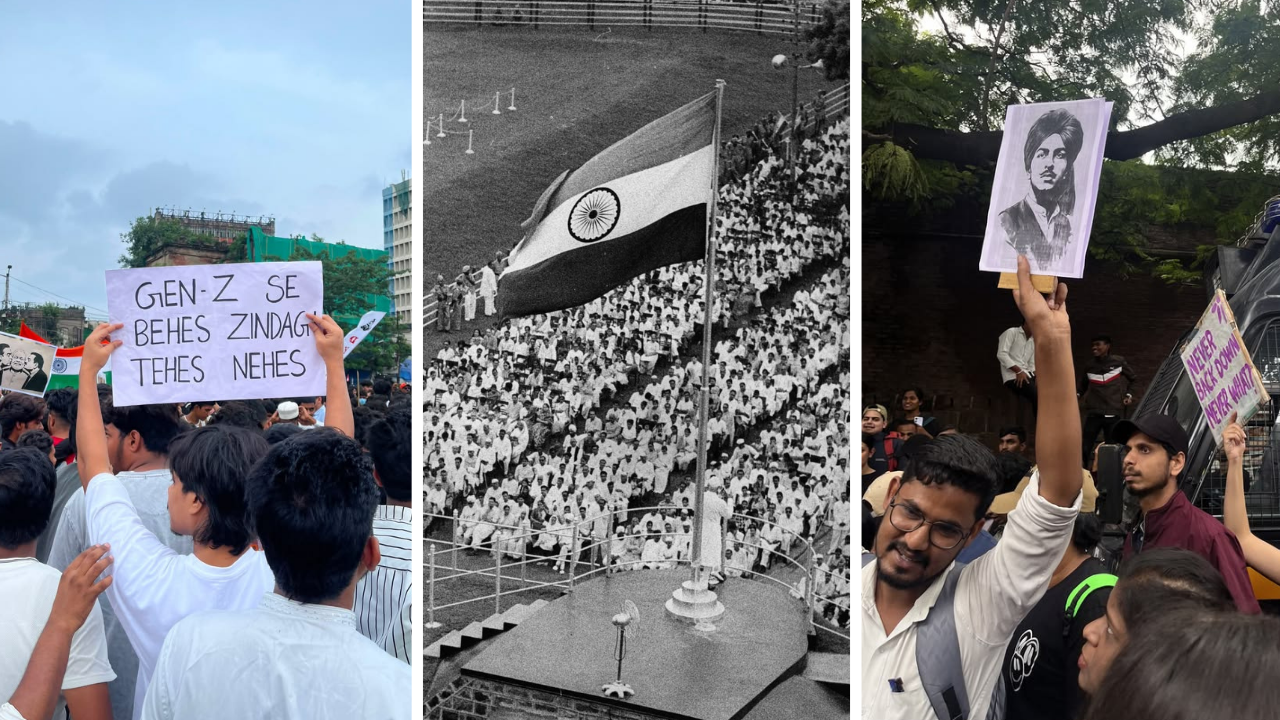
Gen Z Protest, India
Her concern is less about any single government and more about the way ideology, caste, religion, and social hierarchies continue to shape how Indians treat one another. She worries that people are beginning to give up on the possibility of change. “Maybe the first thing we need is a renewed sense of hope,” she says. “That things can change, that we aren’t too far gone.”
There is something unmistakably Gen Z about that mixture of exhaustion and idealism: recognising the scale of the problem while still refusing to completely surrender the possibility of a better future.
“Is freedom real if rights feel conditional?” – Priyanshu Raghuvanshi, Student, 22
Priyanshu’s answer was less polished than the others, but perhaps because of that, it felt unusually honest. When he thinks about independence, he thinks about people being able to coexist without tyranny, about laws and rights not being withheld from citizens, and about the freedom to practise one’s religion, express one’s identity, and protest when necessary.
He also reflects on the darker aftermath of Independence: Partition, communal segregation, and divisions that continue to echo through Indian society. For him, the real test of independence is whether people can voice their opinions without fear. “As long as you can live freely, practise your beliefs, protest, and find community with people who accept you,” he says, “then we are independent.”
Independence Day
What his response captures is a sentiment that appears repeatedly among young Indians: constitutional freedom is not always experienced as an everyday certainty. Whether one agrees with his political conclusions or not, the underlying question is significant. Many Gen Z Indians are evaluating independence not as a completed achievement but as an ongoing negotiation between rights promised and rights felt.
“Patriotism can look like questioning” – Ananya, Editor, 27
Ananya places this year’s Independence Day in the context of student protests and increasing political engagement among young people. “For a very vocal section of Gen Z,” she says, “questioning the government, protesting, and demanding change may actually be their way of expressing patriotism.” She points out that Gen Z may be divided between those who express pride in quieter ways and those who feel comfortable criticising the country precisely because they have grown up with the freedoms that allow them to do so.
Independence Day 2026
That observation is increasingly important because it explains much of the confusion surrounding young Indians today. Older generations often expect patriotism to look like consensus, while many younger Indians see disagreement as evidence that democracy is functioning.
“Independence Without Empathy Is Incomplete” – Diksha Mehta, Creative Head, 23
Diksha’s response brought the conversation back to empathy. “Hum azad nahi hai,” she says bluntly. “The thoughts with which we received independence do not fully prevail anymore.” For her, patriotism is not standing up for the national anthem or treating Independence Day as merely hoisting flags. It is the ability to feel for fellow citizens and for the country as a whole.
And then, in the middle of all these heavy reflections, the internet does what the internet always does. A tweet on X joked: “What do you mean Independence Day is on a Saturday? It was a Friday in 1947, so we should celebrate it every third Friday of August because we need a long weekend!” That, too, is part of the Gen Z story. A generation capable of discussing Partition trauma, constitutional rights, and political dissent is also capable of turning a national holiday into a meme about annual leave. The seriousness and the absurdity coexist effortlessly.
What Gen Z’s Idea Of Freedom Translates To
When Bhagat Singh said that “bombs and pistols don’t make a revolution, that the sword of revolution is sharpened on the whetstone of ideas,” and when B.R. Ambedkar said that “freedom of mind is the only real freedom, that a person whose mind isn’t free is a slave even without chains,” they were both pointing at the same truth: how a country thinks is what makes it truly independent. Do its people operate from understanding, education, and empathy? If not, then no legal system or constitutional agency alone can guarantee freedom.
What Indian Independence Looks Like Eight Decades Later (Credits: Pinterest)
Leadership matters, the freedom struggle had one, the revolution had one, and we cannot do without one even today. But equally imperative is understanding the value of liberty, diversity, and coexistence. The love for one’s nation comes from recognising that while everything may be different, it is collectively one. And if even one of us isn’t free, none of us really are.
Gen Z has grown up in an India that is simultaneously more connected, more expressive, more polarised, and more self-aware than the India of its grandparents. It has inherited both the triumph of Independence and the wounds that accompanied it. History reaches this generation through documentaries, Instagram reels, family stories, political debates, and viral tweets all at once. Almost 8 decades after Independence, perhaps the most revealing thing about India’s Gen Z is that it does not see freedom as a finished monument built by previous generations. It sees freedom as something that must be constantly remembered, argued over, protected, expanded, and felt in the everyday lives of ordinary people.
Original source: https://www.timesnownews.com/lifestyle