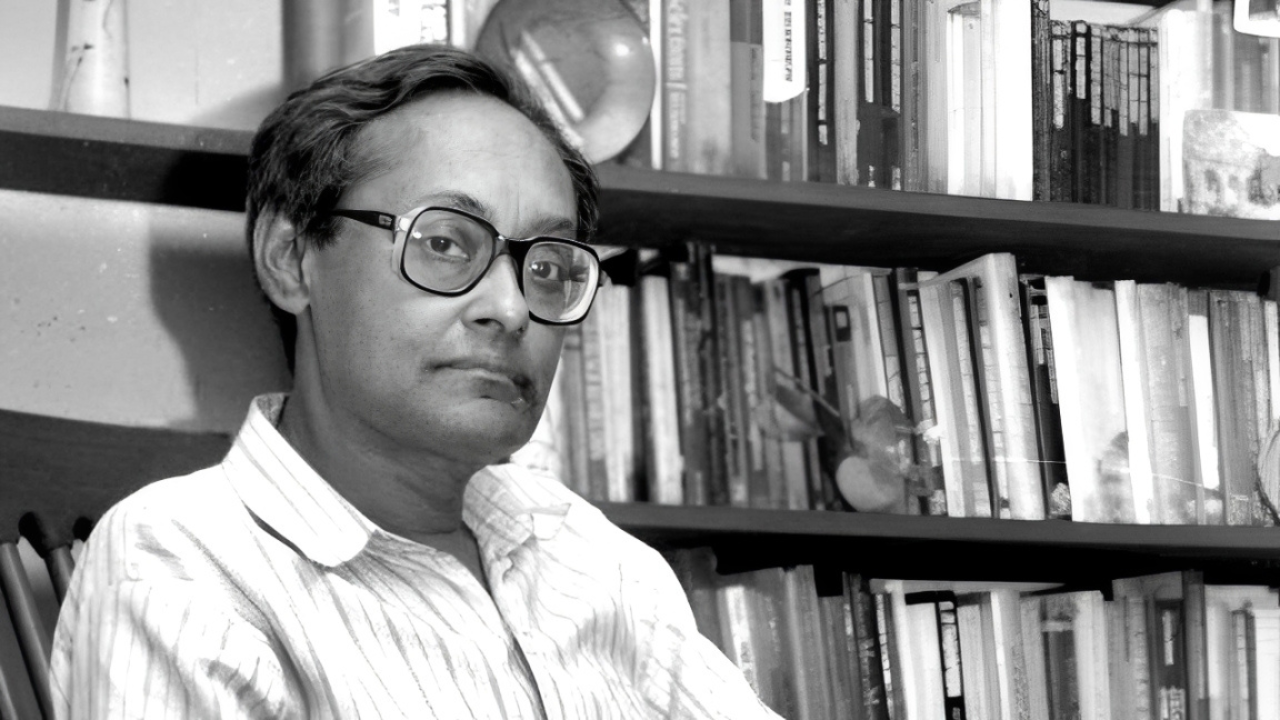
Sumit Sarkar: The Historian Who Rewrote How India Remembers Its Freedom Struggle
A generation learned its own history from his textbook. Sumit Sarkar, who died at 87, shifted the freedom struggle away from great men towards the ordinary people who won it.
For a certain generation of Indian students, the freedom struggle came bound in a single blue-spined book. Sumit Sarkar’s Modern India was the text that taught them their own past, and it did something the older histories rarely had. It moved the story away from a handful of great leaders on a national stage and gave it back to the peasants, workers, women and ordinary townspeople who had actually filled the marches and paid the price. Sarkar, who died at his Delhi home on Thursday at the age of 87, spent a lifetime insisting that history belonged to them too, and in doing so he changed how a country remembers how it became free.
A Life Among Historians
Sarkar was born in 1939 into a Bengali Brahmo family already steeped in scholarship. His father was the distinguished historian Susobhan Sarkar, and his maternal uncle was Prasanta Chandra Mahalanobis, the statistician who founded the Indian Statistical Institute. He took his history degree at Presidency College in Calcutta, then his master’s and doctorate at the University of Calcutta, and taught first there and at Burdwan before becoming Professor of History at the University of Delhi, where he spent the central decades of his career. Colleagues remembered a man of plain habits and fierce discipline, whose life revolved almost entirely around reading and writing, and around a long intellectual partnership with his wife, the historian Tanika Sarkar.

Sumit Sarkar Devoted His Life To History, Scholarship and Intellectual Rigour
The Book That Set The Standard
His reputation was made early. In 1973, he published ‘The Swadeshi Movement in Bengal’, 1903 to 1908, a study of the anti-partition agitation that remains a landmark of Indian historical writing more than half a century on. What set it apart was the sheer depth of its research and the argument beneath it. Sarkar refused to treat the movement as a single heroic wave, showing instead its divisions, its class tensions, and the labour unrest and mass mobilisation that most accounts had ignored. He pointed out how much of what later became Gandhian technique had been anticipated in those years. The book went out of print for a long stretch, and its eventual republication was treated by fellow historians as a genuine event.
The Swadeshi Movement in Bengal
Building A School, Then Questioning It
In the 1980s Sarkar became a founding member of Subaltern Studies, the influential collective that set out to write Indian history from below, recovering the agency of those the elite record had silenced. It was a project close to his own instincts. Yet as it evolved, he became one of its sharpest internal critics, uneasy that its turn towards culture, discourse and identity was drifting away from the hard ground of economic and social realities he believed history had to stand on. He set out those doubts in ‘Writing Social History’ and later in ‘Beyond Nationalist Frames’. It was a rare and principled thing to help build a school of thought and then argue publicly with the direction it took, and it defined him as a scholar who followed the evidence rather than the fashion.
Sumit Sarkar Passed Away at Age 87
Standing His Ground
That independence carried a cost. Sarkar had contributed a volume in 1946 to the ‘Towards Freedom’ project of the Indian Council of Historical Research, a vast effort to document the independence movement through sources. In 2000, with a BJP-led government in office, publication of the volume was held up, an act he condemned as political interference with history. It appeared only in 2007, after a change of government. Through the rise of majoritarian politics, he remained a steady and outspoken defender of secular and democratic values, using his standing as a historian to argue that the past should not be bent to serve the present.
Modern Times
What He Leaves On The Shelf
The measure of Sumit Sarkar is not a title or an award but a way of seeing. He taught that a freedom struggle is not only the sum of its famous names; the tenant farmer and the mill worker and the woman on the picket line are part of the story and not its backdrop. He left behind a shelf of books that historians will argue with for decades, a textbook that shaped millions of minds, and a model of the scholar as citizen, unwilling to let anyone, in power or in vogue, tell him how the record should read. The leaders he wrote about have their statues. Sarkar has something quieter and more durable, the pages that changed how we look at them.
Original source: https://www.timesnownews.com/lifestyle