‘A Voice Told Me To Kill Myself’: A Florida Mother Opens Up About Her Postpartum Psychosis Battle | EXCLUSIVE
While the world watches Lindsay Clancy’s trial unfold, one mother relives her own postpartum psychosis – the voices, the hospitalisations, and a marriage that survived it.
Lindsay Clancy’s public trial has brought one term into the spotlight: Postpartum psychosis. Clancy has told the court that she heard a male voice in her head, over and over, telling her to kill her children. She strangled all three and then jumped from the second-floor window of her Duxbury home. Today, she sits in court paralysed, having lost not only her children but also her partner. Her lawyers are calling people known to the couple, as well as doctors who allegedly failed to understand the intensity of her condition and provide the treatment it required. They argue that she was repeatedly sent home with stronger medication instead. This week, jurors in Plymouth heard her diary entries read aloud in court – pages where she described feeling “so desperate to get a mental break” that her mind was “trying to make something physically wrong” with her. Her defence argues she was never in her right mind. Prosecutors have now rested their case, and the trial continues.
For a lot of mothers watching, this case is not just news. It is a mirror that is bringing back some deeply personal memories.
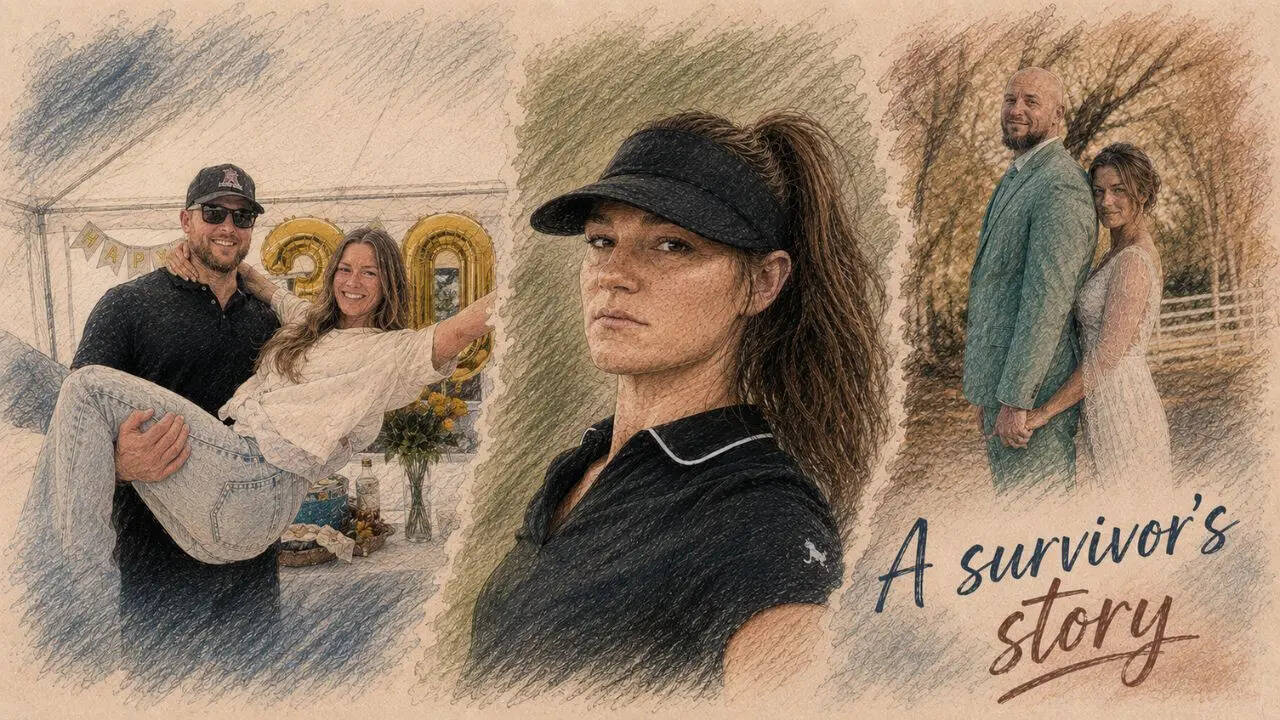
Belinda Stischok is one of them. Today, she is a mother of two, married to her husband Kyle, living a full and healthy life in Florida. But for the better part of a year after her first son was born in 2019, she was somewhere else entirely – in a version of reality only she could see. This weekend, we spoke with Belinda and Kyle about what happened to her, and to their marriage, during that time. As she described what happened, she broke down in tears.
Before we get to what exactly happened, it is worth knowing that Belinda was one of the last people either of them expected this to happen to. She was a personal trainer. She competed in bodybuilding shows. She and Kyle describe themselves as “super active,” careful about their health, disciplined about their routines. “Worrying about a mental health episode was never on the forefront of my mind,” Belinda said. “It was not anything I even knew could happen.”
‘I Lied On Every Question’
Belinda’s pregnancy was, by her own account, meticulously planned. She was once told that she would never have children after emergency abdominal surgery, so when she got pregnant, she treated it almost like a project – researching every choice, writing a birth plan, doing everything “as crunchy as you can go,” as she put it. Nothing about her prepared her for what came after.
The first cracks showed at her six-week postpartum check-up, when she was handed the Edinburgh Postnatal Depression Scale, a standard nine-question screening tool. She was terrified of what an honest answer might cost her. “I lied on every question,” she told us. “As a new mom, you don’t want to answer these questions and then hear, oh, you’re not well, we are taking your baby – because that is the thing you hear about.” She never told Kyle the test had even happened. Even with the lies, the screening flagged mild postpartum depression. She brushed it off. “I’m type A. If you’re going to tell me I can’t handle something, I’m going to say watch me.”
What followed was not depression. It was something far more disorienting, and it did not announce itself right away. Belinda’s psychosis surfaced roughly nine months after birth, long past the window most people associate with postpartum mental health crises.
Looking back now, Belinda says the earliest red flags were visible even before she left the hospital with her newborn. Her birth plan began to fall apart when doctors pushed to break her waters to speed up labour. “My body is telling me no, and you are going against what my body is saying,” she remembers. Her own doctor was not even available for the delivery so a stranger delivered her son instead. By the time she and Kyle brought the baby home, she says, “rest was never in my vocabulary.” She threw herself into keeping the house pristine, sleeping in shifts, trying to manage a newborn largely alone while Kyle went back to work. None of it, at the time, felt like anything more than the ordinary chaos of new parenthood.
When Kyle Noticed The Sun Stare
Kyle did not have a script to follow either. He told us he had never been taught to look for warning signs, so at first, what he saw just looked strange rather than dangerous. Belinda would sit outside for long stretches, staring directly into the sun. She would fill pages with disjointed writing, equations and phrases that meant nothing. “It was very unnatural,” Kyle said. “The only thing I could relate it to is that your wife is being possessed, because it’s no longer her. She’s not herself.”
Belinda remembers it from the inside as a kind of collapse between timelines. She stopped believing her husband was her husband, and stopped believing their son was their son. She thought she had already died, and that the life in front of her was some version of the afterlife – the one she had been told she would never get to have, because doctors once said she could not have children at all. “Why in heaven would I feel so up here,” she remembers thinking.
Belinda’s description echoes something Clancy herself has described to people close to her – an out-of-body sense of no longer occupying her own life. Both women have spoken of hearing voices. Both were placed on a rotating mix of psychiatric medications in the aftermath. And both, at different points, had thoughts of harming someone. For Belinda, those thoughts turned mostly inward, though she says there were moments Kyle later told her about – times she had threatened him – that she believes came from a place of feeling her son was about to be taken from her.
Taken Away From Home, Twice
The first hospitalisation happened after Belinda barricaded herself outside the nursery, convinced someone was going to hurt her baby. Kyle called 911. Because it was 2020, in the earliest weeks of the pandemic, the system that was supposed to help them barely functioned. Nobody told the family where Belinda had been taken. Kyle had to call around to multiple hospitals to find her. She was breastfeeding at the time and says she begged staff to bring her a pump but instead, she was sedated and left in pain.
She was held for 72 hours, released with a bag of medication, which she ended up throwing. “They are making me feel like a zombie,” she said. “I need to feel something again.” The medication had already changed her body in a way that frightened her – she noticed her breast milk had turned a greenish-blue colour. She spent days pumping and dumping it before she felt safe nursing her son again.
Two weeks later, after an argument with Kyle one evening, she walked out of the house barefoot, in her pyjamas, and kept walking. She remembers hearing voices telling her there was “better for you on the other side.” A family friend spotted her miles down the road and called Kyle, who called the police. She was picked up and, this time, held for nine days – medicated daily, including with the antipsychotic Abilify, and placed in isolation. There were also times, she says, when staff would not let her out even to use the bathroom. It was during this time that Kyle, overwhelmed and afraid, packed up their son and left to stay elsewhere. Belinda does not hold it against him. “He was protecting our child,” she said. “I have no resentment.” But she was candid about how it felt in the moment, calling her mother from the hospital and learning her husband and baby were gone: It was the single hardest moment of the entire ordeal, worse than anything psychosis itself did to her mind.
Kyle, for his part, describes those weeks as some of the worst of his life too. He was waking at 2 or 3 in the morning, throwing up from stress, with no “roadmap” for what to do next and no one able to tell him what his wife was even going through. Neither of them describes it as a clean or easy decision. They still talk about that period every year, around the same time it happened, processing it together even now.
The System’s Loopholes
Both Belinda and Kyle come back to one point: nobody had ever told them this was possible. Not the doctors, not the hospital discharge instructions, not any pamphlet. “They hand you a pamphlet for the epidural,” Belinda said. “Why not hand me a pamphlet on, hey, if you’re not sleeping, if you’re not showering, if you’re not eating – here’s what that can mean?”
She is also sharply critical of how quickly medication became the answer once she was inside the system. “I don’t know if it’s regulated as much as it should be,” she said. “I feel like it’s pushed a little bit harder than it should be.” She is not against medication altogether – she credits a later course of talk therapy, with a specialist in postpartum mental health, for helping her find her way back. Her complaint is about a system that reaches for pills before it asks a single question.
Watching the Clancy trial, Belinda sees both overlap and difference. She recognises the medication concerns, the sense of dissociation, the voices. But she is hesitant to call what Clancy described pure psychosis, based on what has come out in court. “It almost seems like she was still there mentally, in a sense,” Belinda said, pointing out that Clancy was journaling and naming her distress in real time – something Belinda says she was incapable of doing herself. “When you’re in psychosis, you’re not aware enough to seek help. There’s no thought of, I need to go to my doctor – because you’re already gone.”
“It’s Okay To Not Be Okay”
Belinda and Kyle went on to have a second son, born at home with a midwife who sets stricy rules from day one: no cleaning, no cooking, no laundry – Belinda’s only job was to rest and bond with the baby. That single instruction, they both said, changed everything about her second postpartum experience.
Asked what they hope comes out of telling this story, Kyle did not hesitate. “Stick through it and don’t give up,” he said, speaking to other new fathers. “There is a light at the end of the tunnel. Don’t leave them alone.” Belinda’s answer was about permission. She wants other mothers to know they don’t have to have it all figured out, and that struggling does not make them unfit. “It’s okay to not be okay,” she said. “You just have to seek help when you notice it – and the noticing is the hard part.”
She is also wary of how the Clancy case might land on struggling new mothers. “It can help mothers understand this can happen to anyone,” she said, “but I worry the hate people are throwing at Lindsay online will stop other moms from speaking up.” For Belinda, that fear is exactly why she chose to tell her own story out loud.
Original source: https://www.timesnownews.com/lifestyle