Noida-based PG Electroplast remains cautiously optimistic on FY27; sees demand staying resilient
Vikas Gupta, Managing Director of PG Electroplast, said the company is confident of navigating commodity inflation by passing on higher input costs to customers while also focusing on value engineering and bill-of-material optimisation to protect margins.

Vikas Gupta, Managing Director of PG Electroplast, said the company is confident of navigating commodity inflation by passing on higher input costs to customers while also focusing on value engineering and bill-of-material optimisation to protect margins.
He added that the current pricing environment remains manageable, although negotiations with customers typically involve some lag. He also believes demand should remain resilient over the next two to three years, with pricing becoming more predictable once geopolitical uncertainties ease.
The company reported a cash and bank balance of ₹491.3 crore as of the end of Q1FY27.
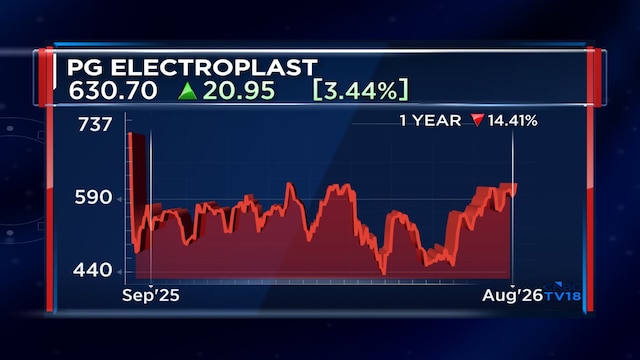
The stock was trading at ₹631.20 at 12:55 pm on the NSE and has declined more than 14% over the past year.
In the April-June quarter (Q1FY27), PG Electroplast reported revenue of ₹2,034 crore, profit after tax of ₹75 crore, and a margin of 7.3%.
This is an edited transcript of the interview.
Q: Revenue growth of around 35% — has it exceeded your own estimates? After quarter four, you had indicated that you were keeping your fingers crossed for FY27, but demand now seems to have turned out better than expected.
A: If you look at the first quarter, our internal plans were broadly in line with the growth we achieved. We were hopeful that the AC season would do well, and we recorded almost 38% growth in our AC business during the quarter. The washing machine business also performed exceedingly well, growing 67%. We believe FY27 has started on a good note, and we remain cautiously optimistic that this momentum will continue.
Q: During the conference call, you indicated that demand has been in line with, or even better than, your expectations. The next two to three years also look promising. I am trying to understand whether price hikes, driven by commodity inflation, could dent demand. How do you see the outlook over the next two to three years, especially if supply-side volatility continues?
A: Please understand that demand is still holding up despite the current price inflation. We are seeing similar trends across other sectors as well. For instance, the two-wheeler industry is performing well despite pricing volatility. We believe demand should remain resilient despite the current pricing challenges. Over the next two to three years, there should be greater stability and consistency in pricing. Once the geopolitical situation is resolved, we expect a more predictable pricing environment, which will also make demand easier to forecast.
Q: I just want to understand pricing a little better. Will you take further price hikes? You have already taken some in quarter one. Should we expect more in quarter two, given that volatility is still persisting?
A: Please understand that increases in raw material costs or foreign exchange fluctuations are generally passed on to our customers. However, there is always a lag while negotiating with clients to pass on the full impact. That remains an ongoing discussion. We are hopeful of recovering the complete impact. At the same time, we are working with customers on value engineering and bill-of-material (BOM) optimisation to mitigate cost pressures. That process is ongoing.
Q: Your inventory at the end of FY26 stood at around ₹1,600 crore, which came down to roughly ₹1,000-1,100 crore by the end of May. What is the current inventory level, and what are you guiding for going forward?
A: We were hoping to bring inventory levels down further, but we could not achieve that because of certain challenges. Given the current volatility and the unpredictable nature of supply chains, we prefer to maintain some additional inventory. There are also QCO-related challenges expected over the next two to three quarters. We are reviewing the situation, but we expect inventory levels to normalise over the next one to two quarters.
Q: What is the current inventory level?
A: The current inventory level is around ₹1,200 crore. We are hoping to bring it down further.
Q: In a situation where supply-side issues persist while demand remains strong, there could be pressure on the balance sheet because of higher inventory, receivables and creditors. What is the working capital cycle likely to look like going forward? The company has also turned cash positive. How do you see the balance sheet evolving?
A: Please understand that the AC season is now almost over, and we are seeing inventory levels come down. However, as we approach the next peak AC season, we will reassess the supply chain situation. Based on that assessment, we may decide to build inventory for compressors, copper tubes and other components. We expect to review this around October or November.
Q: What is the current working capital cycle in terms of days?
A: The current working capital cycle is around 65-70 days.
Q: And that remains the target?
A: Yes, we expect it to remain in the same range.
PG Electroplast’s current market capitalisation is ₹18,020 crore.
Watch accompanying video

Original source: https://www.cnbctv18.com/technology/