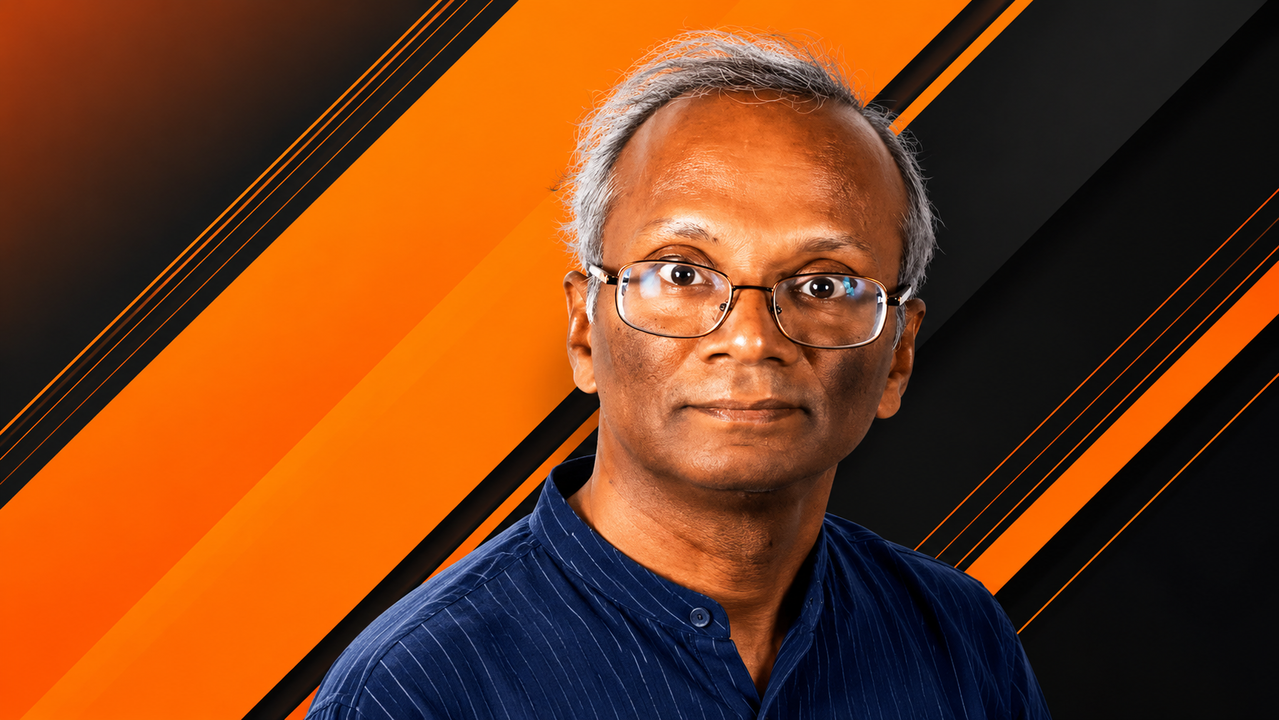
Who Is Deepak Dhar? Physicist Wins Dirac Medal, An Honour Once Given To Stephen Hawking
- Authored by: Govind Choudhary
- Updated Aug 10, 2026, 14:07 IST
Indian physicist Deepak Dhar wins the 2026 Dirac Medal for his pioneering work in statistical mechanics, adding another major honour to his remarkable scientific career.
Deepak Dhar Wins 2026 Dirac Medal, Joins Elite List Of Physics Laureates (AI-generated)
Deepak Dhar, a prominent name in the list of India’s leading theoretical physicists, has been awarded the 2026 Dirac Medal by the International Centre for Theoretical Physics (ICTP). Notably, this award is among the world’s most respected recognitions in theoretical physics. Dhar is one of four physicists selected for this year’s medal for their important contributions to statistical mechanics, a field that looks at how large groups of particles function as a system.
The Dirac Medal was established in 1985 in memory of physicist Paul Dirac. Over the years, it has been awarded to leading scientists including Stephen Hawking.
Why Has Deepak Dhar Won The Dirac Medal?
Dhar has studied complex physical systems and statistical mechanics. Statistical mechanics helps scientists understand the collective behaviour of huge numbers of particles. Its ideas are also finding applications beyond traditional physics, including in areas such as complex networks, artificial intelligence and financial systems.
One of Dhar’s most recognised contributions is Dhar’s burning algorithm, which is linked to sandpile models. The work has played an important role in research into self-organised criticality and other complex systems.
Dhar has also been associated with the International Centre for Theoretical Sciences in Bengaluru and has spent much of his career advancing research and teaching in India.
Dhar’s journey into physics began in Pratapgarh, Uttar Pradesh, where he was born in 1951.
He grew up in a Hindi-medium environment. His mother wanted him to become an IAS officer, while his father encouraged his interest in science by bringing home science magazines.
One magazine, Understanding Science, particularly influenced him and helped develop his interest in the subject.
Dhar went on to study at Allahabad University before pursuing an MSc at IIT Kanpur.
According to Scientific India, his academic journey later took him to the United States and the California Institute of Technology (Caltech). There, he received a Richard Feynman fellowship and worked closely with legendary physicist Richard Feynman.
Dhar also served as Feynman’s teaching assistant and completed his PhD in 1978.
He Chose To Return To India
After completing his doctorate, Dhar could have continued his career in the United States. Instead, he returned to India and joined the Tata Institute of Fundamental Research (TIFR) in Mumbai.
At TIFR, he became part of a strong community of theoretical physicists and began a career that would span several decades.
Dhar later served as a professor at IISER Pune, where he spent nearly eight years and taught and mentored students.
His work over the years has helped strengthen India’s contribution to statistical physics and theoretical research. In 2022, he became the first Indian to receive the Boltzmann Medal, one of the most important international honours in statistical physics.
The 2026 Dirac Medal adds another major chapter to the career of a physicist whose work has helped put Indian statistical physics on the global map.
Latest News


Govind Choudhary is the Chief Copy Editor for Tech at Times Now with over five years of experience in the media industry. He covers consumer technolog… View More
Original source: https://www.timesnownews.com/latest-news