EXCLUSIVE | Between the Fork and the Feed, India’s Dining Culture is Coming of Age
- Authored by: Aalokitaa Basu
- Updated Aug 12, 2026, 18:17 IST
The concept of ‘eating out’ in India has evolved. But one of the defining minds behind this cultural evolution refuses to put the evolving landscape – or himself – in a box marked ‘fine dining’. It’s much more dynamic.
India’s dining culture is the most evolved it’s ever been – but there’s more to explore (Credit: iStock, Aalokitaa Basu)
The act of eating in itself is a simple pleasure. Stripped down to basics it’s probably what your mother fed you when you were sick. But the other end of this spectrum – the one where ‘eating’ becomes ‘dining’ – continues to expand and mutate as we speak.
‘Chef-driven restaurants’, ‘ingredient-first menus’, ‘tasting tables’ – it’s hard to imagine a time when these words weren’t part of India’s restaurant vocabulary. Back in the day, there were few reference points for both what an independent restaurant could be, as well as what a diner could expect from it. That bar was set right at the turn of the century, when Chef Rahul Akerkar opened Indigo in 1999. An independent restaurant within a restored colonial bungalow in Mumbai’s Colaba is pretty much the blueprint of what a frequent diner might refer to as ‘fine dining’ today; but Chef Akerkar is pretty insistent on keeping that term at bay.
“Indigo was never conceived as a fine-dining restaurant. It was always meant to be a chef-driven restaurant built around thoughtful, seasonal cooking, warm hospitality and an almost obsessive attention to detail. If people chose to call that fine dining, so be it, but that was never really the objective,” he shares.
Now despite his reluctance to accept the terminology or his widely-accepted role as one of the architects of India’s ‘dining out’ culture, what Chef Akerkar managed to do with Indigo, set a nearly two-decade precedent of what the new and young India would love to indulge in today: beyond the five-star ecosystem, the chef and his carefully sourced ingredients front and centre and hospitality that feels personal. Now you’d assume it would have been tough to get investors on-board for an idea that’d never been attempted, in a landscape that was on the verge of evolution. But that was hardly the hiccup.
“By the time we opened, my investors were already completely on board, so there was no real educating to do there; the bigger challenge was helping diners understand what we were trying to achieve,” recalls the Chef, adding, “There was very little in India at the time that resembled what we were doing, so there weren’t many reference points. Some guests embraced it immediately, while others needed a little hand-holding to understand the cuisine, the style of cooking and the idea of a chef-led restaurant.”
The hand-holding definitely helped considering the current flock of diners have no dearth of worldly references before they walk into a space. What trailblazers like Chef Akerkar started was seamlessly taken ahead by booming international travel, food television and of course, social media. The Chef agrees: “I do believe diners today are genuinely more adventurous. The biggest change is exposure…so they’re naturally more curious about what’s on the plate.”
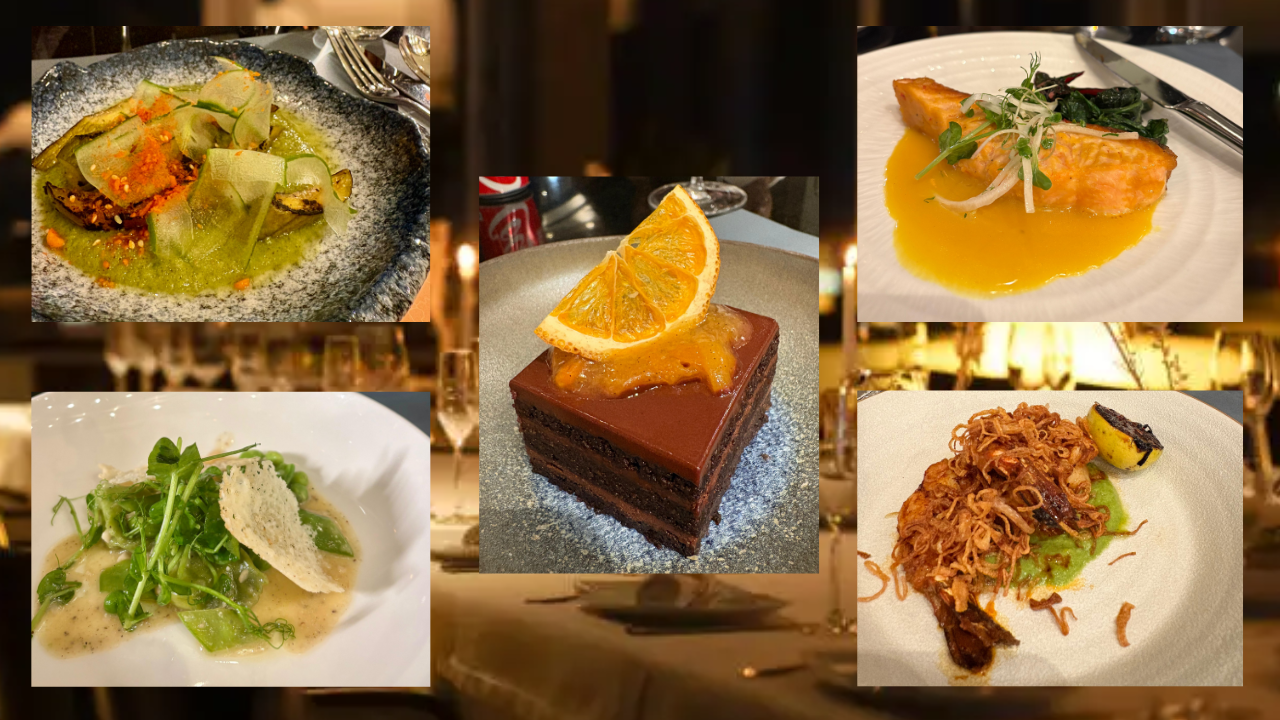
That willingness to explore is evident in the food he brought to the capital for the recent collaboration between his Mumbai restaurant Ode, and Sorrento, at Shangri-La Eros. The menu was a neat demonstration of what he meant by new interpretations: familiar flavours and textures nudged into unexpected territory, without losing sight of the ingredients themselves. A burnt cucumber arrives sharpened by kiwi salsa and peanut thecha; charred prawns find their brightness in mojo verde, crisp shallots and lime. There is a spinach and goat cheese agnolotti, softened by the sweetness of snap peas and finished with a sharp parmesan wafer, before the mains move between charred cabbage served over leek soubise with pickled celery and apple mostarda, or an Atlantic salmon slow-cooked for 48 hours, its richness cut through with pineapple glaze and a turmeric root broth. More piquant picks off the intentional menu include a roast butternut squash with smoked chilli, seed granola and pickled radish, as well as a grilled Aussie lamb chop paired with chickpea stew, served with radicchio and roasted fig. Dessert landed on either a vegan chocolate fudge cake with kumquat marmalade or some classic salted caramel tiramisu. It’s the kind of cooking that makes the idea of an ‘interpretation’, tangible, even if you’re a food purist – and that’s the real win here.
But no great stride really ever comes without new pressures. If back then it was manually widening diners’ horizons, today, it’s curating the restaurant’s image. There are very few still, who reach for the cutlery before the phone once a dish arrives. This leaves restaurants – new, old and ancient – negotiating between the plate and the camera. While the Chef doesn’t dismiss this reality, he is pretty firm on the hierarchy that must be maintained: “The best restaurants are still cooking for their guests, or at least they should be. Social media is an incredibly powerful marketing tool, and ignoring it would be naive, but if you start designing food purely to photograph well, you’ve probably lost sight of why restaurants exist in the first place. A dish should taste exceptional before it looks exceptional.”
The mammoth strides India’s dining-out scene has taken over the past few formative decades is undeniable. But there is still always scope for more exploration. As a matter of fact, the Chef believes that keeping up with the endless roulette of international cuisines, the ones that stand the least explored are India’s own. “Our culinary heritage is extraordinarily diverse, yet commercially we’ve only scratched the surface, ” he reflects, adding, “We’ve become very comfortable looking outward for inspiration, whether it’s European or East Asian cooking, and I’d love to see more chefs give the same curiosity and respect to the food traditions that exist within our own country. That doesn’t mean simply reproducing traditional dishes; there’s enormous scope to understand the ingredients, techniques and stories behind them and interpret them in a contemporary way.”
It won’t be an overestimation to say that the average India diner is evolving way faster than the country’s restaurant scene. What this means is that the space for gimmickry and fads is shrinking by the day. Relying on authenticity in such a scenario may feel like too basic an advice, but with decades in the business, that’s exactly what Chef Akerkar’s advice is, besides of course, starting the exploration in one’s own backyard: “I hope more chefs begin exploring India’s regional cuisines with real depth rather than treating them as passing trends, while also finding their own voice within that tradition.”
All this brings one to the most obvious question the hospitality industry is struggling with: ‘What makes people return?’ The answer is stupidly simple. Spectacle may have become important – essential even. But the substance, must always beat it to the punch.
Latest News


Aalokitaa Basu is a writer and Senior Copy Editor whose work explores the intersection of lifestyle, culture, beauty, wellness, and self-possession. H… View More
Original source: https://www.timesnownews.com/lifestyle